Study examines bumblebee and honey bee competition

 University of Aberdeen
A new scientific study is to look at how Hebridean bumblebees and honey bees share and compete for resources.
The three-year Hebri-bees project - led by the Unversity of Aberdeen - hopes to find out whether honeybees kept in apiaries in the islands are having a negative impact on wild bumblebee populations.
Similar studies have been done in agricultural landscapes on the mainland but never before in the Hebrides.
Researchers say the islands offer an ideal study environment because their machair grasslands are unique flower-rich landscapes which are home to some of the rarest types of bumblebees in the British Isles.
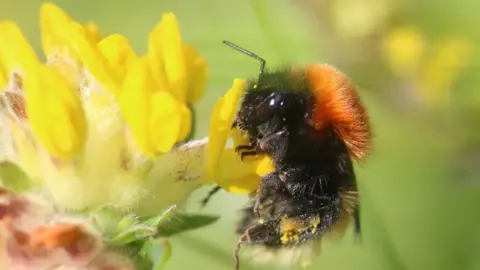
The research will include looking at the great yellow bumblebee which was once widespread across the UK but is now largely confined to northern Scotland's coasts and islands, with the Inner and Outer Hebrides acting as its main strongholds.
The threatened moss carder bee, which earlier university surveys identified as the most common bumblebee in the machair, will also be examined.
As well as investigating whether these rare bumblebees are in competition with honeybees for food the study will also look for evidence of disease transmission between species.
The work, spanning across the Hebrides, from Islay to Lewis, as well as parts of Scotland's north-west coast. will involve field observations and pollen analysis to identify the flowers being visited by different bee species.
 University of Aberdeen
Ecologist Dr Johanna Yourstone, who is leading the study, said they would be following the pollen trail to identify exactly where bees were foraging.
She said: "It may be the case that we see honeybees flying across the machair, but pollen analysis could show they were actually collecting most of their food from heather elsewhere."
"Looking at the pollen gives us a much clearer picture of what's really happening in the landscape."
"What we need now is robust evidence, so that future decisions are guided by science rather than assumption."
