Dinosaur highway 'one of the longest in the world'

 Oxford University Museum of Natural History
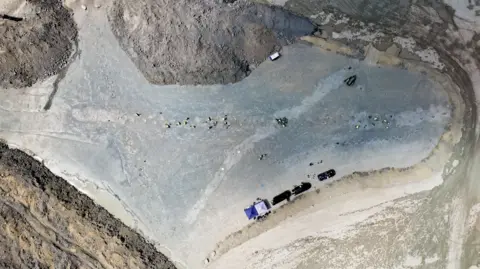
A dinosaur trackway made up of 200 footprints which were made 166 million years ago is one of the longest of its kind uncovered in the world, researchers have said.
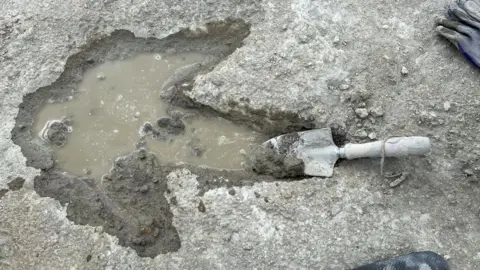
The tracks were first spotted by a worker at Dewars Farm Quarry in Oxfordshire four years ago - with paleontologists soon descending on the site.
Since then, an excavation saw scientists uncover hundreds of footprints at the site which they believe reveal the comings and goings of Cetiosaurus - a huge sauropod.
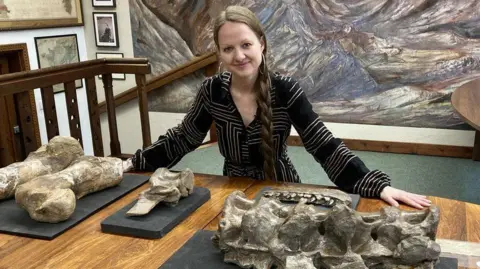
Dr Emma Nichols, from Oxford University's Museum of Natural History, was called in to co-lead the excavation and shared more details of the project in an interview with BBC Radio Oxford.
Explaining the tracks, she said: "There were four trackways of sauropod footprints and none of them were the same size as each other."
"What that tells us is a possibility of a bunch of different things - it could be that they were all Cetiosaurus and they were moving as a family herd, or as a herd of different aged individuals, not necessarily related.
"Or it could be that we have more than one type of sauropod."
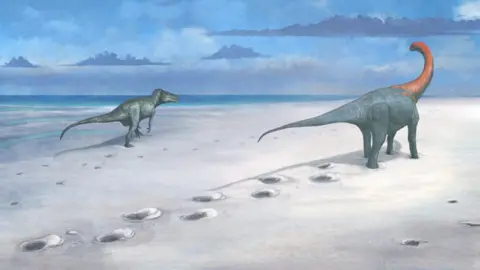
Cetiosaurus were four-legged, long-necked, plant-eating beasts that could reach about 18m (59ft) in length.
But they were not the only creatures that called what is now modern-day Oxfordshire home.
Nichols said: "In 1997, at the first major excavation that is connected to the ones that we've been doing more recently, something really incredible was discovered, which is a Megalosaurus trackway.
"The land in Oxfordshire would have been ruled by Megalosaurus - they were nine metres long and were Britain's answer to T-Rex."
 Mark Witton
Winding back 166 million years, Nichols said the area surrounding the tracks would have been "a really lovely tropical, kind of lush environment".
"Britain was actually underwater, and there was a shallow inland sea covering Oxfordshire - but there was a series of islands - like the Bahamas or Florida Keys - and that's where the dinosaurs would have been living," she said.
"So Megalosaurus, Cetiosaurus and other dinosaurs would have been living on these little islands."
One area of the site even reveals where the paths of a sauropod and megalosaurus once crossed, with Nichols saying the footprints were on the "same bedding plane".
 Kevin Church/BBC
All of the recently excavated footprints are evenly spaced except for one print, which is out of line with the others.
Nichols suggested this showed the sauropod had stopped and leant on one leg for a moment "as if it's looking back over its left shoulder".
"There might be lots of reasons why the animal would do that, and of course we weren't there 166 million years ago," she said.
"But depending on where in time the Megalosaurus is on that trackway at the point where the sauropod put its foot down, it could very easily be explained by Megalosaurus coming up behind it."
She said the sauropod would have been "too big" for a Megalosaurus to hunt, but if it had smaller animals around it the predator may have been "tracking the herd".
The future fate of the trackway has yet been decided but scientists are working with Smiths Bletchington, who operate the quarry, as well as Natural England, on options on how to preserve the site for the future.
But they believe there could be more footprints at the site, with more echoes of our world's prehistoric past just waiting to be discovered.
A previous version of this story stated the trackway was the longest of its kind in the world. This has since been updated after Dr Emma Nichols clarified her previous comments.
