World's largest scorpion roamed UK 400 million years ago, says expert

 Franz Anthony/Natural History Museum
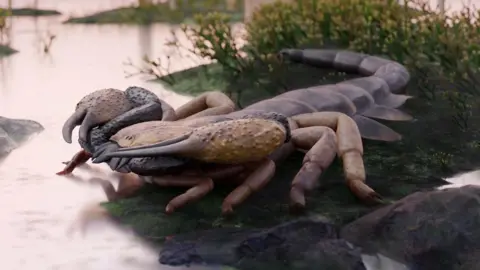
Experts have identified a giant scorpion that lived about 415 million years ago, which they believe may be the largest scorpion ever discovered.
Dr Richard Howard of the Natural History Museum, who led the study, said fossil fragments suggested the Praearcturus gigas scorpion had 16cm-long pincers and a body about one metre long.
The species was identified from fossils found in the St Maughan's Sandstone Formation, which spans Powys in Wales, and Herefordshire and Worcestershire in England.
The scorpion lived during the Early Devonian period, about 415 million years ago.
Howard said the study had been a "very long time" in the making, with work on the fossils dating back to about 2008.
The fossils were first discovered in Herefordshire in the 1870s, with further finds made in Birmingham in the 1970s and Trudoman Quarry in Powys in the 2010s.
For more than 150 years, scientists were unsure what animal the fossils belonged to.
Howard said that, although some researchers suggested in the 1980s that they were from a scorpion, many believed they came from a giant crustacean because the remains were incomplete.
"They described it nicely, but they didn't really have any advanced images of it," he said.
"They just had drawings and also not everyone believed them."
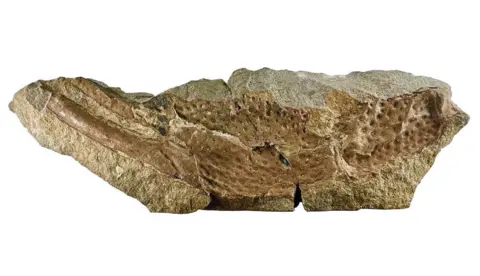
Howard explained how better-preserved fossils and modern techniques, including CT scans and 3D modelling, had now shown the fossils belonged to a "giant scorpion".
 The Trustees of the Natural History Museum
According to Howard, a key piece of evidence was a distinctive chest plate, known as a sternum, that matched one found in a fossil scorpion discovered in Canada and described in 2015.
Howard said both species share an "unusual" long, triangular sternum with a groove down the middle.
"It supports the idea that our fossil is a scorpion because why else would it have this unique feature in common with another thing that is unambiguously a scorpion?" he said.
"We have the whole animal preserved in the Canadian species.
"So it's a really, really, really, really fine, minor feature of the body that you wouldn't even pay that much attention to until you realise, oh, they're exactly the same," he added.
 Richard Howard
Addressing the view that there were bigger scorpions in water, Howard said the sea scorpion (known as a eurypterid) was a different extinct group of arthropods.
He said the team did not have a "whole animal", only fragments from three sites.
"We're working with lots of fragments, so we can't say precisely how big," Howard said.
"We can't just give you a measurement of how big it was from the end of the pincers to the end of the tail."
However, he added they could compare preserved parts to other scorpions.
One claw alone measured about 16cm - similar to, or larger than, modern giant scorpions like the emperor scorpion, which reaches about 15–20cm.
"So we can safely say it's extremely large and there's no other scorpion in the fossil record that has claws anywhere near that size," he said.
Howard added the species lived about 415 million years ago, long before later giant arthropods of the Carboniferous period, "which is when the earth had forests and jungles and swamps and land-based ecosystems were very developed".
Therefore, he suggested, its unusual size may be linked to early land ecosystems with little competition from other large animals.
What is the St Maughans Formation?
The St Maughans Formation is a prominent Lower Devonian geological formation in Wales, famous for its ancient river-deposited red sandstones, according to the Earth Heritage Trust.
It forms part of the wider Old Red Sandstone sequence and is recognised for its cyclic river deposits and well-preserved early terrestrial fossils.
