UK police bosses say unsafe social media platforms should be blocked for under-16s

 Getty Images
Children should be blocked from accessing social, AI and gaming apps which do not disable "high-risk" features such as private messaging, UK police chiefs have said.
The National Crime Agency (NCA) and National Police Chiefs' Council (NPCC) said under-16s should be banned from sites that did not prevent children from being contacted by strangers, and those that recommended harmful content or permitted the sharing of nude photos.
The joint call has been made in response to the government's consultation on whether to ban social media for under-16s.
In response, the government said tech firms must protect children online and it backed regulator Ofcom "to act against those who fail to comply".
"We are going further - consulting on options from age limits and app curfews to outright bans," a government spokesperson added.
"We also remain committed to making it impossible for children in the UK to take, share or view nude images, and are working at pace to deliver this."
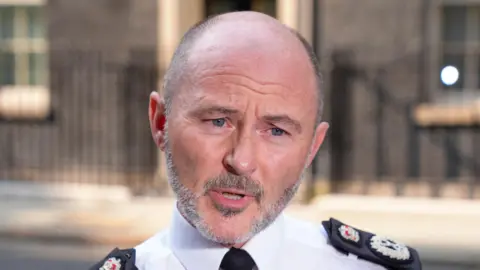
But NCA director general Graeme Biggar said "our assessment is clear: the online environment in its current form is not safe for children".
"The industry response has been too slow, while the problem has been getting worse," he said in a statement.
"Enough is enough."
Chief constable Gavin Stephens, chair of the NPCC, added the online sphere had become "something of a wild west" in which law and regulation had "failed to keep up with the pace of technology".
Biggar said both crime agencies would prefer children to be able to participate online safely and reap the benefits it provides.
Their proposals also fall short of an Australia-style ban on social media for the under-16s, he added.
The government recently pledged to introduce some form of social media restrictions for under-16s even if it stopped short of a ban.
'Harm at-scale'
The NCA and NPCC identified six features of platforms they believe enable "harm at-scale" and should not be present on apps or services used by children.
These are:
- Mass discoverability of children
- Unrestricted contact from unknown adults
- Private or encrypted messaging
- Algorithms that promote harmful and illegal content
- Nude image sharing or streaming
- Weak age checks allowing children to easily access adult environments
Many such features are already targeted in the Online Safety Act - a set of rules and accompanying codes which platforms must comply with to operate in the UK.
Ofcom has the power to investigate and fine companies suspected of breaching these rules.
But police argue the government should legislate to prevent under-16s accessing any platform or app which offers features deemed "high-risk".
It also wants Ofcom to be given the power to enforce platform's minimum age policies effectively and mandate the introduction of device-level nudity controls so that under-18s cannot take, share or stream nude images or videos.
 Reuters
Biggar said that in 2025 the NCA saw 92,000 reports of potential child sexual abuse activity online from tech companies, and the number was growing - with offending becoming more severe.
"They involve younger and younger children and we are increasingly seeing children offending as well as being victims," he said.
He argued the issue had worsened because tech firms had chosen not to make child safety "a core design principle".
"This refusal to prioritise safety by design is boosting criminals' speed and reach," added Stephens.
It is not the first time that the government has been called on to strengthen measures to prevent children from taking, seeing or sharing nude images online.
Such measures were proposed as part of the government's violence against women and girls strategy.
But former minister Jess Phillips recently accused the government of being slow to enact the measure.
Meanwhile some charities have raised concerns about end-to-end encrypted messaging - saying making messages readable only to the sender and receiver could impede efforts to find and clamp down on child abuse and grooming.
Instagram recently disabled the tech for direct messages sent on the platform, while TikTok has told the BBC it has "no plans" to introduce it.
However some experts and campaigners argue private messaging can be a vital way to preserve online privacy and data.

Sign up for our Tech Decoded newsletter to follow the world's top tech stories and trends. Outside the UK? Sign up here.
