'I spent two years looking for work before I got a job'

 BBC
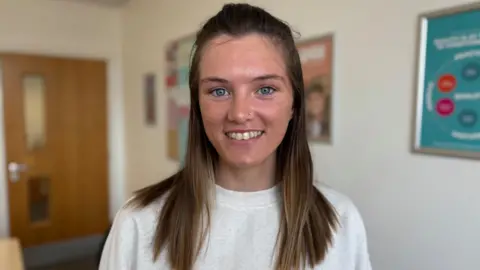
BBCNeala Sheils spent two years applying for jobs with little success before finally securing work in a hotel last month.
Before she got a job, the 20-year-old from Glasgow was one of growing number of young people classed as Neet, meaning they are not in education, employment or training.
The majority (60%) have effectively dropped out of the labour market altogether and are not actively seeking work.
Neala says she wanted to work but the support she received from the Jobcentre was hampered by seeing a different work coach at almost every appointment.
"I just felt as if I was repeating the same thing over and over again," she says.
It was only after a referral to a specialist employability service run by mental health charity SAMH that Neala's situation began to change.
It offered support with confidence-building, teamwork, interview skills and applying for jobs.
Three months later, she secured employment.
Neala says the support took account of her autism, which she says had contributed to difficult experiences in previous job interviews.
"Some places were basically saying, 'We can't give you the job, you've not got good confidence, your eye contact's not good', stuff like that," she says.
"But obviously that's not easy when you've got autism and those are the traits. So, it knocked my confidence a lot as well."
She is now preparing to start college, where she hopes to pursue a career supporting older people with dementia.
But her experience reflects the challenges facing many young people who are classed as Neet.
Across the UK, the latest data from the Office for National Statistics suggests 981,000 people aged 16 to 24 were Neet between April and June.
That is an estimated 13% of that age group.
Some are officially unemployed, but most are now what is termed "economically inactive" - which means they are not seeking work or able to start a job.
Scotland no longer publishes Neet statistics in the same form as the rest of the UK.
Instead, it uses a different measure that stops tracking young people once they turn 19 - just as many are entering the age range where problems tend to emerge.
Those who are between 20 and 24 are more likely to be Neet than those aged 16-19 in the UK.
Allison Catalano, an economist at the Fraser of Allander Institute, says the lack of comparable data makes it difficult to assess Scotland's performance.
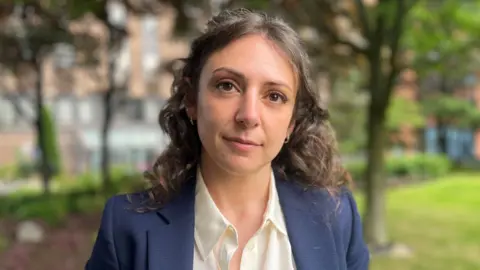
She says it is hard to tell if Scotland is doing better or worse than the UK as a whole.
"They don't make that data publicly available, so we can't really suss it out on our own," she says.
"We know that 16 to 19-year-olds in Scotland look better than the rest of the UK.
"We don't really know what's going on with those 20 to 24-year-olds."
She says this age group is less likely to remain in education and more likely to be navigating the transition into work.
"That's the age they start moving out of it," Catalano says.
"So that transition period is when unemployment is most likely."
'We need to do more'
Health, and particularly mental health and neurodevelopmental conditions like autism and ADHD, are likely factors for the increase in Neets.
Alex Cumming, from SAMH, says there is not enough specialist employability support for young people like Neala to get into work.
"I think there's some fantastic initiatives, there's some good partnership and good projects, but we need to be doing more," he says.
"Mental health problems have doubled in the past 10 years. So it's more people suffering with anxiety, depression, low mood."
He says young people who struggle at school because of these issues could see an impact on their qualifications, which could affect the confidence they need to move onto college and the workplace.
A Scottish government spokesperson said it had supported more than 55,000 young people with employability services between April 2019 and March 2026.
They said they were exploring ways to better understand the participation of 20-to-24-year-olds.

