What is happening with the Rosebank and Jackdaw oil and gas fields?

 Getty Images
A decision on whether to give the go ahead to two oil and gas fields has edged a step closer.
After years of debates and legal wrangling, public consultations on updated plans for the Rosebank oil field off Shetland and the Jackdaw gas field, which lies east of Aberdeen, are closing.
Industry bodies argue that starting production at the sites will provide jobs and improve the UK's energy security as overseas conflicts threaten supply.
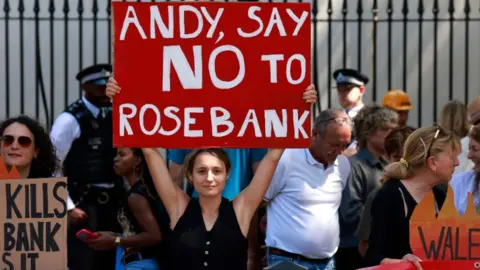
Environmentalists insist that more drilling would be unconscionable, hampering efforts to cut planet-warming carbon emissions as deadly heatwaves and extreme weather affect billions across the globe.
They also say starting production would not protect energy security and that transitioning sooner to greener technologies would be better for supporting jobs.
Such arguments are currently being weighed by the UK government, which will make a decision on both fields after considering the results of the consultations.
What are Jackdaw and Rosebank?
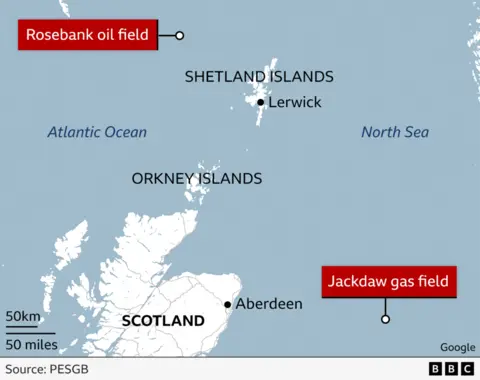
Jackdaw, which is about 150 miles (241.4km) east of Aberdeen, is a gas field which its operators say could be connected to the UK network within months.
Rosebank, about 80 miles (128.7km) north-west of Shetland, is Britain's largest untapped oil field, which would also produce some gas.
It would take longer than Jackdaw to become operational, but is scheduled to be up and running by 2027 if approved.
Updated documents setting out plans for the fields were published by operator Adura and put out for public consultation. The Jackdaw consultation closed last week, while the consultation on Rosebank closes today.
Licences for the fields were granted by the then Conservative UK government in 2022 and 2023 - sparking legal challenges from environmental groups.
The Court of Session in Edinburgh ruled last year that Rosebank and Jackdaw had been unlawfully approved because the government had failed to take into account the climate impact of burning extracted oil and gas from the sites.
A judge ruled that more detailed climate assessments had to be published. These updated estimates were put out for consultation last month.
With the consultations closing, the UK government can decide on whether to re-approve the fields, with input from industry regulators.
Prime Minister Andy Burnham has left open the possibility of granting approval for Jackdaw and Rosebank - saying he will stick to Labour's promise not to issue new oil and gas licences while honouring existing ones.
It is not yet known when the government will announce its decision.
Would Rosebank and Jackdaw cut energy bills?
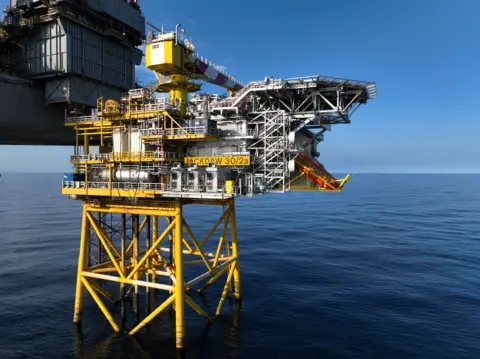
If approved, Rosebank is expected to fill up to 500m barrels of oil over its 25-year lifetime.
But that increased supply does not necessarily guarantee cheaper energy bills for people in the UK. Prices are determined by international markets which are vulnerable to shocks such as the conflicts in Ukraine and Iran.
Most of the oil produced from Rosebank would be sent to the Netherlands because the UK's remaining refineries are not equipped to process the heavier type of crude oil extracted from the North Sea.
If any of the refined products - such as diesel or jet fuel - were to be used in the UK, they would then to be reimported.
When plans for Jackdaw were unveiled in 2022, developers said it would produce enough gas to power 1.4m homes, equating to about 2% of the UK gas demand.
It would be a relatively simple process to connect Jackdaw to the UK energy system, meaning gas could be quickly pumped to the mainland.
Backers say opening the fields would improve the UK's energy security.
Yet Fatih Birol, a leading energy economist at the International Energy Agency, told The Guardian earlier this year that new drilling in the North Sea "would not change much for the UK's energy security" or bring down energy bills.
He said that the UK would still be reliant on oil and gas imports, with prices set internationally.
How much CO2 will Rosebank and Jackdaw produce?
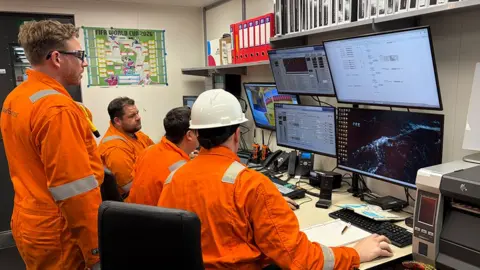
Both Jackdaw and Rosebank are operated by Adura, a joint venture between Norwegian company Equinor and Shell. Aberdeen-based firm Ithaca also owns 20% of Rosebank.
It has estimated that Jackdaw could produce 35.8m tonnes of carbon over its 11-year lifetime, the equivalent of 90% of Scotland's emissions for 2023. Adura said a more likely estimate was about 23.6m tonnes - equivalent to 60% of the 2023 figure.
Those figures are dwarfed by the projections for Rosebank - almost 250m tonnes of planet-warming emissions.
Yet Adura's updated environmental impact assessment, ordered by the Court of Session, says that emissions from Jackdaw would "not materially influence" global warming.
The firm says that displacing imported liquified nature gas from the United States with gas from the Jackdaw field would save the equivalent of four million tonnes of CO2. Campaign groups say that would not lower worldwide emissions as the US gas would still be sold and burned elsewhere.
Adura also said the climate effects would be "minor" because the UK has a "well-regulated industry" aligned with the Paris Agreement, a legally binding commitment to limit global warming to between 1.5 and 2C.
However, Greenpeace UK chief scientist Doug Parr said opening a new field was "wholly incompatible" with the Paris Agreement.
How many jobs would Rosebank and Jackdaw support?
Industry body Offshore Energies UK (OEUK) has said Rosebank and Jackdaw would support a peak of more than 3,500 jobs during the construction phase.
It says the fields would support 880 jobs throughout during their lifespans, with an average salary of £85,850.
OEUK also says they would provide £1.4bn in tax revenues by 2029, rising to £3.8bn by 2034.
Such figures are particularly attractive in the north-east of Scotland, which is contending with the decline of an industry which has long been its economic lifeblood.
According to research for the UK Parliament, about four fifths of the oil and gas from British-controlled parts of the North Sea had been extracted by 2024.
Campaign group Uplift says that trying to prop up the declining industry with the Rosebank and Jackdaw fields would only delay the transition to greener energy production, which it argues is needed to protect the environment and support jobs.
"The only way to protect workers, supply chain firms, and communities that are currently dependent on the oil and gas industry from this decline is to invest in renewables and other industries that have a long-term future," it says.
Opening Rosebank and Jackdaw would deliver big profits for energy firms, and little benefit to taxpayers, Uplift adds.
Ami McCarthy, head of politics at Greenpeace UK, said: "Trying to squeeze the last few drops of expensive oil and gas out of the North Sea while the world is reeling from climate impacts is beyond ridiculous."
It is these debates that the UK government is considering as it prepares to make its decision on the oil and gas fields.
Regardless of their choice, ministers will be accused of betraying either the oil and gas industry or the environment.
As concerns over energy supplies and the climate crisis deepen, this years-long debate is only intensifying.
