Campbell's Bluebird back on Coniston Water
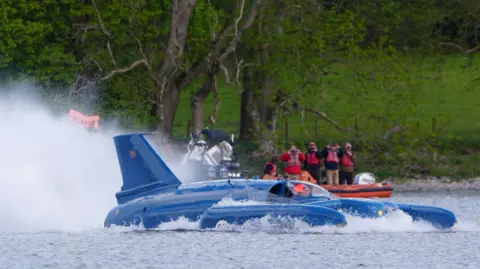
Donald Campbell's restored Bluebird craft has been fired up on Coniston Water for the first time since the daredevil pilot's fatal crash on the lake almost 60 years ago.
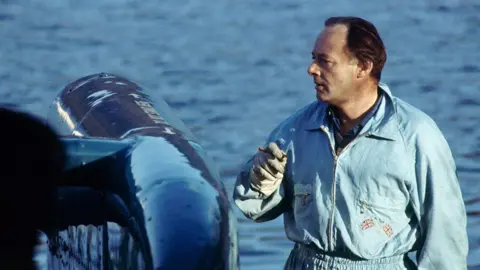
He had been attempting to push his world speed record past 300mph (480km/h) when the jet-engined hydroplane, called K7, somersaulted on 4 January 1967.
Its mangled wreckage was recovered in 2001 with the craft handed to Coniston's Ruskin Museum two years ago following the settlement of an ownership row with Bill Smith, the engineer who led its rebuild.
Campbell's daughter Gina said she was "blown away" to see it running on the lake once more.

 Getty Images
In total, Campbell set seven water speed world records piloting Bluebird, including four on Coniston Water, between 1955 and 1964.
He achieved a further world best on land in 1964 - becoming the only man to set fastest times on water and land in the same year.
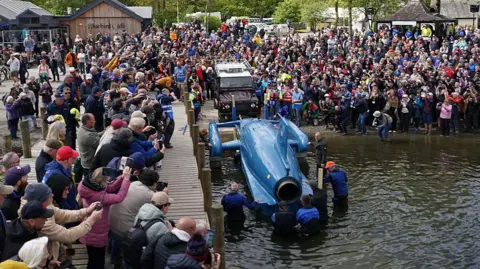
At about 14:15 BST, the restored craft was lowered into the water ahead of safety checks on the first day of a week-long event which is set to see several runs at up to 150mph (240km/h).
About 90 minutes later the jet engine was fired up.
'Tear in my eye'
Gina Campbell said: "To see it and hear it… I never thought I'd live to see the day.
"It's thanks to so many people. It's just been amazing. For once, I'm speechless."
Speaking from the water's edge as Bluebird was moved into position, Donald's nephew Don Wales said: "What a day. To see the boat on the lake again, it's utterly magnificent.
"You can feel the love and the warmth of people here wanting to see it.
"We've got a few thousand people here today, it's glorious at Coniston.
"As soon as it touched the water, there was a tear in my eye. It really was quite a moment and the minute's silence was very fitting.
"Without the restoration team and a lot of other people we wouldn't be here today."
The week's events are intended to mark what will be the 70th anniversary of Donald setting the first of his records on the lake in September 1956.
Australian Dave Warby, son of the late Ken Warby MBE who set the current water speed record of 317.59mph (511.11 km/h) in 1978, is at the controls - with Campbell's teddy bear mascot Mr Whoppit with him in the cockpit.
 Getty Images
Jeff Carroll, chairman of the Ruskin Museum which owns Bluebird and displays it in a dedicated wing, said it marked the "next chapter" in the machine's story.
"All this started for me as a kid brought up in Coniston, reading books on rainy Sunday afternoons about Campbell and this mythical boat that was in the lake somewhere.
"Then she came out and was no longer a myth. She was rebuilt by Bill and co, and you have to pay tribute to him because without his bloody mindedness it wouldn't be here."
Recent months have seen a different team of engineers install a replacement engine as well as carry out checks on electrical and hydraulic systems.
Bluebird last ran almost eight years ago, on Scotland's Isle of Bute, when it was in the hands of Smith and a team of volunteers known as the Bluebird Project who had been enlisted to restore it in 2006.
 Getty Images
The Ruskin Museum issued legal proceedings in 2023 following what it said had been "several years of trying to persuade Mr Smith and his organisation to honour the original agreement and allow K7 to be brought back to Coniston".
Having vowed to "fight to the death" to retain control, Smith eventually relinquished his part-ownership claim and agreed to pay £25,000 towards the museum's legal costs.
He has repeatedly criticised the organisation on social media since then, though, recently alleging Bluebird was damaged by its new engineers.
However Carroll disputed those claims, saying work to ready the craft had been conducted "as sympathetically as possible" and had not caused harm, with "safety put above historical perfection" in a small number of areas.
