Bluebird's Campbell knew speed record 'was a lethal pursuit'

 Neil Sheppard
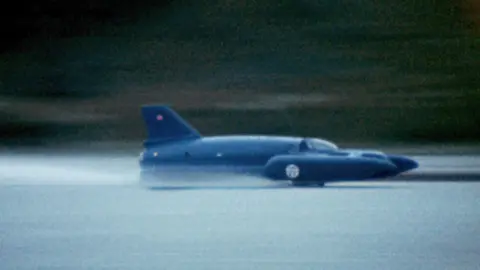
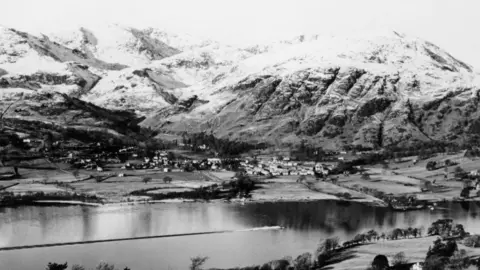
Donald Campbell's restored Bluebird is soon to power across Coniston Water for the first time since the crash that claimed the record-breaker's life almost 60 years ago - a tragedy relayed across the globe in grainy black-and-white footage and front-page headlines.
"It was just a normal morning," says Bluebird support crew member Anthony Robinson as he looks back on the fateful events of 4 January 1967.
"I'd made coffee and toast for the team and we were all down by the lake at seven o'clock.
"The first run was recorded at 297mph. It was on the return journey things went wrong. Nobody really knows why for certain."
Campbell, 45 and the setter of eight world records on land and water, had been determined to advance the latter above 300mph (480km/h).
Hampered across two months by technical issues and bad weather in this picturesque corner of England's North West, that day's early frost, Robinson recalls, had given way to calm conditions judged to be ideal for such an endeavour.
With its thrust generated by an Orpheus jet engine, Bluebird would be pushed to the limit, its grace and might beguiling those watching from the shoreline.
But on that second leg, with terrifying finality, the hydroplane lifted from the surface, somersaulted through the air and crashed in a scatter of debris.
 Getty Images
Robinson, then in his early 20s and known to Campbell as 'Robbie', was first on the scene in a support boat, along with mechanic Leo Villa and photographer Geoff Hallawell.
"Bluebird had sunk by the time we'd got there," he says. "So we had no idea how much damage had been done to the front of the boat.
"We found Donald's gloves, his shoes and his socks along with his Mae West [life vest] and helmet as they were all floating on the surface.
"Leo's first thought had been to get some oxygen because he was thinking Donald could be strapped in the cockpit and still breathing. We know now, of course, that was never the case."
Journalists rushed to get details back to their offices, some fighting for the phone in the Sun Hotel - run by Robinson's family - where Campbell had been staying.
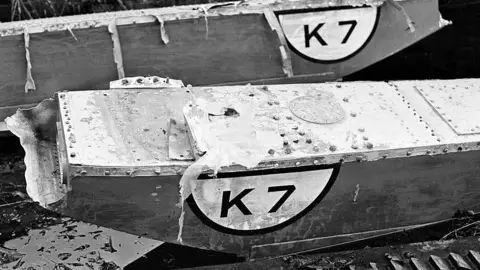
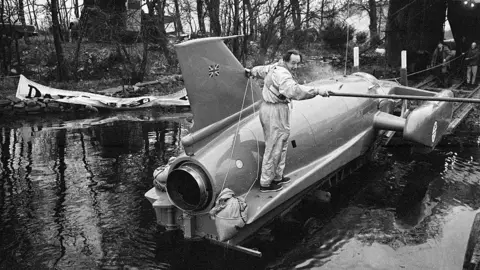
The crumpled, rusting Bluebird and its daredevil pilot remained on the lake bed until 2001 when they were raised by a dive team, with Campbell's remains later buried in a local cemetery.
 Mirrorpix via Getty Images
Bill Smith, a Tyneside engineer who led the recovery, was enlisted to restore the machine to its former glory ahead of it being handed to Coniston's Ruskin Museum.
Summer 2018 saw an accomplishment many reckoned impossible as it was fired up on Scotland's Loch Fad, but a bitter row marred the rebirth as Smith claimed part-ownership in a dispute not settled until 2024.
At last, on Monday and throughout the rest of the week, it is scheduled to take to Coniston Water again, this time with Australian Dave Warby at the controls.
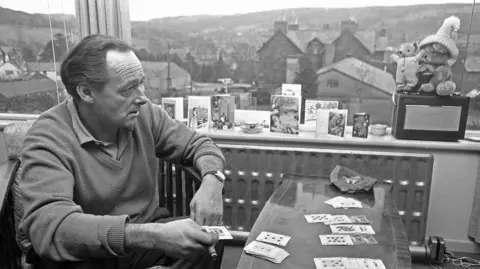
Neil Sheppard, author of Donald Campbell, Bluebird and the Final Record Attempt, believes the event will draw visitors from far and wide - testament to the "enormous courage" shown by the craft's original pilot as he battled American challengers as well as the cultural revolutions of the Swinging Sixties and Space Race.
"He knew record-breaking was a lethal pursuit and he'd already had a crash at more than 300mph in Utah in 1960 attempting to break the land speed record [in Bluebird CN7].
"Campbell and his team were incredibly conscientious, but the K7 boat was always very close to a knife-edge when it was running in record-setting configuration.
"By 1966, Campbell only held the water speed record. He was very patriotic and thought it was vital Britain should still be in the fight for honours."
Those achievements, Sheppard says, were made all the more difficult as funders turned their attention to the glamour of grand prix racing and Britain's new heroes behind the wheel.
"As the attempt went on, Campbell's finances were becoming increasingly strained.
"He'd had sponsorships from some pretty big companies in the 50s and early 60s, but after that all the big firms deserted him.
"He lived life well and yet he was running a jetboat and a jet car, and had plans to build a rocket car capable of travelling at supersonic speeds.
"That ambition meant he would have had to go back to companies and show them he'd got 300mph [on water].
"What he needed when he arrived at Coniston was for that record to happen quickly. It didn't."
 Mirrorpix via Getty Images
Requiring an average speed of 300mph across two runs, success finally appeared to be within his grasp as he completed the first shortly after 08:45 GMT on 4 January.
Turning around without refuelling, Campbell hit the throttle for the return northwards with Bluebird reaching 328mph (527km/h) as it approached the start of the kilometre (0.6-mile) stretch being measured.
Disaster struck.
An inquest, held in 2002, recorded a verdict of accidental death with coroner Ian Smith concluding it was likely Bluebird had been unbalanced by factors including rough water and the speed of travel.
He said that while the lake had been mirror-smooth for Campbell's initial run, it was not so for the second, adding the wake from the first effort may have contributed to a rippling.
While running into that wash was also put forward at the time of the crash, along with the suggestion Campbell may have been at fault by lifting off the throttle as he reacted to danger, Sheppard disagrees.
He contends "Bluebird doesn't produce much in the way of wake, especially at full speed because there's so little of it in contact with the water".
 Mirrorpix via Getty Images
Instead, with the machine "bouncing off the water in a way not previously seen as its dynamic stability broke down", he argues the engine had cut out on the approach to the measured kilometre, causing deceleration and a loss of downward pressure.
Sheppard, who will be appearing at the Coniston Institute on Monday alongside his co-author Dr Keith Mitchell, explains: "It's like jamming on the brakes. "But with a jetboat and the centre of gravity as it was, jamming on the brakes doesn't push the nose down, it does the opposite.
"So even though it was slowing down, the boat was going to take off.
"Campbell was past the point of no return. There was nothing he could do."
When Bluebird is lowered back into Coniston Water, Robinson, now 81, is hoping to once again be out in a support boat.
He is confident it will be "something special" and a fitting tribute to his friend.
What, though, of the future?
"In terms of running, my own view is that this should be a one-off," he says.
"People will be able to see and hear this great record-breaker over the next few days, but then I think Bluebird should enjoy a well-earned retirement."
