What is causing the summer wildfires?

 HIWFRS
Wildfires are increasingly common in the south of England but what exactly are they and what causes them?
It has been another summer of heatwaves in the region and the hot, dry weather increases the risk.
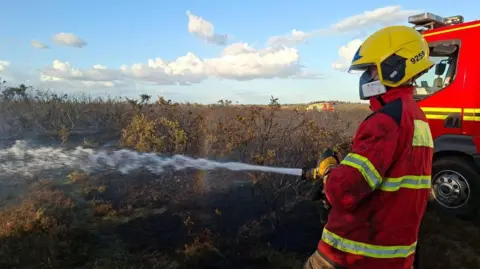
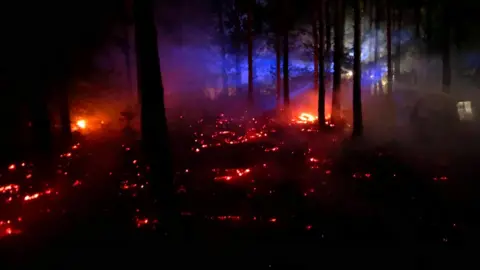
About 80 firefighters have battled a large heathland blaze on the Isle of Wight this week and other recent incidents include a forest fire in the New Forest, a heathland fire near Studland, farm, a blaze at a farm near Tadley and another at a crop field near Hungerford Park.
In 2025, fire and rescue services in England and Wales broke a new record when they responded to nearly 1,000 wildfire incidents, and the National Fire Chiefs Council (NFCC) says climate change is increasing their risk and severity.
The charity said while the number of current active incidents has started to fall, "the challenge is far from over".
"Many wildfires can burn for hours or even days, requiring large-scale, resource-intensive responses from firefighters, who remain on the frontline protecting people, homes, businesses and our countryside," it added.
What are wildfires?
 Hampshire and Isle of Wight Fire and Rescue Service
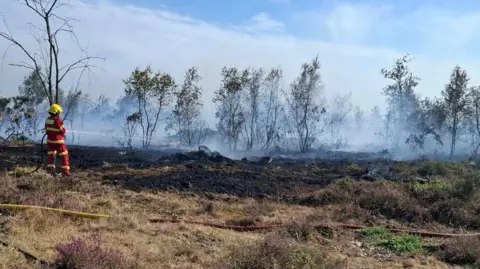
According to UKHSA, a wildfire is "any uncontrolled vegetation fire serious enough to require an emergency response".
This includes fires covering at least a hectare of land - the size of two rugby pitches - and with flames reaching more than 4.9ft (1.5m) high.
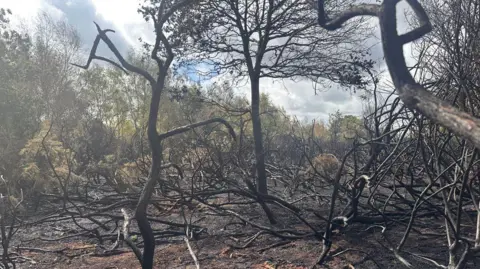
They burn grassland, moorland, woodland and peat, and the problem is that they can start and spread very quickly.
Other criteria, according to NFCC national operational guidance, states that a wildfire requires a "committed resource" of at least four fire engines, for them to be at the scene for at least six hours, and for the incident to present a "serious threat to life, environment, property and infrastructure".
How do they start?
Most wildfires are caused by human carelessness.
Arson, campfires, discarding lit cigarettes, disposable barbecues, not burning debris properly, and playing with matches or fireworks are often blamed.
On a hot summer's day, glass bottles can also start fires if left in direct sunlight.
Agricultural vehicles can also catch pieces of flint, causing sparks, and the National Farmers Union, police and local fire services have produced a farmland safety and fire prevention booklet for farmers.
 Ringwood Fire Station
Firefighters also cite the 30-30-30 rule when it comes to conditions that can cause wildfires.
The figures refer to the measurement of wind speed, temperature, and relative humidity (RH).
So if the wind speed is greater than 30km/h (19mph), the temperature more than 30C (86F), and the RH less than 30%, then any wildfire, depending upon the fuel, will demonstrate extreme fire behaviour and intensity.
Climate change is also the spectre at the feast. The government says it is "making our summers hotter and drier - ideal conditions for fire".
"When landscapes experience several consecutive days of dry weather and little or no rain, plants and soils lose moisture faster than they can recover," it adds.
"Vegetation becomes a more available fuel source, making it much easier for fires to spread."
An NFCC spokesperson tells the BBC: "While wildfire activity this year has not reached the exceptional levels seen in 2025, it remains significantly higher than in many recent years."
What helps prevent them?
Royal Berkshire Fire and Rescue Service advises:
- Extinguishing cigarettes properly and not throwing cigarette ends on the ground
- Not leaving bottles or glass in woodland (instead take them home and recycle them)
- Not leaving barbecues unattended and to only light them in designated areas
- Talking to young people about the dangers of lighting fires
The NFCC says with schools closed for summer and more people spending time outdoors, everyone has to play their part.
It warns: "Dry conditions can persist long after periods of hot weather and it only takes one spark to start a wildfire.
"Most wildfires are preventable. By making simple, responsible choices, we can all help protect our communities, wildlife and natural spaces while easing the pressure on firefighters, who have worked tirelessly to keep people safe throughout the summer."
