Man abandoned as a baby finds birth family after 65 years

 Julie Stevenson
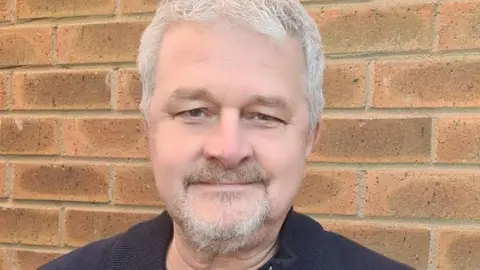
For 65 years, David Stevenson lived with a question that shaped his entire life: where do I come from?
David, from Peterborough, was a foundling - the term used for a baby abandoned by their birth parents and discovered by strangers.
Just a few days old, he was discovered in the hallway of a block of flats in Golders Green, London, in 1960. With no knowledge of the circumstances that led to his abandonment, he was later adopted by the Stevenson family.
"Growing up, I knew I was a foundling. My adopted parents had shared that with me. But it wasn't until I had children of my own that I started to think about where I had come from," he said.
 Julie Stevenson
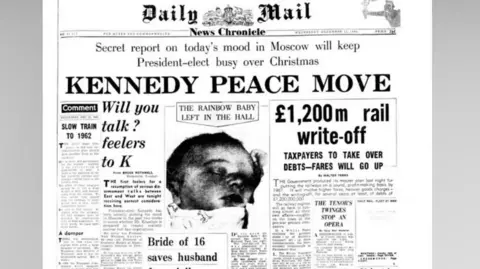
In 1960, the Daily Mail ran an appeal to identify the "rainbow baby" left on the second floor of the London building. The newspaper revisited the story in 2009 in a further attempt to uncover new leads.
Despite years of searching, David said there was very little information about his birth parents in his adoption records.
"It was like finding a needle in a haystack," he added.
"But my wife got involved and realised there was a police report in the records and was able to locate the woman, a PC named Tegwen Curl, who dealt with me. She was able to give us more information about the day I was found."
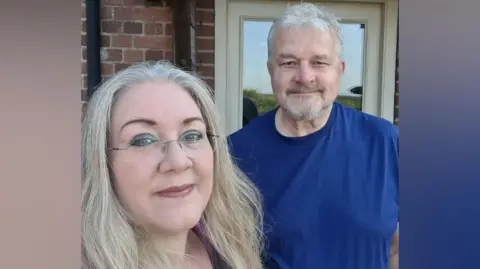
His wife, Julie Stevenson, a former Peterborough City Councillor, said: "The police officer said she had never forgotten rescuing David. It was one of the most poignant events in her career."
 Julie Stevenson
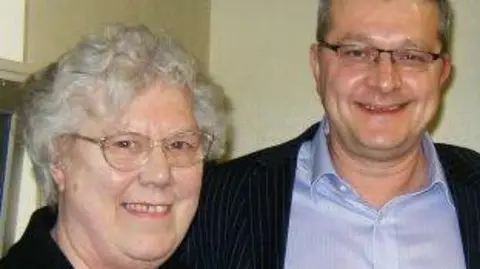
The search eventually uncovered details of David's birth mother, Petra, who was born in the Netherlands in 1940 and raised in a Catholic family.
Julie said that, aged 19, she had travelled to France and later England to work as an au pair, where she became pregnant with David in 1960.
"Although it's unclear whether she knew she was pregnant when she arrived in London, she carried him to full term and appears to have been supported by those around her throughout the pregnancy," she added.
 Julie Stevenson
'I have sympathy for her'
David first connected with ITV's Long Lost Family team during a visit to the Foundling Museum in 2015.
"The programme had a breakthrough in identifying who my birth mother was, through DNA and genealogical research, which is amazing," he said.
"She unfortunately died in 2010. But she has been brought to life through the stories my new relatives have told me about her - she was a very loving lady."
David added: "I think she had made some sort of an arrangement for me to be looked after. But maybe something went wrong with that arrangement which led me to be taken into care.
"But I have nothing but sympathy for her. It was difficult for girls in the 1950s and 60s to be unwed mothers. I think she did the best she could."
Julie added: "We have to believe she had her reasons for not feeling she could come forward, and that's okay. Who are we to judge? We didn't live her life. It's just something very tragic that had happened."
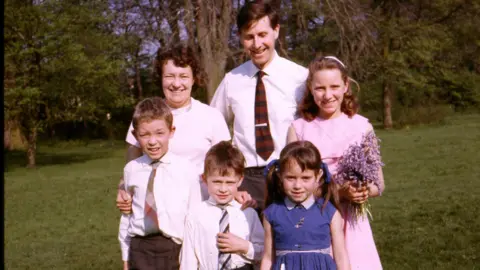 Julie Stevenson
David has since reconnected with his mother's sister, Maryanne, and cousins in Rotterdam, which he described as a "fascinating story".
He added: "The family have been so welcoming and are such nice people. It was a delight to meet them.
"It's the technology of DNA that has made it possible. A girl in Canada matched with me on this DNA site that led us to this family. I have now also learnt my great-grandmother was Indonesian.
"It's hugely rewarding to understand where I came from...although there is still some paternal side to investigate."
The journey to reconnect with his biological family was featured on ITV's Long Lost Family - Born Without Trace on Monday.
Do you have a story suggestion for Peterborough? Contact us below.
Follow Peterborough news on BBC Sounds, Facebook, Instagram and X.
