What GWR nationalisation means for passengers

 Getty Images
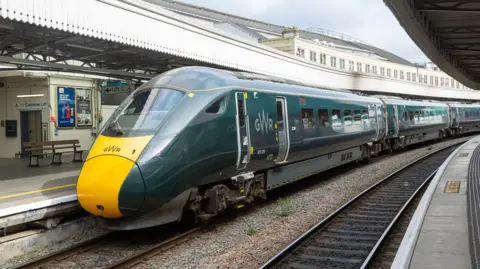
Following the announcement that rail operator Great Western Railway (GWR) is to be brought under public ownership in December, train passengers may be wondering if the move will make any difference to things like ticket fares, jobs and timetables.
The Swindon-based operator, which is owned by FirstGroup, has run services and linked London to the south-west of England and Wales since 1996.
Several rail firms around the country are already publicly owned, including Great Anglia and South Western Railway. Welsh services were nationalised in 2021 and Scotland took trains into public ownership the following year.
The government plans to nationalise nearly all rail services in England by 2027.
When will GWR be nationalised?
The government confirmed that GWR will be nationalised on 13 December.
A spokesperson for the rail operator said they welcomed the clarity provided by the announcement and would continue to work closely with the Department for Transport (DfT).
Helen Godwin, mayor for the West of England Combined Authority, also welcomed the news.
"We deserve four trains an hour at stations across our growing regional rail network," she said.
"We will continue working with partners to deliver the infrastructure needed to make that ambition a reality."
What is nationalisation?
Nationalisation means bringing something under the control and ownership of the state or government.
The UK's rail system was fully nationalised shortly after World War Two, with the government owning all the networks and trains.
However, the industry was privatised in the 1990s and companies took over the operation of trains.
The rail infrastructure is managed by publicly-owned Network Rail while passenger train services are run by individual operators which are both privately and publicly owned.
The nationalisation process forms part of the Rail Public Ownership Bill which was the first major piece of legislation passed by the Labour government when it came into power in 2024.
The bill allows ministers to take operators back into public control as their contracts expire. Most of the freight operators will remain in private hands.
South Western Railway was the first company to be nationalised as its franchise ended in May 2025.
What is Great British Railways?
Eventually, all the train operators are likely to become part of a new organisation called Great British Railways (GBR).
The planned state-owned company will operate most of the country's rail infrastructure and the majority of passenger rail services as well as devolved and open-access operators.
For now, the train companies we are all familiar with will remain in stations around the country.
Will train fares go down?
No - but they will not go up this year.
Last year, the government announced a freeze on fares in England until March 2027.
The cap applies to regulated fares and includes season tickets and off-peak returns.
The government estimated that the move would save commuters on more expensive routes more than £300.
Transport Secretary Heidi Alexander previously said the focus of renationalising the country's rail network would be on improving services and infrastructure, rather than lowering ticket prices.
Will ticket buying methods change?
Unlike GWR, Transport for Wales (TfW), Cross Country and South Wales Metro network offers the option of pay as you go to passengers travelling between stations in South Wales. This facility is available in the West of England.
The payment method means passengers do not need tickets and they pay the best-value fare as prices are capped at a daily and weekly level to provide the best value.
Passengers travelling through the Severn Tunnel do not benefit from the scheme.
It is not yet known if the companies that are yet to be nationalised in England will offer the payment method.
What will happen to GWR staff?
In 2024, the government said it expected existing contractual terms and conditions for staff working at privately-owned operators like GWR to remain in place as ownership transfers into the public domain.
Transport union RMT welcomed the establishment of GBR as a "once in a generation opportunity" but said it would seek discussions with the government to ensure the working conditions of the entire railway workforce were "protected and improved" with the new operator.
Is rail nationalisation good or bad?
The government said that ending payments to private sector operators would save £150m a year.
According to statistics, the government spent £21.6bn on railways in 2024-25, which was a 6.5% decrease compared to the previous year.
Although the government expects to save money through the nationalisation process, there is a risk for them if something goes wrong on the railways as there will be nobody else to blame.
It also hopes to establish an independent watchdog - the Passenger Standards Authority - to "champion improvement in service against a range of measures".
Follow BBC Wiltshire on Facebook, X and Instagram. Send your story ideas to us on email or via WhatsApp on 0800 313 4630.
