'We used to hold patients who died - now we save them'

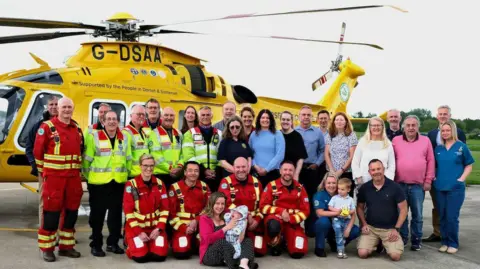 Dorset and Somerset Air Ambulance
Being given blood quickly in the aftermath of a traumatic incident, can often be the difference between life and death.
Yet, it has only been in the last 10 years that airborne first responders were able to offer the life-saving treatment.
Since 2016, Dorset and Somerset Air Ambulance (DSAA) has given more than 450 transfusions while attending incidents, giving them a better chance of survival.
"Before we carried blood components, many of us remember holding the hands of patients who sadly died on the way to hospital," said Dr Phil Hyde, DSAA's medical director.
"Today, we are holding hands and seeing patients survive, going on to meet them, their families and even their children," he added.
It was made possible to deliver transfusions at the scene and in the air through a collaboration between Dorset County Hospital, NHS Blood and Transfusion, the Devon Freewheelers and the South Western Ambulance Service NHS Foundation Trust.
It meant doctors could then replace lost blood at the side of the road, in rural locations or even at the patient's home, before they arrive at hospital.
DSAA believes beginning a transfusion as soon as they reach a scene could be the difference between reaching the hospital and surviving, or not.
Hyde said it was a "gift from society" to offer the service.
He said the service gave them "the ability and confidence to sustain patients with catastrophic bleeding long enough to get them to hospital for the ongoing emergency treatment they need".
Follow BBC Somerset on Facebook and X. Send your story ideas to us on email or via WhatsApp on 0800 313 4630.
