First wildfire warning of the year issued in Northern Ireland

 PA Media
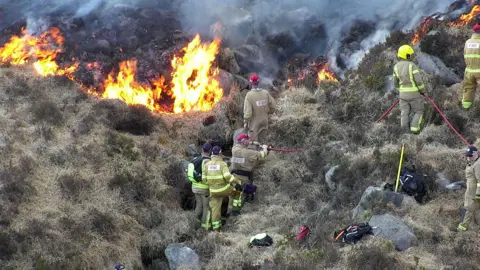
The sun has finally come out - but with it comes the first wildfire warning of the year.
The wildfire season has begun in Northern Ireland, with a dry spell of weather and breezy conditions expected in the coming weeks.
A yellow warning for wildfires was issued across the country from Wednesday until at least Sunday, and an amber warning was in place for some areas on Thursday and Friday.
Emergency services have urged the public to take precautions, including avoiding open flames in rural areas, and properly disposing of cigarettes and barbecues.
A new wildfire action plan, published by the Department of Agriculture, Environment, and Rural Affairs (Daera) earlier in April set out a coordinated response to what officials describe as a growing threat.
It includes dozens of measures aimed at improving resilience and reducing the frequency and severity of fires.
"We have all witnessed the devastating consequences of wildfires in recent years, endangering homes, businesses, and communities while also damaging vital upland habitats across Northern Ireland," said Agriculture Minister Andrew Muir.
"The wildfire action plan lays out how we will work together to reduce wildfire risk by implementing specific actions over the years ahead."
 Getty Images
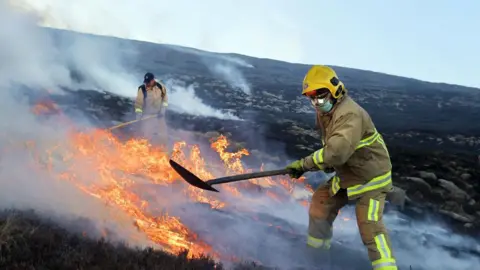
Fire risk levels across the island typically rise between late winter and autumn, particularly during dry and breezy spells with rising temperatures.
Authorities in the Republic of Ireland issued a 'Condition Orange' warning this week - the second highest level - which indicates a high risk of fires.
On Thursday, a fire broke out in the Clonmany area of County Donegal.
Speaking to Highland Radio, director of human resources, economic development and emergency services at Donegal County Council, Garry Martin, said there was a "substantial" response to the blaze, with over 40 firefighters at the scene.
He said on Friday that the fire had been brought under control.
What has happened in previous years?
Last year, the Northern Ireland Fire and Rescue Service (NIFRS) attended 95 wildfire incidents, 83% of which were due to deliberate ignition.
The majority of these incidents, 93 in total, happened between March and May, highlighting the increased risk during the spring period when vegetation is dry and weather conditions are favourable for fire spread.
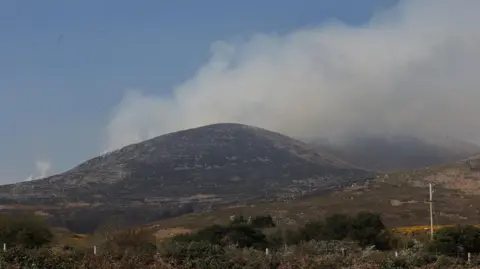
A major incident was declared in April 2025 when a large wildfire broke out near the Mourne Mountains, and led to homes being evacuated. That blaze was treated as arson.
Around this time, other wildfires broke out in places such as Bloody Bridge near Newcastle, Silent Valley near Kilkeel, Sawel Mountain near Newtownstewart and in Dervock in County Antrim.
A number of homes were evacuated in April 2025 after a large wildfire broke out on Sandbank Road, Hilltown.
How can wildfires be prevented?
 PA Media
In a statement this week, NIFRS wildfire lead and area commander Ryan Thompson said wildfire incidents had the "potential to devastate our countryside and put wildfire and our community at risk".
"With drier weather, we urge everyone enjoying the outdoors to please act responsibly," he said.
The NIFRS is asking people to adhere to the following advice to prevent fires in the countryside:
- Extinguish all smoking materials properly and don't dispose of them on the ground or out of car windows
- Avoid lighting open fires in the countryside as these can easily get out of control
- Don't leave glass bottles in woodland or grassland - sunlight shining through the glass can start fires
- Take glass bottles and all other litter home or place in a bin
- Keep children away from lighters, matches and open fires
- Only use barbeques in a suitable and safe area and never leave them unattended
- Ensure barbeques are fully extinguished and cold before disposing of the contents
- Don't attempt to tackle fires that can't be extinguished with a bucket of water - leave the area as quickly as possible
- If you see a fire in the countryside, dial 999 and report it to the fire and rescue service
- If you see someone setting fires, report it to the PSNI
In May 2025, the Mourne Heritage Trust said Stormont should consider banning fires at certain times of the year. It also questioned whether a helicopter could have been used to fight a fire in Silent Valley in the previous April.
At the time, Daera said it would consider banning fires, while the NIFRS said a helicopter would not have been appropriate due to a number of operational factors.
The new wildfire action plan outlines that Daera plans to undertake a review of existing burning legislation in Northern Ireland.
What should you do if you see a wildfire?
 Pacemaker
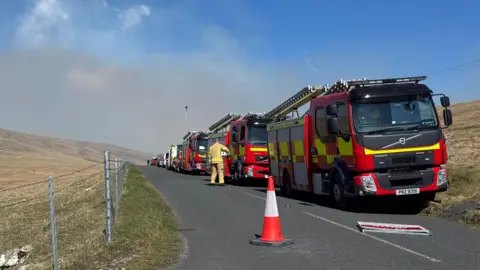
People who are out in the countryside and see a fire are asked to call 999 immediately and ask for the fire and rescue service.
"Don't assume that someone else has made the call. Leave the area as quickly as possible and get to safety," Thompson said.
"Please do not attempt to tackle a fire yourself if it can't be extinguished with a bucket of water and if you witness deliberate fire setting, report it to the PSNI as it is a crime."
Thompson said the NIFRS was "continuing to work closely" with its partner agencies through the Wildfire Action Plan to "reduce the frequency and severity of wildfires".
"This coordinated approach ensures our firefighters are ready to respond to incidents in their local areas to protect lives and the environment," Thompson said.
"The responsibility of protecting our countryside belongs to all of us, so we must work together to prevent these devastating fires from starting in the first place."
