The 'reverse' careers fair for neurodivergent jobseekers

 Grace Wood/BBC
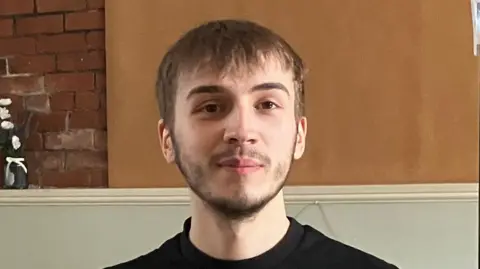
Toby Rowley and Kieran Wilson are both 19 and left school with no qualifications, wanting to get straight into work.
Yet with neurodivergencies and lacking GCSEs, they struggled to get anywhere with their job applications.
They are part of a scheme in Bradford which tries to improve the work readiness of teenagers like them by offering internships and "reverse" careers fairs.
These events lack the noise and bustle of a busy jobs fair, and instead the employers are encouraged to talk to them in a quiet place.
Wilson has applied for around 50 roles in construction, hoping to start training as a bricklayer, but feels his school record is holding him back.
"I didn't take my GCSEs because I have anxiety so I was stressed. That's my biggest challenge, not having the qualifications for getting the jobs that I want."
As a "supported intern" with Coleman Training Development, he is selling his skills at the Skills House-organised careers information session.
The council's business engagement officer, Sunil Shah, says employers walk around the room meeting candidates, rather than the other way round.
"The reverse job fair is giving the supported interns an opportunity to talk about their skills and experiences and aspirations, and an opportunity for employers to engage with the supported interns in a quiet space.
"The careers fairs tend to be very noisy, not very conducive to people with neurodivergence."
The candidates prepare whiteboards with a CV on and present them to potential employers.
"At a traditional careers fair, the onus is on the jobseeker to reach out to the employer, whereas here it is reversed.
"So it works for the intern because they don't feel that they have to go out of their comfort zone."
 Grace Wood/BBC
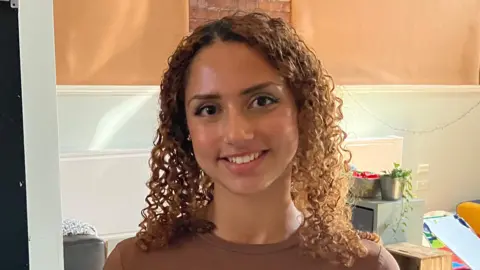
Dealla Ceasar, 20, from Bradford is looking for work in the beauty industry or a caring role.
She says job applications can be challenging for someone with additional needs but the fair has given her hope that some employers are different.
"It makes you feel like you're really supported and there's actually hope for people who have disabilities," she says.
"I met quite a few people who gave me good ideas and I learned a lot."
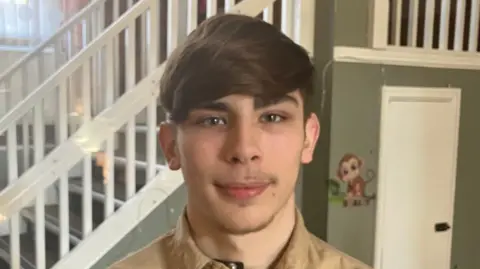
Toby Rowley is looking to work in a gym or as a personal trainer.
He also left secondary school with no GCSEs and joined Coleman Training Development.
"I wasn't the type of kid I am today. When I came to Coleman, it all just changed."
He found the training programme - which supports young adults aged 16 to 25 with educational challenges into independent, sustainable paid employment - gave him confidence and focus.
"I just thought, I need to actually get my head down. They actually helped me one on one and got me through stuff."
 Grace Wood/BBC
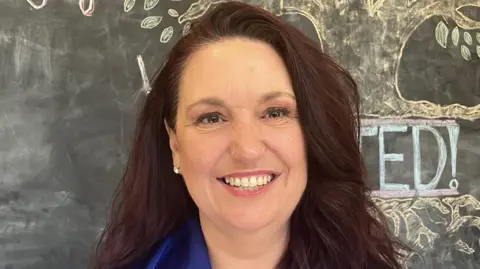
The programme is run by Roxanne Coleman, who herself has ADHD and autism. She says young people often turn up frustrated from a bad school experience.
Coleman calls the first year of the programme a pre-internship and the second year a supported internship.
Based in Bradford, it supports 36 young people and is looking to expand to 48 from September.
"A lot of them have education-based trauma," she says.
"The first two weeks is lots of boundary pushing and kicking. They're really pushing every button they can.
"I get called all the names under the sun, but we don't expel them. We don't throw them out. We're like a bridge in between work and school."
She says often they cannot cope with college or university and employers do not want someone with no qualifications and a lack of professional skills.
"Even those with qualifications go to an interview and can't speak because they don't know how to answer, or they've become so overwhelmed, or they turn up wearing a tracksuit."
The programme works with companies like Virgin Media, GXO Logistics, Bradford Christian School, Bradford Repaint, Melrose Interiors and local food banks.
"We do a thing called soft work experience in the first year, so normally in the voluntary sector, because they're just a lovely first experience of an employer. And then we start working with companies.
"We work with the young person to find out their likes, their dislikes, the things they want to do, their skills and qualities.
"Then we look at their postcode and we teach them to research an area that they are prepared to walk or get a bus to work in.
"Then they contact the company and we contact them in the background," she explains.
 Grace Wood/BBC
Jason Lake is a network manager at Virgin Media, which is running a pilot scheme with Coleman Training Development, taking interns out on repair jobs and teaching them to be engineers.
"When we've had the interns with us we've kitted them out so they look like an engineer straight away, so if they're out in the public domain no one will know that they're an intern," he explains
He is trying to get the company to take more interns on a regular basis.
"Individuals have come into the department with me for 12 weeks and they've completely changed.
"Their confidence has increased, their ability to communicate has gone through the roof and it's given them hope that they perhaps didn't have.
"I'm aware some of the interns come from poor backgrounds and they are limited with opportunity and I think what we've offered them is potential, that there's something else," he says.
Listen to highlights from West Yorkshire on BBC Sounds, catch up with the latest episode of Look North.
