Woman becomes world's first to receive new cancer therapy

 PA Media
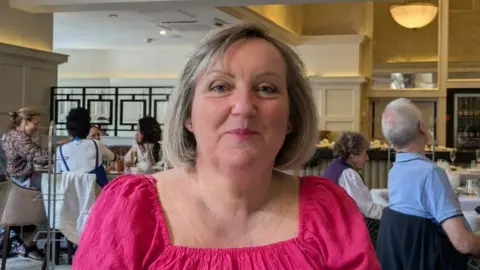
A woman with advanced ovarian cancer has become the first patient in the world to receive a pioneering new therapy.
Tracy Tomlinson was given the drug at The Christie hospital in Manchester as part of a clinical trial evaluating a new type of treatment for several types of cancer.
The therapy, known as ZI-MA4-1, will be tested on people with ovarian cancer, lung cancer, sarcomas and head and neck cancer in a trial led by the Christie, and a site at the Royal Marsden in London.
The 58-year-old, from Chadderton, Oldham, decided almost straight away she was going to go for it, she said, although she admitted it was a "little bit scary" being the first person to have the treatment.
Many people in the early stage study - which is primarily focused on safety - have few other options for survival.
Tomlinson has already beaten the odds in staying alive, having undergone surgery and several rounds of chemotherapy since she was diagnosed in 2020.
The new therapy works by combining two powerful methods in fighting cancer.
Firstly, it harnesses the body's natural killer cells, which are specialist immune cells that destroy abnormal ones.
Secondly, T-cell receptors on the cells are engineered to recognise and target tumours producing a protein called Mage-A4.
Mage-A4 is found in several types of cancer and experts believe it is an ideal target for attacking abnormal cells.
Unlike some personalised treatments, ZI-MA4-1 is designed as an "off-the-shelf" therapy that uses immune cells from donors.
The treatment is manufactured in advance from donor cells rather than being individually tailored to each patient, with hundreds of doses produced from a single manufacturing batch.
Experts believe this could mean advanced cell therapies are available to more patients more quickly, and at a cheaper cost.
 PA Media
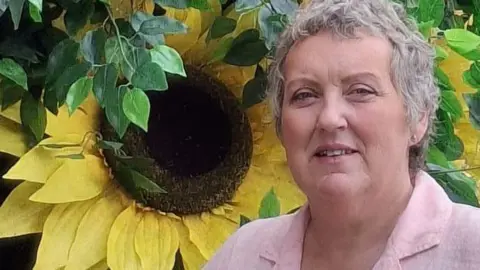
Tomlinson, a former civil service manager, said she was diagnosed as stage 3C, which means there were cancer growths spreading into the peritoneum of the body.
She currently has a tumour between the liver and kidney as well as small tumours elsewhere.
She said: "It is a lot to live with and there's been ups and downs - there's been elation, there's been disappointment, and bits in between.
"But I try very, very hard to remain very positive. Every day that I wake up is a positive. You've got to have hope."
Tomlinson said in her working life she was target-driven and set herself very high standards.
"But you can't control cancer," she said.
"What I can control is how I look at it, how I deal with it, and trying to eat healthily and taking the positives in everything.
"And I've learned to appreciate the smallest of things that we take for granted – and the people around you and what they mean to you.
"Also, the beauty of outside and the trees and the colour of the trees and the birds singing."
 PA Media
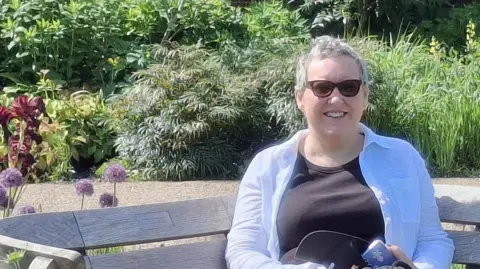
Last year, she was referred to The Christie's early phase clinical trials team and learned she was a suitable candidate for the Zima-101 clinical trial.
"I decided almost straight away that I was going to go for it," she said.
She has had three infusions of the therapy, with the option of another one depending on what scans show.
"If it benefits me, absolutely fantastic," she said.
"But if it benefits other people in the future, that's important too.
"I don't want to have gone through everything I've gone through for nothing. I want to feel like I have made a difference."
Prof Fiona Thistlethwaite, consultant medical oncologist at The Christie, said: "While this is an early-stage study primarily focused on safety, it represents an exciting step forward in efforts to develop new treatment options for people like Tracy with advanced solid tumours."
She said it could "help shape future cancer treatments and ultimately improve outcomes for patients".
'Landmark moment'
Dr Jon Lim, consultant medical oncologist in advanced immunotherapy and cell therapy at The Christie, said this novel approach was "very exciting".
"This is the first of its kind globally - where it's taking donor immune cells, manipulating or engineering them, and putting them into the recipient.
"Tracy is essentially getting somebody else's immune cells that have been engineered to 'see' her cancer."
Namir Hassan, of Norwegian firm Zelluna, which makes ZI-MA4-1, said Tomlinson's first dose was a "landmark moment".
Only around 15% of women survive ovarian cancer for five years or more after they are diagnosed.
Listen to the best of BBC Radio Manchester on Sounds and follow BBC Manchester on Facebook, X, and Instagram. You can also send story ideas via Whatsapp to 0808 100 2230.
