Lung cancer patient first in world to get new vaccine

 BBC
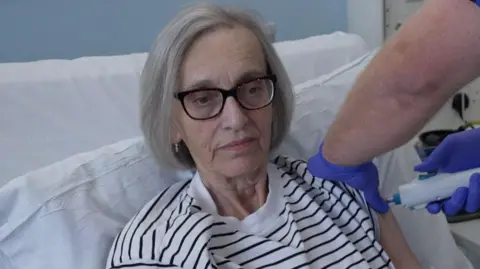
BBCA woman from Merseyside has become the first patient in the world to receive a new vaccine which doctors hope could significantly improve the treatment of some forms of advanced lung cancer.
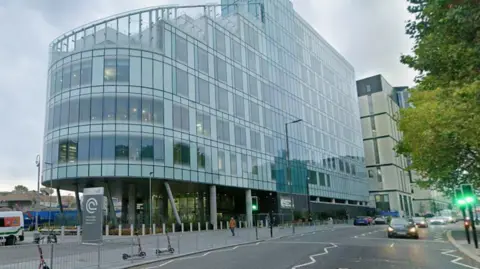
Chris Jones, from Hoylake, Wirral, is taking part in a new clinical trial at the Clatterbridge Cancer Centre in Liverpool.
The vaccine uses cells from the 68-year-old's own tumour to help create a synthetic DNA which it is hoped will make immunotherapy far more effective.
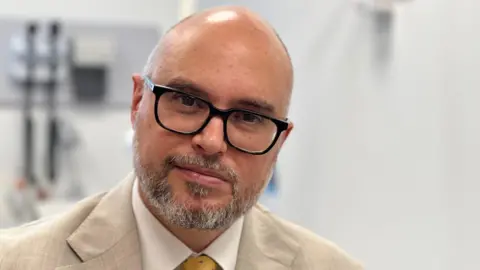
One of the consultants involved in the trial said: "It feels like a massive step forward... it is extremely exciting."
 Google
Chris has advanced non-small cell lung cancer, which accounts for more than 80% of all lung cancers.
While her immunotherapy has helped to some extent it has not worked well enough.
Medical Oncology Consultant Dr Carles Escriu said this was a problem for about half of the patients they treated.
He explained that such patients "will have an initial response to the immunotherapy but eventually the cancer will learn how to become resistant.
"So what we want to do is boost the immune system, hoping that we can achieve this long-term response."
'Specifically made'
Chris has agreed to take part in an early stage clinical trial, looking at whether that can be done.
As she was prepared for the injections she said: "I'm a bit nervous."
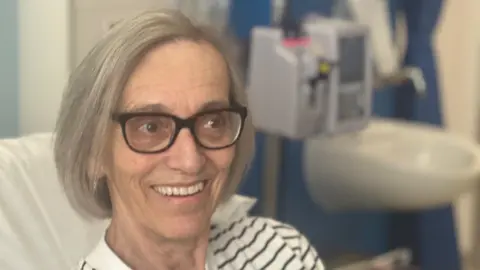
She said she had volunteered "because I obviously want to live longer if I can and if it helps other people in the future then that's a bonus – for everybody."
Chris has another reason for volunteering.
Just under 10 years ago her eldest daughter Alex died from secondary breast cancer.
"If there'd been something for her like this maybe things would have been different," she said.
"I think trials are amazing."
Chris's vaccine was made specifically for her.
Scientists used a biopsy from her own tumour to map the DNA of her cancer.
They then used that information to engineer the vaccine using synthetic DNA.
That DNA is known as "doggybone" because of its unusual shape.
Researchers say it is faster and cheaper to produce than normal bacterial DNA and this makes individually tailored vaccines potentially more achievable for the NHS.
A needle-free device is used to deliver a shot in each arm. This is followed by Chris's normal infusion.
Each dose is carefully checked by research nurse Will McCaig before he dispenses it into Chris's arm with a loud click.
"A lot of work has gone up until this point and I can't believe we're here but we are," he said. "I'm really, really proud to be involved."
Many organisations including the University of Liverpool, the Clatterbridge Cancer Centre, NHS Blood and Transplant, and specialist genetics and immunotherapy firms have worked together for months to reach this point.
"This is a very complex study that requires a lot of co-ordination, and few centres worldwide would consider doing a study like this," said Escriu.
"So it's fantastic to be a part of it."
Only 10 people will take part in this early stage trial, receiving seven doses over the next 24 weeks.
The two professors jointly leading it, Christian Ottensmeier and Natalia Savelyeva, hope it will improve care for more than half of patients with advanced lung cancer.
Prof Ottensmeir said the aim was to help the immune system recognise and fight tumours that have previously evaded detection.
"I hope this research will contribute to new ways of thinking about cancer vaccine use in advanced lung cancer," he said.
Chris says she hopes to retire when she can and "enjoy life... just have fun".
In six weeks' time she will be scanned to find out how her vaccine is working.
She, and the entire team treating her, hope that her tumour will have shrunk.
"I'm not ready to go yet," she said. "I've got things to do."
Listen to the best of BBC Radio Merseyside on Sounds and follow BBC Merseyside on Facebook, X, and Instagram. You can also send story ideas via Whatsapp to 0808 100 2230.
