Staff say maternity ward is 'unsafe' as inspectors criticise delays

 BBC
BBCStaff at Scotland's biggest hospital described conditions in the maternity unit as "unsafe" and "dangerous" during an inspection by the NHS watchdog.
The Queen Elizabeth University Hospital (QUEH) in Glasgow was ordered to make 26 improvements by Healthcare Improvement Scotland (HIS).
These include addressing delays of almost eight days to induce labour, which put mothers and babies at increased risk.
Dr Mary Ross-Davie, NHS Greater Glasgow and Clyde's (NHSGGC) director of midwifery, apologised to women who faced delays to their care and said improvement work had been developed to address the issues in the report.
Inspectors also raised serious concerns around cleanliness in wards and the management of patient safety incidents, where care had gone wrong but reviews were not always properly carried out.
Grieving family 'still haven't had answers'
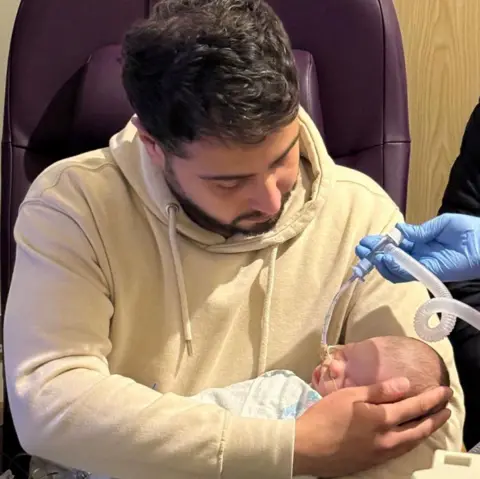 Hameed family
BBC Scotland News has spoken to the family of Leyan Hameed, who died of a brain injury eight days after her birth by emergency forceps at the hospital last February.
An investigation by the health board found there were delays sourcing ultrasound equipment, inconsistencies in medical notes, and too few staff with the right skills on shift, when her mother Rawan arrived at the maternity unit.
Leyan's father Mohammed says the report reflects a lot of his own family's experience despite the health board carrying out a significant adverse event review (SAER).
"In our circumstances, we still haven't had any answers," he said. "The purpose of a SAER report is to review what went wrong and to prevent it from happening again.
"It's deeply concerning as a healthcare professional myself that we are now, in our case, a year and four months on, and clearly there hasn't been anything done."
The health board's director of midwifery, Dr Mary Ross-Davie, said: "We continue to offer our deepest condolences to the family of baby Leyan Hameed.
"We know the loss of a child is devastating and we remain committed to helping the family understand what has happened.
"A significant adverse event review has completed, and it remains our intention to meet with the family to answer the questions they have and offer our ongoing support."
January's unannounced visit to the QEUH maternity ward was the seventh by the NHS safety watchdog.
Inspections of all 18 obstetric units across Scotland were ordered in 2021, following an independent review into a number of spikes in neonatal deaths.
The Scottish government also committed to a national review of maternity care after a BBC Disclosure investigation heard calls from families, NHS staff and experts for urgent action to improve safety.
During its visit to the QEUH, Healthcare Improvement Scotland heard from staff who described their working conditions as "unsafe" or "dangerous" at times, as part of incident reports.
It said staff worked hard to provide kind and respectful care, despite dealing with increasingly complex patients. Some staff became tearful during discussions with inspectors.
Inpatient wards were found to regularly function at between 7% and 13% over capacity.
Issues with the skill mix of midwives had made it harder to provide safe maternity care and maintain patient safety, according to the report.
 Getty Images
Staff suggested women could have had better birth experiences "if appropriate care had been provided without delay".
Some staff described concerns about a lack of "civility" between different teams working under stress, and managers who lacked awareness of "the reality of daily pressures".
Other issues in the report included:
- difficulties sourcing foetal monitoring equipment to assess babies' wellbeing
- emergency trolleys that had expired equipment, expired emergency medication and were visibly dusty
- staff disposing of urine into a sink due to a broken waste disposal unit
- sharps disposal bins contaminated with blood
- mould around windows
- a leaking toilet that had a towel placed under the pipework to collect water
Inspectors also raised concerns that serious adverse event reviews had not been commissioned in response to some safety incidents, including where mothers had ended up in intensive care.
Other incident reports had been closed before women had given birth, where a delay may have impacted the mother or baby.
HIS ordered the health board to make improvements in conducting reviews quickly to identify immediate patient safety concern and to put measures in place to address them.
Melissa Dowdeswell, director of nursing for HIS, said that where "the fundamentals of care" were not in place, there was a risk to harm to patients.
She said that inspectors had raised their concerns with the chief executive of NHSGGC.
"Staff described that they felt they were overwhelmed," she said.
"They weren't always able to take a break, and obviously we do know that staff wellbeing is an important factor in patient safety."
During the inspection, the triage area where women first present to maternity services was found to be experiencing delays for a first assessment, and patients were waiting up to 42 minutes to be seen by a doctor.
On the day of the first visit, there were also delays of about 21 hours to induction of labour due to staffing and capacity pressures. Over the previous six months, the longest delays had exceeded 100 hours, up to 190 hours.
Delays occurred too for patients accessing the labour ward, in the provision of one-to-one midwifery care and in labour ward transfers for women being induced.
Dowdeswell said delays like this had been a theme seen through other HIS inspections.
"There are different complexities, and each mother and baby have got different clinical needs," she said.
"But what we do know is that delays are not acceptable."
She said work was ongoing at a national level to combat delays in maternity care.
Dr Ross-Davie, from NHSGGC, said: "We are sorry that some women have experienced delays in accessing care in our labour wards.
"Improving this is a priority for us, and we are continuing to develop new pathways to reduce waiting times."
She said providing good care was the "absolute priority" and that 55 more midwives will have joined the team by October.
 PA Media
Health Secretary Angela Constance told BBC Radio Scotland Breakfast she was "deeply concerned" by the report and had met the chief executive of the health board with the expectation to address the action points in the report "immediately".
She added: "I also expect all NHS boards to take note of this report and findings and to identify opportunities for local improvement, including the areas of good practice.
"The findings of this report, and the wider HIS inspection programme, are informing the approach we will take to the forthcoming independent review of maternity services."
