Is London a swimmable city?

 Laure Latham
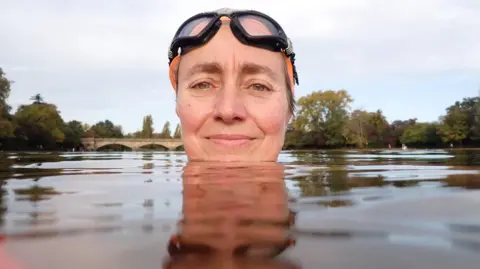
Laure Latham enjoys swimming in the Serpentine lake in Hyde Park in the centre of London.
Not only is she an ultra-marathon swimmer, she is also president of the Serpentine Swimming Club and a big advocate for the right for everyone to have access to swimming, especially with increasingly warmer summers hitting the capital.
"To enjoy wild swimming, everybody needs to be a confident swimmer, and that's a bridge we need to cross at some point, leaving nobody behind," she writes online.
She says teaching more people to swim "should be a national health priority", a sentiment echoed by London Mayor Sir Sadiq Khan, who said accessing London's waterways "is an issue of social justice".
But, as more people seek out London's waterways in the heat, can free, outdoor swimming become a normal part of city life while remaining safe and accessible to everyone?
This is the ambition behind the London mayor's Clean Rivers and Waterways plan, released this week.
The 10-year plan aims to reduce pollution, improve water quality, restore habitats and, where possible, make rivers and waterways clean and safe enough for swimming.
As part of the plan, a total of £1.8bn has been pledged by water companies, London's boroughs and charities, with the mayor adding £2.7m across three years, on top of £13.6m already promised.
"Rivers are London's blue treasures, and Londoners should be able to access them," said the capital's deputy mayor for environment and energy, Mete Coban.
Earlier this year, at the age of 33, the deputy mayor started swimming lessons himself.
"I think there's so many Londoners, especially my age, who don't know how to swim, because they haven't had access to affordable swimming," he said.
He said of the new plan: "We want to create more access to affordable swim spots across the city where we can support Londoners to be able to educate and train them and support them to learn how to swim."
The plan comes just weeks after a teenage boy died after entering the water at the Royal Victoria Dock in east London in June.
It prompted a safety campaign by the Port of London Authority (PLA) to try to teach young people about the dangers of the water.
 Getty Images
Inequalities
According to the 2024 Active Lives Children Survey, 86% of children from the most affluent families can swim 25 metres unaided, compared with 42% from the least affluent families.
Among white British children in years seven and eight, more than 80% can swim, compared with less than 50% of black children of the same age.
"Around 700,000 Londoners cannot swim. That's not a coincidence. Many people, particularly from lower-income backgrounds and some communities, haven't had access to affordable swimming facilities," said Coban.
City Hall said the mayor's Clean Rivers and Waterways plan will also work with organisations such as the Black Swimming Association, which focuses on water safety and drowning prevention, particularly among African, Caribbean and Asian communities, with a view to boosting swimming skills across all of London's communities.
 Getty Images
Clean enough to swim?
Boosting swimming skills is just one part of the challenge, though. Providing safe, unpolluted swimming spots is another.
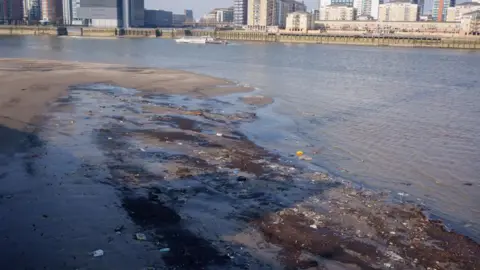
Sir Sadiq said London's waterways have suffered from "decades of neglect and pollution", and added that although they are the capital's "lifeblood", they are often "cut off from the communities around them".
BBC News previously reported that between 2020 and 2023, the River Thames has been polluted by at least 72 billion litres of sewage discharges, and it is thought that figure was likely to be much higher.
In May, for the first time ever, a stretch of the River Thames at Ham and Kingston was given the official status of "designated bathing water" by the Department for Environment, Food and Rural Affairs (DEFRA).
This is just one stretch, but could other stretches also be designated as official bathing areas if they are improved?
For Chris Romer-Lee, swimming consultant and co-founder of Swimmable Cities, safely swimming in the River Thames will require better education and infrastructure.
He points to Copenhagen in Denmark and cities in Switzerland as examples of swimmable cities.
"In Switzerland, you find showers, changing facilities, toilets and safe access points. People understand how the river works.
"They know when conditions are safe and when they aren't. They understand the flow, the risks and how to use the river responsibly."
He believes the UK still does not do enough water-safety education.
"A swimmable London will not happen overnight," he said. "Examples from cities across Europe show that cleaner rivers, safer access and better water education are key."
 Getty Images
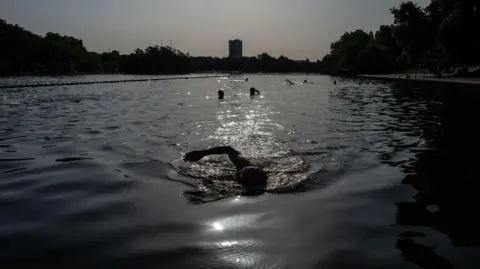
Swimming can bring together people from different backgrounds and help create strong communities, Laure said.
This is true of the community at the Serpentine Swimming Club, which has 3,000 swimmers, she added.
"Not all swim at the same time, but we sort of keep up with the regulars. And when somebody hasn't been around for a few days, or somebody is going through tough times, we will reach out and support them whichever way we can," she said.
"It is also a community made up of people from all socioeconomic backgrounds; in the water, everyone looks the same.
"There are no suits, expensive clothes or status. It's a great cross-section of society."
Listen to the best of BBC Radio London on Sounds and follow BBC London on Facebook, X and Instagram. Send your story ideas to hello.bbclondon@bbc.co.uk
