The story behind a seaside town's quaint alleyway

 Steve Ladner/BBC
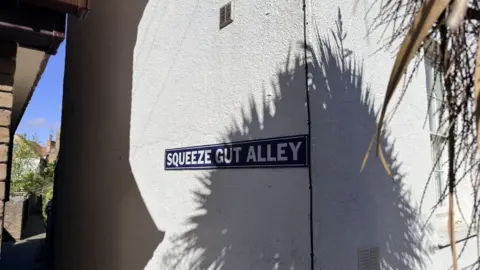
The seaside town of Whitstable is a popular holiday destination - with a rather quaint landmark called Squeeze Gut Alley.
Situated between Middle Wall and Island Wall, it is about one foot and three inches (39cm) wide in one end, and about two-feet (60cm) wide on the other end, according to Peter Banbury and Steve Keeler from Whitstable Museum.
It was commonly thought this passageway was named because of its supposed links with town's smuggling history.
Banbury and Keeler told Secret Kent the naming of the alleyway may have come from boys who were escaping from the police.
Keeler explained some police officers were "quite rotund" and could become stuck in the alleyway if they chased the boys.
He added not a single alleyway was used, specifically, for smugglers to escape authorities.
"Squeeze Gut Alley may have been used by them because custom officers would have pursued them on horseback," he said.
Several hundred years ago, Banbury said smuggling was a "major part of life in the town".
"Coastguards were employed to claw back revenue lost due to contraband in the town," he added.
Banbury said no coastguards were born in Whitstable. This was to avoid any possibility of personal connections between officers and gang members.
"If the coastguards didn't know the smugglers, chances were they wouldn't give them any tip-offs," he said.
Banbury said locals also aided and abetted smugglers.
"They normally turned a blind eye to what was going on, and they would profit from this," he added.
Keeler said Whitstable was the "ideal location" for smuggling because it was, at the time, an isolated area.
"There was about 1,000 people living there and the coast near Seasalter was known for being misty during the night, so this was a good cover for smugglers."
Both Banbury and Keeler said many of the alleyways in Whitstable were named after people or the shop next to it.
They added passageways such as Squeeze Gut Alley and Coastguard Alley were important landmarks of the town.
"It's great they have survived because they tell us so much about the past, and gives us an insight into how people lived back in the day," Banbury said.
Follow BBC Kent on Facebook, on X, and on Instagram. Send your story ideas to southeasttoday@bbc.co.uk or WhatsApp us on 08081 002250.
