PSNI takes BBC behind the badge with unprecedented access

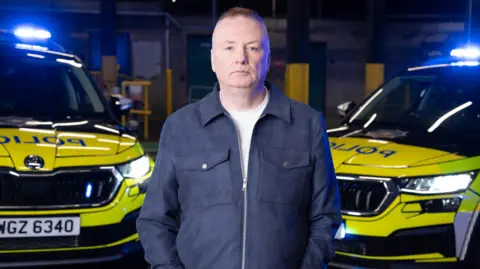 BBC/ Third Street Studios
The 999 call comes in and that's it – sirens on, lights flashing as we race through the night.
A sex offender is in his home in east Belfast and there's an angry crowd outside. He was put out of his home days earlier but now he's back and they're incensed and at his door.
The patrol car pulls up and immediately it's a confrontation. The police officers face split-second decisions that could mean the difference between de-escalation or things getting dangerously out of control.
It's the kind of dilemma that could come up on the award-winning cop drama Blue Lights.
But this is real life, and my heart is pounding. I've been working for the BBC for more than 20 years, but it is nights like this that have had the most profound effect on me in all my years in journalism.
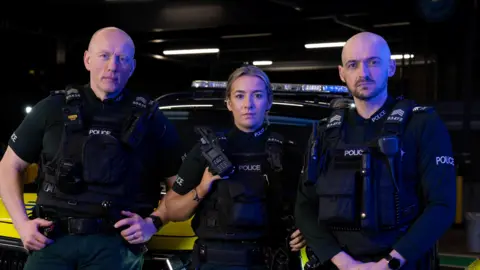
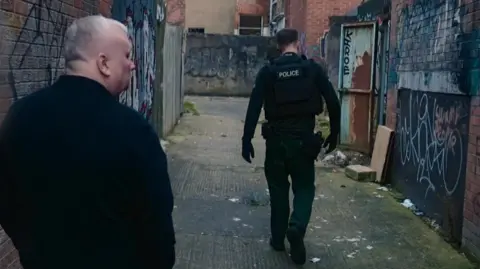
Over the course of the past two years, I've been allowed unprecedented access to a team of seven Police Service of Northern Ireland (PSNI) officers, following them on countless days and nights as they deal with everything from public disorder and city centre assaults to drug dens and drunk drivers.
Peelers: The PSNI For Real is the result – a new six-part series that examines policing in the only part of the UK where officers carry guns and routinely don't tell anyone their real job, for fear of being targeted by dissident republicans.
The peelers – slang in Northern Ireland for police – have often been in the headlines in Northern Ireland, and not always for the right reasons.
In my time as a broadcaster, I'm accustomed to holding the PSNI to account, asking tough questions of chief constables and senior officers.
The force has faced scrutiny in recent years over a number of high-profile issues: the release of personal details of staff and officers via a mistaken data breach; its struggle to attract more recruits from Northern Ireland's Catholic community; and, "clear evidence" of sexism and misogyny found within the force by an independent review.
The relatively new chief constable, Jon Boutcher, is a bruiser. He isn't afraid to ruffle feathers with politicians and is furious about the policing budget, but has also vowed change within the PSNI.
When I first met him, I got the sense he was wary of me, but also frustrated that the story of the hard work being done by those wearing the uniform was not being told.
It was an eye-opener to see the huge level of responsibility placed on the officers I met.
 BBC/ Third Street Studios
Despite the daily pressures of their job, they welcomed me into their patrol cars and behind the scenes in the police station.
They were taking a risk putting themselves into the public domain, and so opening themselves up to the social media armchair experts. But they too wanted the real story told.
I quickly realised it was the close bonds that help these officers get through the tough times and long shifts.
And they really are long - I never quite got used to spending 12-hour shifts in the back of a police car, meaning that I would sometimes fall asleep while they raced to calls, with sirens and blue lights on, to the next incident.
There's a huge expectation on those at the front line and conversations are needed on the issues they deal with.
I saw up close how they are faced with people struggling with addiction – in one call out, they found a man in a flat apparently seriously ill from drug use (he is still alive today).
These are societal problems that officers find themselves trying to contain on the front line.
Officers are also at the sharp end of the Northern Ireland's mental health crisis, finding themselves plugging the gap as society leaves people behind.
And that's before we tackle the question of how Northern Ireland treats its police.
We need officers to be at the heart of our communities but many feel the need to move away from where they grew up because of the risks that come with being a member of the PSNI.
Our society is still suffering from the divisions of the past and if police officers are truly at the heart of binding our society together, how come those with vocal influence in Northern Ireland are not ensuring police officers can continue to live safely within the working class communities they were born in?
If this sounds like a very negative picture, well in some ways it is.
These officers face long hours, huge responsibility and a constant conveyor belt of call-outs, each one more unexpected, stressful and unsafe than the last.
 BBC/ Third Street Studios
Of course, they won't always get it right and some decisions will be questioned.
That is something we see in the series. But, surely, it's about the intent behind those decisions.
The officers are acutely aware of ever-looming police ombudsman scrutiny, but there needs to be a conversation about the realities of policing Northern Ireland's streets.
I watched, for example, masked up youths on high-powered scramblers taunting the police, racing in front of them in the city centre streets.
The peelers knew if one of them fell off their bikes during a chase, it would be the officers' careers in jeopardy. That needs to be looked at.
But, I also learned when getting to know these officers, their lives on shift are about friendship.
Practical jokes; coffee breaks; banter; and, certainly in my experience, plenty of slagging for the journalist tagging along in the back of the car.
That's the bond - they call it "the police family " - that helps these peelers stay together and resilient when, say, faced with dozens of angry people outside a sex offender's house.
On that night, it's all about those split-second decisions – speaking to community leaders to urge for calm; talking to the man in question, barricaded in his house, to discuss an exit strategy; working out a plan with the PSNI's Tactical Support Group to take him safely out the front door and away.
So, the officer asks the man one final time: 'Ready?'
And with that, they're out the door, tactical specialists to the front and back, a line of officers blocking the angry residents, the man's head down low as officers shout instructions and bundle him into the waiting police vehicle.
Then it's over. The residents disperse. The officers get back in their cars and it's another call, another dash through the Belfast night on just another shift.
Episode one will be aired on BBC1 NI at 22:40 BST on Monday.
