The twilight zone: Every night trillions of tiny creatures rise from the ocean depths

 Dante Fenolio/DEEPEND-RESTORE/Science Photo Library
In the ocean's twilight zone, where the reach of the Sun fades to nothing, the world's largest migration begins every time night falls. It could also have an outsized effect on our climate.
During World War Two sonar technicians made an extraordinary discovery. The pings from their echo sounders reflected off what they thought must be the ocean floor. But the sea was much shallower than they had expected and – even more puzzlingly – the seabed seemed to move up and down throughout the day.
This wasn't the undulating ocean floor, however, but the many inhabitants of the twilight zone making their nightly migration to the surface to feed. This concentrated "deep scattering layer" of marine organisms, suspended in the water column, was so extraordinarily high that it scattered the sound, reflecting the sonar pings as if it was a solid object.
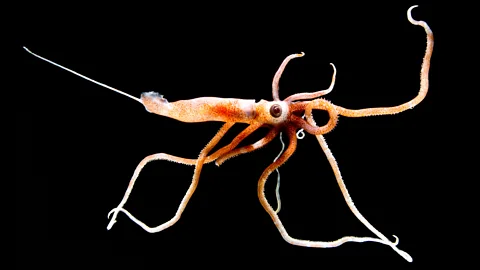
Beneath the waves, the twilight zone – or mesopelagic zone – starts at a depth of 200m (656ft), where the ocean is bathed in perpetual twilight. Sink deeper and the reach of the Sun's rays fades rapidly. The last remnants of sunlight vanish completely around 1,000m (3,280ft). There, the only light is the eerie glint of bioluminescence, produced by creatures that glow in the dark.
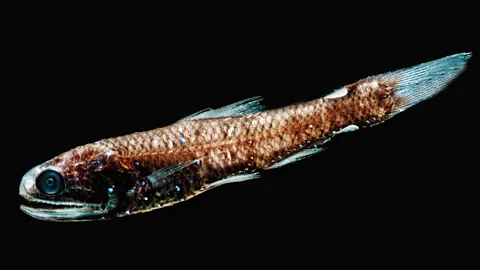
This vast layer of water spans the globe and is teeming with an astonishing diversity of life. It is home to an estimated 95% of all fish biomass, and around 10,000 million tonnes of fish.
Every night trillions of zooplankton that inhabit this zone rise from the deep to feed under the cover of darkness. This phenomenon, known as diel vertical migration (DVM), is the largest natural migration of animals on the planet, with an estimated biomass of 10 billion tonnes. As the Earth spins on its axis, diel vertical migration takes place throughout the world's oceans. "I like to think of it as a Mexican wave," says Laura Hobbs, lecturer in Arctic Marine Science at the Scottish Association for Marine Science, describing the swell of animals rising and falling, following the night around the globe.
 Dante Fenolio/DEEPEND-RESTORE/Science Photo Library
"Zooplankton go to the surface to feed because that's where the phytoplankton is," says Hobbs.
"Zooplankton", she explains, is an umbrella term for many different species of tiny animals that live in the ocean. "These critters are just millimetres long, they're tiny. And they're swimming hundreds of metres every single day, up and down again. It would be like running multiple marathons." (Read about Jailing Cai's incredible experience of photographing animals of the twilight zone.)
Phytoplankton, meanwhile, are the plant-plankton. "Phytoplankton need the sunlight [to grow]. That's why they're restricted to the surface layers."
"As the Sun rises," says Hobbs, "the zooplankton become threatened by visual predators, bigger zooplankton or fish [that can see them now in the light]. So, they migrate back down into darker waters and stay there to digest. Then they excrete their waste, get hungry again and, as the Sun sets, they come back up for more."
One of the first direct observations of DVM, says Jon Copley, professor of ocean exploration at Southampton University, UK, was made in 1966 by the legendary ocean explorer, Jacques Cousteau when diving in his UFO-shaped "diving saucer" submersible. Almost half a century later, Copley himself was also lucky enough to see the phenomenon up close.
Copley has explored the deep ocean all over the world and the big realisation, he says, is how much of the Earth rests in perpetual darkness. "We're told it's an ocean planet, a blue planet. Well, 71% of the surface is blue – but actually the blue comes from the sunlight reflecting off the sunlit upper layer. Most of [the ocean] is beyond the reach of the Sun's rays. It's not only an ocean planet, it's a deep, dark ocean planet."
Copley was in the Gulf of Mexico, ascending at dusk from exploring a brine pool at 650m (1,970ft) depth, when he passed through the deep scattering layer. "We were in a Johnson Sea Link submersible, which is an acrylic sphere sub. So, we had a really good view," he says.
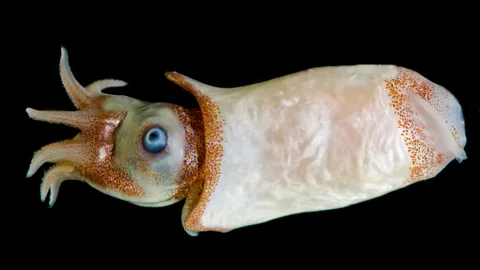
To save battery power on the sub, all the lights were turned off. The only light was that of tiny glowing sea creatures. "It looked like a blizzard, with these flashes of light." That's when he realised they were coming up through the vertically migrating layer – countless animals also making their way to the surface.
 Dante Fenolio/DEEPEND-RESTORE/Science Photo Library
Copley couldn't distinguish the different species that were emitting light as, he says, often it's just a single organ that glows "or different bits of their bodies". "It was like playing dot-to-dot to guess the animal," he says.
As they rose higher, the pilot put on a strobe light so the ship would be able to locate the sub when they surfaced. And each time the strobe flashed, "everything else flashed back", says Copley. At this point, Copley realised he had only been seeing a fraction of the life that surrounded them. "Suddenly I thought, 'wow, we're really in a soup!'. It's not a just a watery ocean, it's a living soup."
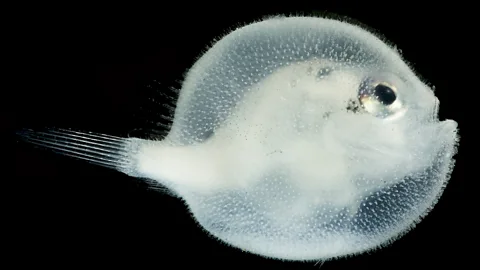
The creatures of the mesopelagic play a critical role in oceanic food webs. Many of the species in this zone are important prey for larger predatory species, including ones we humans rely on for food such as tuna and swordfish. And it is thought that these tiny swimming animals may contribute to biomixing too, that is the churning of ocean waters and transportation of nutrients from deep to shallow waters and vice versa.
However, many of these animals are so tiny that they live in the "viscous world", says Copley. "The world we're familiar with is what we call the 'inertial world'. So, if we dive into a swimming pool, do a stroke and stop, we will glide through the water, "because we live at the inertial scale".
"When you get really small, you enter the viscous world, where the physics is quite different. If we were to dive into a swimming pool full of molasses, we'd do a stroke and we'd stop." That, he explains, is what the ocean feels like for the smallest of sea creatures.
More like this:
Copepods – tiny crustaceans sometimes called the "insects of the sea" – make up a huge proportion of the deep scattering layer.
"Copepods are one of, if not the most abundant animal in the sea, by biomass and by number," says Hobbs. "They are absolutely everywhere in the world's oceans. When you look at them under a microscope, some of them are sort of cute and funny. They're darting around, and they're just like nice little insects. Then you come across some that are really big. They're the predatory ones. They've got massive, aggressive mouthparts. They're ferocious looking."
Many copepods live right on the boundary between the inertial and viscous worlds, says Copley. "Sometimes they can move fast enough that they break into the inertial world and they will glide. But a lot of the time their feeding appendages are within the viscous world. When they capture a food particle, they can't throw it to their mouth – because as soon as they let go of it, it will stay where it is, stopped by the viscosity of the water. So they have these amazing appendages for catching food particles and bringing them to their mouths.”
 Dante Fenolio/DEEPEND-RESTORE/Science Photo Library
A single copepod – trapped in its viscous world – might not have much effect on ocean mixing, but imagine trillions of these minute creatures all waggling their little limbs at the same time. "When you get enough of these animals together, they might start to produce larger effects," says Copley. "It's such an interesting possibility, and something we've overlooked in our understanding of the oceans."
Diel vertical migration is also thought to transport up to six gigatonnes of carbon – more than double the emissions from all cars worldwide – from the upper ocean into the deep sea per year, where it can be stored for centuries. This plays a crucial role in regulating the Earth's climate as it keeps carbon locked away and out of the atmosphere. If they survive the night, these tiny travellers will carry any organic matter they've consumed at the surface back down to the depths as night turns to day.
"Rather than [the organic matter] sinking and getting eaten on the way down, now it's inside whatever's swallowed it," says Copley. "It's carried back down to the deep, where it may be released, or that animal might be eaten by something else. This gives us a kind of a shortcut for getting carbon down into the ocean, and that's really important."
Once carbon moves below roughly 1,000m (3,280ft) depth in the ocean, it can remain out of the atmosphere for millennia. "This migration has these really important consequences for what the ocean does as part of our planet's living system," says Copley.
The twilight zone and its many inhabitants, however, face a multitude of threats. Climate change-driven sea-ice decline means sunlight can reach deeper into the ocean for longer periods of time, trapping zooplankton in the depths as they wait for darkness to come. And ocean warming is altering the habitat range of species, impacting the food chains that rely on them. Fisheries, too, have begun peering into the darkness in the hope of expanding their catch.
Some areas of the deep ocean are protected, though. These include the marine protected areas (MPAs) off Hawaii, the South West coast of England, Nova Scotia and the Azores. But, however far these MPAs stretch into the deep ocean, they are only designed to protect the seabed.
Now, the International Union for Conservation of Nature (IUCN) has called for a pause on expansion of mesopelagic fishing until we better understand this crucial portion of the ocean. The IUCN's Motion 035 is a radical idea that would protect whole of the water column and not just the ocean floor.
Despite over 200 years of research into this epic daily migration, many questions remain. "We don't understand what the variability within the zooplankton community is," says Hobbs. "Are the smaller versus bigger zooplankton doing something different? Are species behaving differently? Understanding this variability is really important. For example, a change in the dominant species in a certain area [due to ocean warming], could have implications for the carbon flux and for predator-prey interactions. There is still so much to find out."
--
For essential climate news and hopeful developments to your inbox, sign up to the Future Earth newsletter, while The Essential List delivers a handpicked selection of features and insights twice a week.
