'The deep sea will come to me': The blackwater diver who photographs the creatures of the deep

 Jialing Cai/ Ocean Photographer of the Year
When photographer Jialing Cai plunged into the ocean in the dead of night, she found creatures of the deep had risen up to meet her.
In blackwater diving, the ocean floor is invisible, says Jialing Cai. You float in an endless black void.
"There is no reference for you to know your location in this three-dimensional space," says the specialist underwater photographer. "If you're not aware of your depth, you could start sinking down deeper and deeper."
During her first nighttime dive, however, "the excitement overwhelmed my fear". Cai soon found that this black "empty space" was, in fact, teeming with life – from baby octopuses, jellyfish and crabs, to juvenile fish and all manner of copepods, or "insects of the sea".
Cai, from Chongqing, China, is an award-winning blackwater photographer. In 2023, she was named Oceanographic magazine's Ocean Photographer of the Year for her image of a paper nautilus, a rarely-encountered octopus with a paper-thin shell-like egg case. Then, in 2025, Cai won the Oceanographic Female Fifty Fathoms Award for her collection of photographs that captured some of the ocean's most charismatic visitors from the deep.
Cai doesn't need to dive deep, though, to capture these deep ocean creatures. She simply waits for them to emerge from the depths at night as they come to surface to feed – in what is the biggest mass migration of animals on Earth.
Little is understood about the true nature of life in the ocean's midwater. Usually, specimens are collected in nets. Removed from their natural environment, their lifeless – often damaged – bodies are then preserved in jars.
These stunning images, however, reveal the amazing daily lives of the interior of the ocean, says Jon Copley, professor of ocean exploration at Southampton University in the UK. "Having photographic evidence of these animals is important because they're rarely seen in their natural habitat. Traditionally specimens of mid-water animals like these are collected in nets, which don't preserve the intricate structures that you can see in a photo."
 Kim Aristorenas
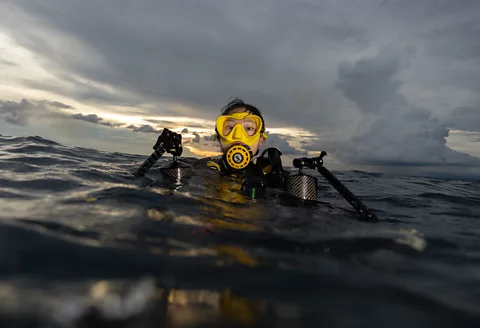
In December 2018 – at just 19 years old – Cai embarked on her first ever blackwater dive in Batangas Bay, Philippines.
In the water, colour disappears very fast as you descend, says Cai. "You have to get very close to the subject if you want to capture a good image. You want to be relatively still, even as they move around. And sometimes you find a subject, you get close to it, and then it starts to swim. Then you just have to chase it."
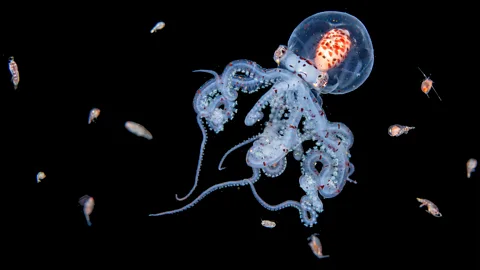
Hyper-focused on photographing her first deep ocean species, Cai swam away from the dive boat and her dive guide who was in the water with her. This is when she captured the image of a wunderpus octopus (seen above). As an adult this wunderpus will have zebra-like stripes, but in its juvenile stage, says Cai, its colour cells have not yet developed. "Almost transparent, it can blend in with the empty dark space."
Cai used three bright lights to capture this image, which also attracted all manner of zooplankton – larval shrimps, crabs and worms – to join in the fun. "There's a huge diversity of life here. It's like a festival."
Suddenly, though, Cai realised she had swum so far from the boat that she could no longer see its lights. Alone in the darkness, she turned around in the water – and saw nothing. "I turned off all my lights: my camera light, my hunting light." She hoped this would allow her to detect the obscure light of the boat in the distance.
Still, there was nothing but the black of the night ocean.
Cai surfaced and turned on her lights. That's when the dive boat crew spotted her and – after a few minutes that felt like a lifetime – she was safe.
An ordinary diver
When Cai was studying marine biology at the University of Virginia in the US she thought exploring the deep sea would be as ambitious going to outer space. Then, one day, her lecturer explained the phenomenon of diel vertical migration (DVM).
Every single night, he explained, trillions of tiny zooplankton rise from the deep sea to feed in the relative safety of the cover of darkness. They swim for hundreds of metres to shallow waters, some even making it to the surface. During this nightly migration, the ocean hums with an "evening chorus". This is the chatter of countless fish, shrimp, jellies and squid making their way to the surface.
Then, just before sunrise, they return to the abyss.
"Diel vertical migration happens in every marine and freshwater environment on the planet," says Laura Hobbs, lecturer in Arctic marine science at the Scottish Association for Marine Science. "This is the biggest migration by biomass on the planet – and it happens every single day."
"It hit me like lightning," says Cai. "I couldn't help but interrupt the professor. I said, 'Are you saying that I actually don't have to go down to the deep, deep sea to see the creatures myself? I can just be an ordinary diver?' I realised I could take glimpses into a world that my mortal body would never allow me to reach. I just have to throw myself out into the open ocean at night, and the deep sea will come to me."
So, Cai learnt to dive and to use a camera. Today, she specialises in photographing zooplankton in the blackness of the open ocean at night. Diving no deeper than 30m (98ft), Cai photographed these deep ocean animals that swum up to meet her.
 Jialing Cai/ Ocean Photographer of the Year
Dance of the immortal jellyfish
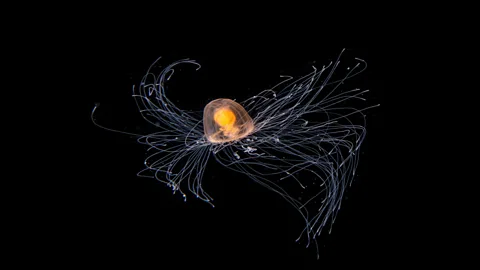
This mature immortal jellyfish "looked like a lightbulb in the night of the ocean", says Cai. The immortal jellyfish gets its name from its ability to "revert itself back into its baby stage, its polyp stage" on sensing danger, such as pathogens in the water, she explains. "It can restart its lifecycle again and again." In theory, immortal jellyfish can live forever.
The jellyfish was startled by Cai's bright light and immediately retracted its tentacles when she approached. So, she reverted to a red light, using a white strobe to capture the image in an instant. Immediately, the jellyfish began to extend its tentacles, dancing like a swirling tornado. "You sometimes have to use these kind of tricks to let marine creatures show us how they really behave," says Cai.
 Jialing Cai/ Ocean Photographer of the Year
Borrowed venom
The diel vertical migration crew is a crowd jostling with both predators and prey. "These little critters form the basis of the food chain," says Hobbs, "so they're really important for everything from fish to whales." To survive being eaten by larger predators – or each other – many of these animals have developed ingenious defence strategies to protect themselves.
More like this:
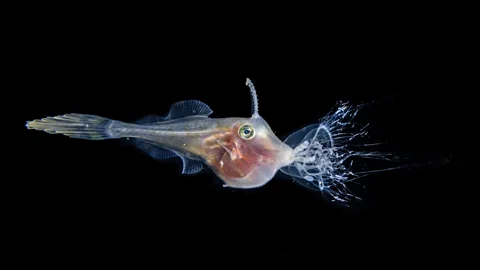
This juvenile fish has captured a jellyfish in its mouth, making use of the toxins in its tentacles. "This is a very typical behaviour for these juvenile fish," says Cai. "They take advantage of the venomous tentacles of the jellyfish. Every time I tried to approach the fish, it would immediately steer its chemical shield towards me."
 Jialing Cai/ Ocean Photographer of the Year
A gauntlet of predators
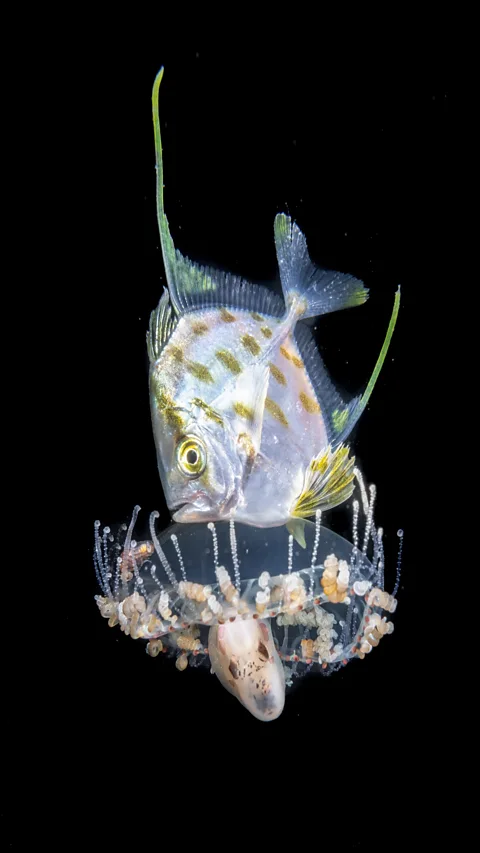
"Here you can see a juvenile trevally, a kind of jack fish, sitting on the bell of a jellyfish," says Cai. Inside the jellyfish, you can see a baby octopus is being digested. "Its soft, blood-tinged eyes are visible within the gelatinous stomach. For the baby octopus, this jellyfish is brutal." For many small zooplankton, said Cai, the jellyfish's gut becomes their final resting place. For others, like the jack fish, the jellyfish offers refuge.
Cai's images, says Hobbs, offer a fascinating insight into the diversity of life at this scale in the ocean. "These huge migrations are happening as part of a complex three-dimensional environment, where tiny zooplankton move towards the surface to feed whilst simultaneously running the gauntlet past a variety of predators. It's amazing to think that each of these species is following their own strategy, shaped by its preferred prey, potential predators, and reproductive needs."
 Jialing Cai/ Ocean Photographer of the Year
Trash shelter
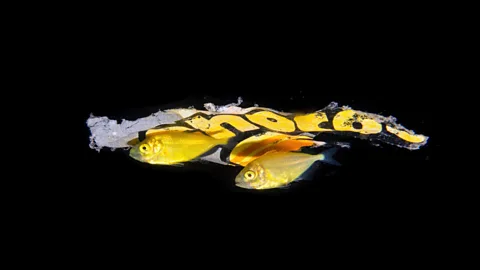
Here "two tiny fish, each no bigger than my thumbnail, are navigating the open ocean at night beneath the fragile shelter of a drifting piece of candy wrapper", says Cai. "An unintended refuge in a world increasingly shaped by human debris."
The twilight zone – or mesopelagic zone – is a vast layer of water that spans the globe. It stretches from a dusky 200m (660ft) beneath the waves, to pitch darkness at 1,000m (3,280ft) depth. This portion of the ocean is home the vast majority of marine life – with more fish than the rest of the ocean combined – and is critical to both ocean ecosystems and the global carbon cycle.
There are various ways that human activity negatively impacts the twilight zone, says Copley. "These are depths that are fished for some fish species. Then, of course, the other big impact throughout the deep ocean is climate change. This affects the twilight zone and what lives there. Predictions are that the abundance of life there will decline."
This zone urgently needs protecting, says Copley, with research showing that climate change will curtail life there by as much as 40% by the end of the century.
 Jialing Cai/ Ocean Photographer of the Year
Metamorphosis
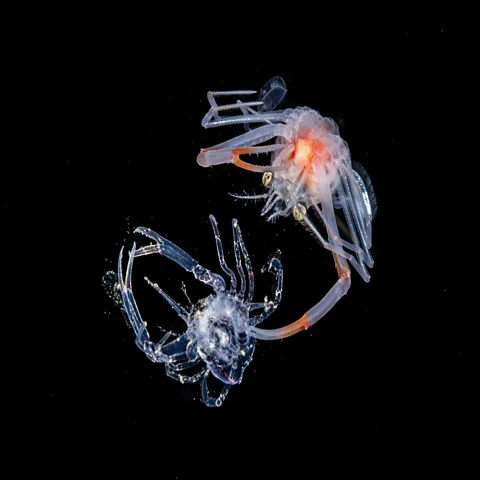
Some of these tiny creatures undertake epic journeys before ending up on our shores. Crabs, for instance, are usually thought of as seafloor dwellers. But, like most marine animals that we encounter in coastal areas, they go through a planktonic stage, says Cai. As larvae they drift in the water column, undergoing multiple stages of metamorphosis, before they eventually settle into their final habitat.
"This image captures a juvenile crab in the act of moulting, shedding its old exoskeleton much like slipping off a sweater," says Cai. "If you look closely, you can spot subtle differences in shape and structure between the transparent moult and the crab's newly emerged body."
So, next time you watch a common shore crab scuttling around inside your seaside bucket, just think – it may well have travelled more than a hundred miles in the depths of the ocean, surviving against all odds.
--
For essential climate news and hopeful developments to your inbox, sign up to the Future Earth newsletter, while The Essential List delivers a handpicked selection of features and insights twice a week.
