This fish species survived 100,000 years without males. Scientists thought it should be long dead – but it's thriving

 Manfred Schartl
All-female species have been long thought to be evolutionary dead ends. So how has one remarkable fish survived for 100,000 years without males? The answer is revealing new insights into how nature keeps genomes healthy.
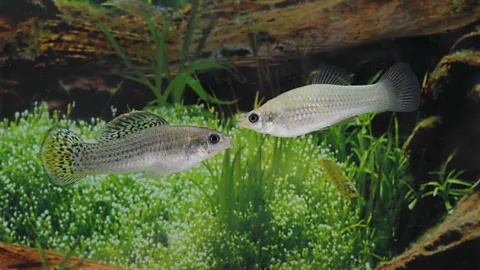
In the rivers of Mexico and southern Texas swims a fish that shouldn't exist. In the warm, slow-moving waters, she drifts among her all-female shoal, her silver scales brushing against males of closely related species. It's here that she selects a mate. But in an unusual evolutionary twist, his genes play no part in her offspring. This is a biological heist known as gynogenesis, in which she uses the male's sperm only to trigger egg development, but quickly discards his DNA. She produces only daughters, each a clone of herself.
This fish is the Amazon molly, named after the all-female warrior tribe in Greek mythology, and it has been puzzling scientists for nearly a century. Evolutionary theory suggests that asexual species should quickly die out, as without sex harmful mutations build up in their genomes over time. But this female-only species has persisted for around 100,000 years. By conventional thinking, it should have been a fleeting blip in the tree of life. Yet, this small, unassuming creature endures.
How has the Amazon molly survived when theory suggests it should be long extinct? As new research starts to unravel this mystery, scientists are finding that asexual species may be more resilient than once thought – challenging the long-held idea that life without sex is doomed to fail.
Why sex matters
To understand why the Amazon molly's survival without sex is so remarkable, it helps to know: why does sex exist at all?
"Sexual reproduction is a pretty weird and complicated way to reproduce, right?" says Edward Ricemeyer, computational biologist at the Ludwig Maximilian University of Munich in Germany, and co-author of the new study on the Amazon molly.
Sex is costly, Ricemeyer explains. Individuals must find and compete for a mate, and each parent contributes only half their DNA. Reproduction is often unequal, with females of many species investing far more energy than males in producing, birthing or incubating, and raising offspring.
Asexual reproduction, by contrast, sounds like a much better deal. No need to find (and deal with) a mate, and you can pass on 100% of your genes. Yet across the tree of life, sex – the mixing and recombination of genes from different individuals – is truly dominant.
"If you look at the overall picture, it's 99.9% sex," says Dave Speijer, an evolutionary biologist at the University of Amsterdam, in the Netherlands, specialising in the origins of sexual reproduction.
 Getty Images
One such reason, Speijer argues, is that sex allows populations to explore the genetic "space of possibilities" more efficiently.
During sexual reproduction, the DNA of two parents is reshuffled through a process called recombination, giving each offspring a unique combination of genes. It's a little like shuffling and dealing out a deck of cards, each reshuffle creating a new hand for evolution to test out. This means there is usually more genetic variety within sexual species, as every individual has a different mix of genes – a unique hand of cards – which is typically beneficial to a species' survival.
Sex also offers protection. Without this genetic reshuffling, genomes face a slow, creeping threat called Muller's ratchet.
When DNA is copied, explains Speijer, "there are always errors". In sexual species, these mistakes can be shuffled out of the gene pool, but in clonal species, they are passed down over and over again. Over time, these harmful mutations are thought to build up like notches on a one-way ratchet – degrading the genome, click by click, until the species goes extinct.
According to this idea, asexual species should be short-lived, doomed to genetic decay. Yet some, like the Amazon molly, not only survive, but thrive.
Speijer thinks part of the confusion could stem from how the theory is interpreted. "Muller's ratchet doesn't say, 'Hey, if you don't have sex, then you'll get mutational meltdown.'" Instead, he argues, it is better understood as a broader constraint on all life. Any system must have a way of managing genetic "mistakes" and sex is just one such strategy.
Seen this way, long-lived asexual species are not necessarily defying evolutionary rules, but finding alternative ways around them. "There are always mechanisms that take care of the mutation rate," says Speijer, even if we do not fully understand them yet.
An 'evolutionary scandal'
The Amazon molly is not alone. Across the animal kingdom, there are several asexual creatures that appear to have persisted longer than theory would predict, from scrub-dwelling stick insects to blob-like "micro-animals".
These species differ from headline-grabbing cases of so-called "virgin births", or parthenogenesis, in which snakes or sharks in captivity reproduce without mates. These are not permanent alternatives to sexual reproduction. When conditions allow, these animals return to sex.
By contrast, the Amazon molly belongs to an exclusive female-only club of species committed to life without fathers, generation after generation. How these long-lived asexuals seem to evade the fate predicted by Muller's ratchet is still debated, but some species appear to have remained genetically healthy for millions of years with no obvious sign of sexual rescue.
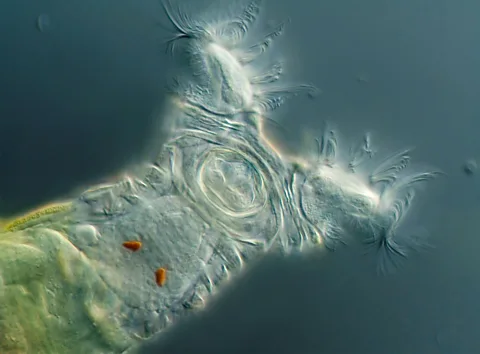
Enter the bdelloid rotifer.
 Alamy
Alamy"They have been called an evolutionary scandal," says Chiara Boschetti, a leading rotifer expert and zoology lecturer at the University of Plymouth, in the UK.
These blob-like creatures are about the size of a grain of sand, yet are surprisingly complex, with a head, a digestive tract and two tiny toes. Widespread in freshwater environments across the globe, they are part of a small group known as the "ancient asexuals" – animals that have existed for millions of years without reproducing sexually. In the case of the bdelloid, tens of millions of years without males, making the Amazon molly's roughly 100,000-year history look short-lived.
"Frankly, we don't know how they've survived for so long," Boschetti says.
There are clues, though. One of the most unusual of these is their ability to acquire DNA from their environment – a process known as horizontal gene transfer. Unlike most animals, which inherit genes only from their parents, bdelloids "steal" genetic material from entirely unrelated organisms – something usually only seen in simpler forms of life, like bacteria.
But, for Boschetti, that's not the most surprising part. "These horizontally acquired genes are actually being used to survive," she says.
Some are linked to surviving dehydration, others to resisting pathogens. "You can dry them, you can cook them," she says, referring to their remarkable ability to endure extreme and novel conditions, from spaceflight to being frozen for 24,000 years in Siberian permafrost.
But whether this DNA theft is acting like an alternative to the genetic reshuffling of sex is less clear.
"It probably is creating diversity," Boschetti says, but "how much the horizontally transferred genes are helping with asexuality is not quite clear yet".
Horizontal gene transfer alone probably isn't the full story. Boschetti believes bdelloids may be relying on a "mosaic" of mechanisms to keep harmful mutations at bay. Still, after decades of study, they remain something of an evolutionary "black box", she says.
Until recently, the secret to the Amazon molly's longevity was similarly mysterious. Now, a new study has shed light on just how the molly does it.
A 'copy-and-paste' system
"The theory has been missing a piece," says Ricemeyer, who co-authored the study. "And this piece was gene conversion."
Gene conversion is a form of genetic repair, and it's not unique to Amazon mollies. It occurs in many organisms, including humans.
In sexual species like us, each individual usually carries two copies of most genes – one copy from our mother and one from our father. When DNA is damaged, for example by UV radiation, cells can sometimes use one copy of a gene as a template to repair the other. This process, known as gene conversion, is often described as a kind of "copy-and-paste" mechanism. Eventually, it can make two copies of a gene more similar to each other.
In humans and most animals, this mechanism largely acts as a background process quietly fixing DNA damage when it arises. But in the Amazon molly, it appears to play a far more front-and-centre role in maintaining its genome.
Ricemeyer and team used whole-genome sequencing to compare the DNA of Amazon mollies across generations. They observed that sections of the molly's DNA appeared to have been repeatedly "overwritten", not through the genetic reshuffling of sex, but rather by gene conversion acting more frequently in the molly than in most other animals. Here, it appears gene conversion is doing something similar for the molly's genome to what sex does for ours – helping to limit the accumulation of harmful mutations.
 Getty Images
To understand how an asexual species could be capable of such extensive gene conversion, it helps to look back at the species' origin.
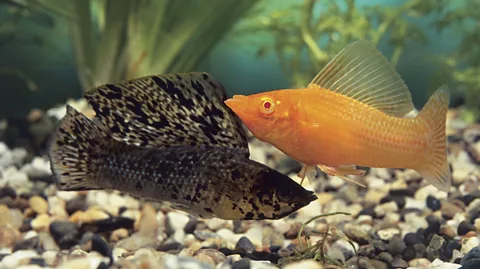
Like most asexual animals, the Amazon molly arose from a single, chance encounter. Research suggests this event occurred around 100,000 years ago when a female Atlantic molly mated with a male sailfin molly.
Unlike most hybrids, such as mules or ligers, this pairing did not result in infertile offspring. Instead, it produced a lineage capable of reproducing without sex. So now, every Amazon molly carries genetic material from two ancestral species – providing the species with high genetic variation from the outset, a biological headstart against Muller's ratchet.
This dual heritage is likely key to the molly's ability for such comprehensive gene conversion. Because her parent species are fairly closely related, their genes are similar enough to mostly perform the same functions, but different enough to offer a wide range of templates to work with.
What's equally surprising is that this copy-paste process appears to occur more often in some parts of the genome than others.
"The kinds of mutations that you expect to be the worst, the most dangerous, the most deleterious, those are the exact places in the genome where we see gene conversion happening the most often," says Ricemeyer. The result is a species that appears to be in remarkably good genetic health despite 100,000 years without sex.
The implications of this finding reach beyond the Amazon molly. Understanding these alternative strategies for dealing with genetic "mistakes" could have wider implications for human biology. Harmful mutations, after all, are not unique to asexual species.
"Cancer is a disease of mutations," says Ricemeyer. Though he is careful not to overstate the implications of their findings, he says that anything that can further our understanding of genetic mutation – and nature's strategies for dealing with them – will be helpful in the long run.
As for other long-lived all-female species, Ricemeyer believes that gene conversion is "very likely part of the story in other asexually reproducing organisms as well".
Whether the Amazon molly has developed a truly stable alternative to the reshuffling power of sex remains an open question. Scientists still don't know how long gene conversion can keep Muller's ratchet at bay.
But for a fish that evolutionary theory once suggested should not exist, the picture of her genetic health is unexpectedly strong.
"We thought sexual reproduction was the only proper way to keep a genome healthy… But now we found out that no, there's another way too," says Ricemeyer. "There's a different route to the same result."
--
For essential climate news and hopeful developments to your inbox, sign up to the Future Earth newsletter, while The Essential List delivers a handpicked selection of features and insights twice a week.
