'A glorious shambles': The Bruce Willis flop that became a cult hit

 Alamy
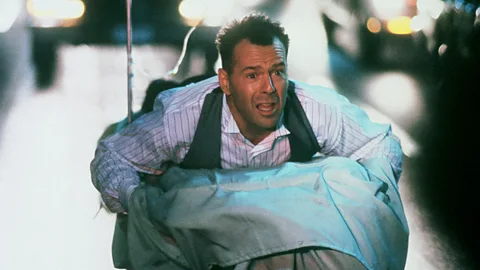
AlamyWhen Hudson Hawk was released 35 years ago, it was "savaged" by critics and was "notorious for its behind-the-scenes chaos". How did it build such an enthusiastic following?
It all started so innocently. In 1980, when Bruce Willis was a bartender and jobbing actor in New York, he made friends with a musician, Robert Kraft. One day Kraft played his buddy a song he was working on about a thief named Hudson Hawk, and Willis liked it so much that he exclaimed, "This is a movie – and we're gonna make this movie!"
It's the kind of thing that thousands of would-be stars have said to their friends, but in this case, the would-be star kept his word. In May 1991, 35 years ago, Hudson Hawk flew into cinemas.
What Willis didn't predict was that his crime caper would become notorious for its catastrophic behind-the-scenes chaos, or that most reviewers – and some of the cast – would declare that the Hawk was a turkey. On the other hand, he also didn't predict that Hudson Hawk would eventually become a cult favourite, with diehard fans of the Die Hard star's passion project calling it a misunderstood classic.
"I love it," says David Hughes, who has just written a book on the subject, The Unmaking of Hudson Hawk. "It definitely laid an egg at the box office – marketing fumbled it and critics savaged it – but it's no turkey. It's funny! And if you don't like one joke, or one over-the-top performance, there'll be another along in a few seconds."
Nick de Semlyen's book on Hollywood action stars, The Last Action Heroes, features Willis among its "kings of carnage", but he isn't quite as enthusiastic. "Hudson Hawk is a glorious shambles," he tells the BBC. "It's the kind of action movie that could only have been made in an era where stars' every 'suggestion' [was] treated like holy writ. With Willis wanting to meld stunts, comedy and – yikes – singing, it mutated into something truly bizarre."
It didn't take long for Willis to make the leap from bartender to superstar. From 1985 to 1989, ABC detective series Moonlighting established him as a wisecracking leading man, and then Die Hard in 1988 made him a bona fide Hollywood A-lister. The producer of Die Hard and its even more lucrative sequel was Joel Silver, so when Willis asked him to produce a goofy, globe-trotting heist movie based on his and Kraft's concept, he didn't need much persuading. However, he wasn't keen on the first draft of the script, by two of the writers on the Moonlighting staff, so he called in Steven de Souza, the co-writer of the first two Die Hards.
 Getty Images
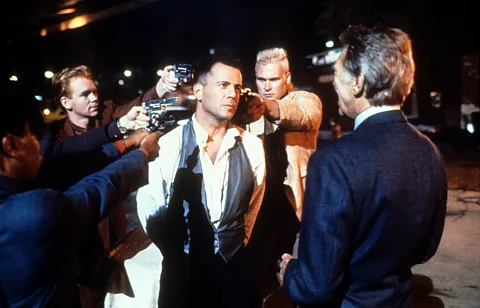
De Souza wrote "a very fine, very fun caper that formed the basis of the film we saw", says Hughes. To summarise – if it's possible to summarise Hudson Hawk – Willis's title character is a cappuccino-loving cat burglar who is forced to steal various knick-knacks designed by Leonardo da Vinci. When slotted together, these knick-knacks will complete Leonardo's greatest invention: a machine that can turn lead into gold.
'Spinning out of control'
So far, so reasonable. Michael Lehmann was hired to direct, having just made the acclaimed high-school black comedy Heathers. And when De Souza had to move onto another project, Heathers' screenwriter, Daniel Waters, was brought in for the next draft.
But Waters didn't want to write an action film, he wanted to deconstruct and parody the genre. As Hughes tells the BBC: "The clash of sensibilities of the screenwriter of Die Hard and the screenwriter of Heathers – both extremely funny people, but on completely different wavelengths – is a comedy mismatch for the ages."
Waters contributed the film's most beloved set piece: the one in which Hawk and his sidekick, played by Danny Aiello, synchronise their heist manoeuvres by crooning Swinging on a Star as they work. But he was informed that certain elements of De Souza's script couldn't be changed – and that included the scenario's "endless chain of villains".
Partly, this was because Willis had cast friends of his to play them. "Everyone had a great reason why we couldn't cut anything," Waters says in The Unmaking of Hudson Hawk, "so we ended up with a movie with a parole officer, a Mafia guy, some CIAs, two crazy villains… There were no adults in the room, let's put it that way."
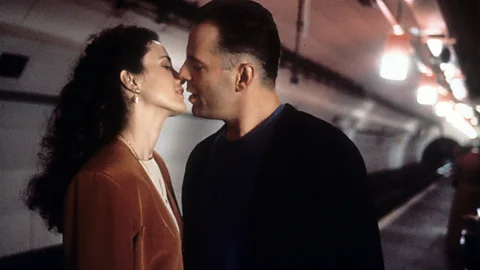
Once shooting got underway in Rome, that became clear. The lead actress, Maruschka Detmers, collapsed on set with chronic back pain, and was replaced by Andie MacDowell. The cinematographer was fired after a fight with Silver. And the phrase "too many cooks" was never more apt. Lehmann would get ready to shoot a scene, only for Willis to mosey up and instruct him to try it another way. Silver would regularly overrule Lehmann, too, leading James Coburn, who played one of the many villains, to remark, "We had three or four directors half the time".
 Getty Images
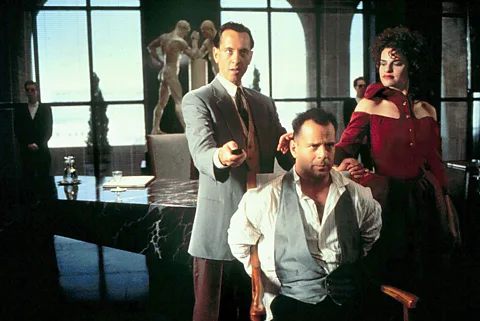
Another of the villains was played by Richard E Grant, whose volume of diaries, With Nails, paints a piercingly vivid picture of a production spinning out of control. For him, the trouble started when he arrived in Rome to find that his hotel wasn't expecting him for another week. Meanwhile, Sandra Bernhard, who was playing his wife, had been in Rome for three weeks without shooting a single scene: she had been rehearsing with a supposedly trained dog that refused to obey any of its owner's commands.
'Box-office bomb' to cult hit
The language barrier and the punishing summer heat were among the factors that led to Grant's all-caps cry for help: "THIS MOVIE IS A ONE-WAY TICKET OUT OF MY MIND!" But the main issue was that new ideas kept being flung into the mix. MacDowell doing an impression of a dolphin? Grant jumping on a table to make a speech? Aiello bringing his character back to life after his fiery death scene? Why not?
"It all feels too close to the kind of high-school-play set-up in which any insane suggestion is instantly cheered and endorsed," wrote Grant. "Except that this isn't school. And everything, including new jokes and suggestions, translates into schedule delays and big bucks burning fast."
The constant rewriting of the script meant a constant rewriting of the schedule. The budget was reported to have swollen from $40m to $60m ($94.5m or £69m today). And things dragged on for so long that Grant had to pull out of playing the Sheriff of Nottingham in Robin Hood: Prince of Thieves. (Alan Rickman got the role instead, and won a Bafta for it.)
But as more and more ideas were added, some scenes had to be cut. A climactic action sequence was due to be set in Moscow, and shot in Budapest, but that sequence was dropped, and the climax was relocated to Italy. The strange part was that the cast and crew decamped from Rome to Budapest, anyway. "This seems like the logic of a deranged baboon," wrote Grant. And that was before he learnt that a general strike in Budapest would make filming even tougher.
 Alamy
AlamyIt was, in Hughes words, "one of the messiest productions in Hollywood history". Back in the US, gossip columnists had a field day, so it was almost inevitable that, when Hudson Hawk was eventually finished, critics agreed that Willis had very much failed to turn lead into gold. "A movie this unspeakably awful can make an audience a little crazy," wrote Peter Travers in Rolling Stone. "You want to throw things, yell at the actors, beg them to stop."
Hudson Hawk's apologists argue that the reviews were responding to the gossip, rather than what was on screen. "Every year or so some big expensive movie comes out, and there's blood in the water, so it's all right for the critics to have a go at it," author and critic Kim Newman tells the BBC. He was one of the few reviewers to buck the trend. "I thought it was clever and interesting and had a lot of charm and invention. And it's better than a lot of films that were officially hits. Have you seen The Bodyguard lately? It was one of the biggest hits of that time, and it's utterly forgettable."
More like this:
Hudson Hawk certainly isn't forgettable, but as the plot staggers all over the place, and the tone lurches from gritty to tongue-in-cheek to surreally silly, it's easy to understand why it was a box-office bomb. Still, its anarchic, making-it-up-as-they-go-along spirit could be why it has now attracted a cult following.
There are countless blogs proclaiming that, in a world of cynical IP cash-ins, it's bracing to see a film that was thrown together for the hell-raising fun of it. And since Willis's retirement due to the brain disorder aphasia in 2022, affection for Hudson Hawk has only grown. "It's a pile-up of bonkersness that leaves you exhausted but impressed at its rococo vision," says De Semlyen. "Frankly, I'll take it over the latest autopilot Jason Statham actioner any day of the week."
Not everyone goes along with this reappraisal, of course. When British critic Mark Kermode told Grant that he was a fan of the film, Grant replied in his own unique fashion: "Hudson Hawk was a steaming pile of donkey droppings, and you are an idiot."
But the film is appreciated by the two people who matter the most – the two people who dreamt it up in the first place. "One of my favourite things about working on the book," says Hughes, "is that when I reached out to Robert Kraft, he'd just got back from Bruce's house in Turks and Caicos, where they'd watched two films: Dr No and Hudson Hawk. It was the first time either of them had watched it in nearly 30 years, and they both agreed, 'Hey, it's not that bad!'"
The Unmaking of Hudson Hawk by David Hughes is published by Plumeria on 11 May.
--
If you liked this story, sign up for The Essential List newsletter – a handpicked selection of features, videos and can't-miss news, delivered to your inbox twice a week.
