New Sweden: The US's long-lost 'secret' colony

 Serenity Strull / Getty Images
It was the smallest, least-populated and shortest-lived colony in the US. But despite being virtually unheard of today, it helped shape the nation's birth 250 years ago.
The 125-year-old elevator wheezed to a halt somewhere above Philadelphia's skyline. When the door creaked open, I was inside the clock tower of the US's tallest municipal building, gazing down at "The Birthplace of America" from a 500ft (152m) observation deck atop City Hall.
From my glass perch, I could make out City Tavern, where the Founding Fathers plotted the American Revolution. Just west, I spotted Carpenters' Hall, where the Colonies united against the British at the First Continental Congress. Nearby was Independence Hall, where the US Constitution was signed in 1787.
Squinting, I then followed a parade of red-white-and-blue American flags down Market Street, towards the Delaware River and New Jersey in the distance.
"So, everything I can see from up here was once part of… Sweden?" I asked our guide.
"I think so," he said, hesitantly. "Though you're the first visitor to ever ask about that."
 Alamy
AlamyAsk most Americans and they'll tell you that the United States started in Philadelphia on 4 July 1776 when the Founding Fathers signed the Declaration of Independence. Fittingly, the city is the epicentre of the US's 250th anniversary celebrations this week, and as many as 1.5 million people are expected to descend on it for what will be the nation's largest Fourth of July festival.
But chances are, almost none of those coming realises that the US's political and ideological birthplace was once part of a little-known Swedish colony known as Nya Sverige (New Sweden). In fact, very few Americans (or Swedes) have any idea that there ever even was a Swedish colony in America.
American origins
This is the second in a four-part series highlighting the many ways the US was founded as it celebrates its 250th anniversary.
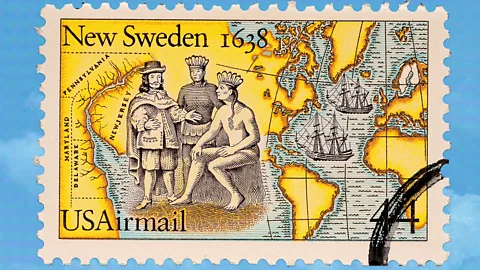
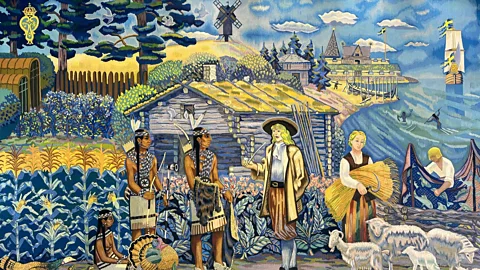
From 1638-1655, this forgotten Swedish settlement extended across the Delaware Valley, encompassing parts of modern-day New Jersey, Pennsylvania, Delaware and Maryland. In addition to being the smallest, least-populated and shortest-lived European colony in the US, it was also the most clandestine.
"It started as sort of secret colony," said Deborah-Jean Hoffman, a board member at the New Sweden Centre, which promotes the Delaware Valley's colonial history. "The Swedes weren't flag-planting like the French or the Spanish. The idea was to create an under-the-radar colony where the Dutch wouldn't see them."
 Eliot Stein
Despite lasting just 17 years, New Sweden would play a pivotal role in forging the nation's culture to come. New Swedish settlers introduced the most iconic of American frontier buildings: the log cabin. They also brought Lutheran Christianity to the New World, led one of the earliest civilian uprisings in the US colonies and left their mark on two future US cities.
And as I was discovering, there are still traces of this long-lost Swedish outpost scattered across the Delaware Valley – if you know where to look.
A covert colony built on revenge
By 1637, European powers had already carved up much of the US's Atlantic coast when Peter Minuit, the disgruntled former governor of the New Netherland colony, approached the Swedish Crown. Minuit had famously purchased the island of Manhattan for the Dutch and spent years scouting the Mid-Atlantic for a place to establish New Netherland. But after being abruptly dismissed in 1632, he sought revenge against his former employers.
"To get back at the Dutch, Minuit went to Sweden and essentially said: you are the only major power in Europe without a colony and you're missing out on the beaver and tobacco trade. I know where you can start one," Hoffman said.
 Jon Caspar
With map in hand, Minuit showed Swedish officials that in between England's claim to Virginia and New Netherland, there was a vast area unoccupied by Europeans. Minuit knew that even though the Dutch claimed the entire Delaware River, they had only actually purchased one side of it along their southern border from the Lenape. He also knew that they were far more concerned with defending New Amsterdam (modern-day Manhattan) than the Delaware Valley.
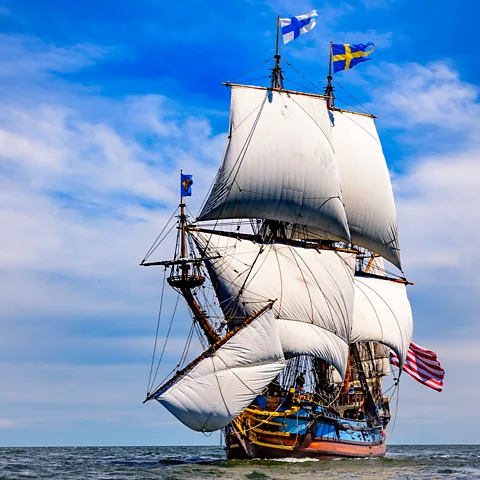
So in December 1637, Minuit led two ships out of Gothenburg with 25 would-be settlers to covertly cut in on the Dutch's trade lucrative trade monopoly with the Native nations. After four months at sea, they quietly dropped anchor along a narrow, winding tributary of the Delaware River claimed by the Dutch in present-day Wilmington, hoping its secluded location wouldn't draw too much attention.
Did you know…?
Both Wilmington and Philadelphia incorporate elements of the Swedish flag in their flags to honour their New Sweden origins.
There was only one problem: "The Dutch found out about it almost immediately," said historian and best-selling author Russell Shorto. "From the beginning, the Dutch considered [the Swedes] to be squatting in their territory, but Minuit knew the Dutch didn't have the manpower to kick them out, so he ignored them."
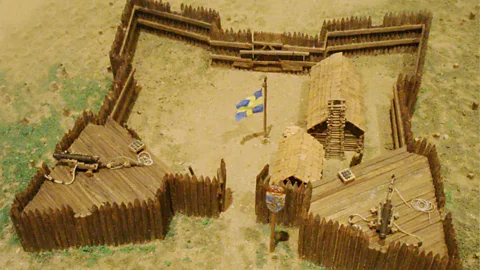
Soon after landing in March 1638, Minuit purchased a 67-mile (108-km) stretch of Delaware riverfront land from five Native American tribes, and the settlers built a stronghold that they christened Fort Christina, after the 12-year-old Queen of Sweden. It was the first permanent European settlement in the Delaware Valley, and the first permanent European structure in what would become the US's first state.
 Stilfehler / Creative Commons
Mutiny and a 'Swedish Nation'
Just five months after Minuit founded New Sweden, he drowned in a Caribbean hurricane while searching for tobacco to make his new colony profitable. Broke and hungry, the 25 settlers he left behind likely wouldn't have made it through the winter were it not for their Indigenous neighbours.
"The Swedes got a lot of help from the Native people. They knew that if you got along, you could not only trade, but survive," Hoffman said. "Unlike the Dutch and English, Swedes understood and respected the Native tribes. About 80% of the settlers were actually 'Forest Finns', because Finland was then part of Sweden, and they had a deep appreciation for living off the land."
More like this:
The colony remained little more than a fledgling, far-flung outpost until 1643, when a 7ft-tall, 400-pound (2.13cm, 181kg) mammoth of a man named Johan Printz was appointed governor. Nicknamed "Big Belly" by the Lenape, Printz had a commanding presence and set out to secure Sweden's foothold in the Americas.
During the next 10 years, Printz built two more bastions along the Delaware River (Fort Elfsborg and Fort New Gothenburg); expanded the colony from present-day Cecil County, Maryland, to Trenton, New Jersey; and established a new capital just south of Philadelphia on Tinicum Island – all while issuing strict orders to maintain peaceful relations with Indigenous tribes.
 Eliot Stein
Despite its territorial expansion, New Sweden never became the profitable venture it was conceived to become because it was chronically under-populated and neglected. The colony never counted more than about 400 people, and from 1648-1654, the Swedish Crown didn't send a single supply ship. Interest in emigrating was so low that the Swedish Empire resorted to sending petty criminals and military deserters as a form of punishment.
With the colony all but abandoned by the Swedish government, Printz ruled with an iron fist to keep his few settlers from deserting. In 1653, when one-quarter of the colony's male population signed a petition accusing Printz of abusing his powers, he declared it a "mutiny", but stepped down – marking one of the first successful political protests in US colonial history.
A vintage tree house
The oldest log cabin in the Western hemisphere was built in 1638 by New Swedish settlers. Known as the C A Nothnagle Log House, it's still a private residence and is located on Swedesboro Road in Gibbstown, New Jersey.
By 1655, New Netherlands' hot-tempered governor, Peter Stuyvesant, had had enough of the Swedish squatters and sent seven armed ships down the Delaware. The outnumbered Swedes surrendered without a shot, marking the end of Swedish sovereignty in the Americas. New Sweden was soon absorbed into New Netherland, but Stuyvesant allowed it to continue as a "Swedish Nation", and settlers were allowed to choose their own government, form their own militia and keep their land.
When William Penn arrived in 1682 after creating his namesake Pennsylvania colony for the English, he found Swedish and Finnish farmers living alongside the Lenape in Philadelphia. "That's why, on top of City Hall, directly below the statue of William Penn, there are four statues: two are Lenape and two are Swedes," Hoffman said. "Have you seen those?"
I hadn't. In fact, despite growing up near New Sweden's former territory, I had never seen or heard anything about it. So, I set out on a road trip to discover it for myself.
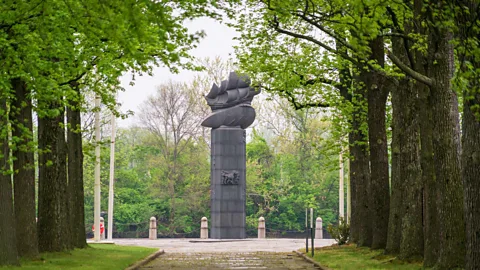 Alamy
AlamyNew Sweden today
"The first three log cabins in America were built right here," said Herb Conner, the lead interpreter at Fort Christina Park in Wilmington, Delaware, where the Swedes' first fortress once stood.
As we walked under a tree-lined path towards the Swedes' original landing spot, known as "The Rocks", Conner said that even as a kid growing up in Wilmington, he had also never learned about the area's Swedish history in school. Later, he discovered that New Sweden was the only European colony in the US that never went to war against the Native people.
"One of the most important lessons [New Sweden] left us is the importance of living peacefully with your neighbour," he said. "We could stand to learn a lot from them today."
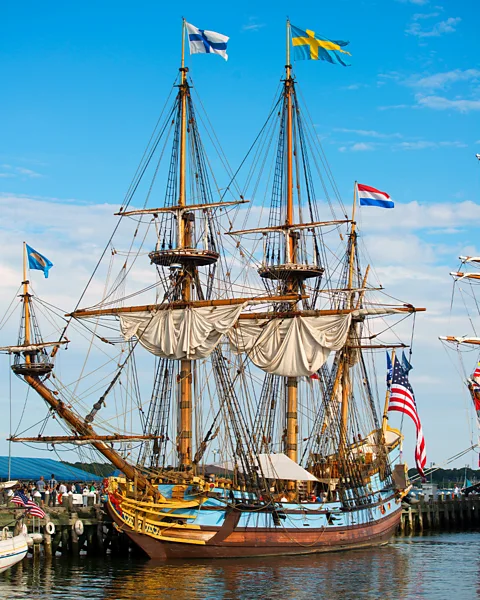
A short walk from the park, a 141ft (43m) replica of that 17th-Century ship, called the Kalmar Nyckel, now bobs on the river and offers narrated cruises. The three-masted merchant vessel is sometimes called the "Swedish Mayflower", but as we plied through Wilmington's newly revamped Riverfront neighbourhood, Captain Lauren Morgens explained why that nickname isn't really apt.
 Getty Images
"The Mayflower barely made it across the Atlantic once," she said. "The Kalmar Nyckel made four round-trip crossings with Swedish and Finnish settlers." During the 90-minute trip, you can help hoist the sails, peer into the captain's quarters and see the cramped spaces where the would-be settlers slept. Visitors also get a crash-course in New Swedish history.
Learn more
From Swedesboro, New Jersey to Swedesburg, Pennsylvania, echoes of New Sweden live on. Here's where else travellers can see glimpses of it:
• The New Sweden Centre – based in Wilmington, but offers free, guided appointments to sites associated with New Sweden across the Delaware Valley
• Gloria Dei (Old Swedes') Church – the oldest-surviving brick building in Philadelphia and the oldest church in Pennsylvania
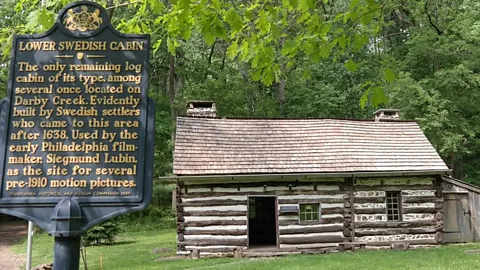
• Lower Swedish Cabin – a 1640s log cabin in Drexel Hill, Pennsylvania open from April to October
• Trinity "Old Swedes" Church – in Swedesboro, this is the first Swedish church in New Jersey and is home to a 17th-Century Swedish cabin
Back on land, I explored three storeys of that history at the adjacent Copeland Maritime Center and Museum. Stepping inside a reconstructed log cabin, I learned that it was actually the "Forest Finns" who introduced this most quintessential of "American" buildings later adopted by so many pioneer families – including future US President Abraham Lincoln.
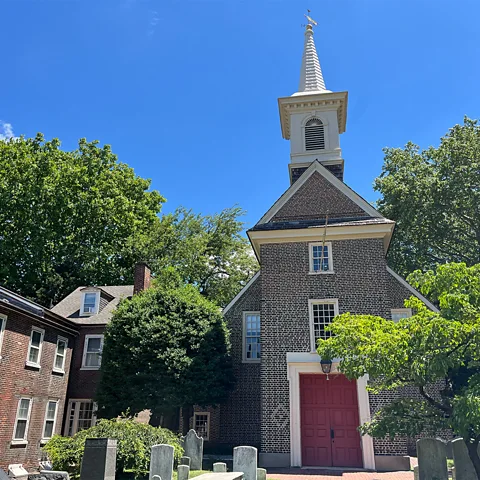
After a short drive down Swedes Landing Road in Wilmington, I arrived at the aptly named Old Swedes' Church. Built in 1698, it holds the distinction of being both the first Lutheran church in the New World and the oldest church in the US still used for worship in its original state. As we strolled through a cemetery towards the colonial-brick structure, the church's director of communications, Betsy Christopher, directed my attention below.
"This burial ground dates to 1638 and is where many of the original Swedish and Finnish settlers from Fort Christina are buried," she said. Christopher explained that nearly 400 years later, many of the area's Swedish descendants still pack the pews each December for the church's candlelit Sankta Lucia Christmastime celebration.
 Eliot Stein
Just 30 miles (48km) separate Wilmington and Philadelphia. As I headed north along I-95, I spotted signs for Governor Printz Park in Tinicum Township, where Fort New Gothenburg and New Sweden's last capital once stood. Today, a reconstructed Swedish farmstead, the foundations of Printz's royal residence and a life-size statue of "Big Belly" himself are scattered along the seven-acre waterfront. But heeding Hoffman's advice, I had an appointment atop City Hall that I couldn't miss, so I kept moving.
Like the relics of New Sweden itself, the two bronze-cast Swedes standing atop Philadelphia are easy to miss unless you know where to look. But there they are on the tower's southern side, gazing back towards the river that brought them here, and watching over the city that grew from their farms.
"You know, it was a descendent of New Sweden [John Morton] who cast the deciding vote here in Pennsylvania to support the Declaration of Independence and separate from Britain," said Tracey Beck, the executive director, as she led me through the American Swedish Historical Museum in Philadelphia the following day.
The sweeping, 12-gallery mansion in South Philadelphia's FDR Park chronicles the nearly 400-year history of Swedish and Finnish influence in the US – starting with the surrounding area's first settlers. And while it's designed to educate Americans about their little-known colony, it often proves to be just as revelatory for Swedes.
 Eliot Stein
"This is a lost part of our history," said Allan Elfström, a Swedish immigrant to the area, while eyeing a timeline of New Sweden. "When I tell many of my [Swedish] colleagues about all of this, they're baffled."
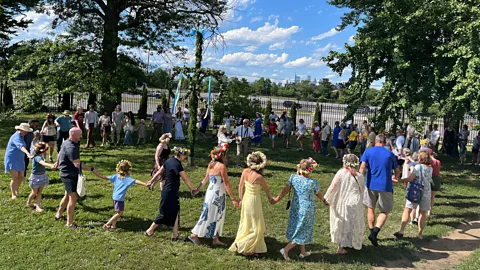
After exploring the museum's halls, I followed some 300 people clad in flower crowns, flowy dresses and traditional folkdräkter costumes outside for the museum's annual Midsommarfest. As the Carlsberg beer flowed and I tucked into smörgåstårta sandwich cakes and lingonberry sherbert, I soon found myself following a fiddler towards a towering maypole topped with Swedish flags.
"This is like our Fourth of July," said the Swedish woman next to me, reaching for my hand. As we spun around in a giant circle, singing Swedish songs under a Nordic cross, I looked up at the Philadelphia skyline in the distance, and thought about something Beck had told me earlier.
"It's so interesting to wonder what-if. There was this whole other European colony we were never taught about that once lived here. How would this country have been different if it had survived?"
--
If you liked this story, sign up for The Essential List newsletter – a handpicked selection of features, videos and can't-miss news, delivered to your inbox twice a week.
