The world's largest mammal migration that few travellers ever see

 Chris Meyer
Every year, millions of straw-coloured fruit bats descend on Zambia's little-known Kasanka National Park, creating one of Africa's most extraordinary wildlife spectacles.
There's a storm on the horizon. Lightning flickers, illuminating the Central Zambezian miombo woodlands with brief flashes of silver. The sun is setting, the air smells of damp earth and somewhere ahead of us, millions of bats are waking up.
We park our vehicle in front of the Musola Hide, Kasanka National Park's prime bat observation point. The 10m (33ft) climb up to the wooden platform feels precarious, the ladder swaying slightly beneath my feet. Across the canopy, the sky glows orange and purple behind the distant thunderclouds. The forest beneath us begins to tremble.
Legions of straw-coloured fruit bats (Eidolon helvum) hang in the trees, packed together so tightly some seem to cling to one another rather than to the actual branches, which sag under their collective weight. The air fills with chatter, whistles and shrieks. And then the bats begin to fly.
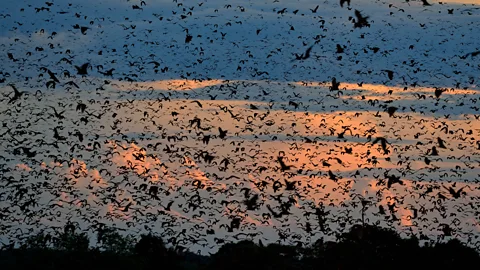
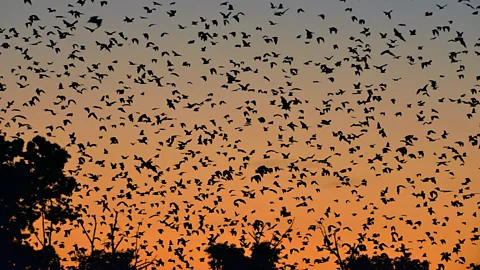
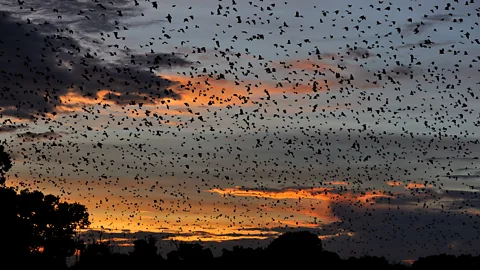
At first, it's only a few, then, one by one, others take flight. Soon, the sky is a vortex of movement. Bats stream out of the forest in every direction, swirling and tumbling like smoke in an updraft. From our perch above the canopy, we see bats pour endlessly from the forest against the glowing evening sky. The air vibrates with the beating of millions of wings.
 Wim Werrelman
Night fliers
This is the Kasanka Bat Migration, the largest mammal migration on Earth. Each year, drawn from across Central Africa by a seasonal explosion of fruit, an estimated eight to 10 million straw-coloured fruit bats (Eidolon helvum) gather right here in the park. That's eight times as many mammals on the move as the Serengeti Great Migration.
The nightly spectacle takes place from late October to December. By the end of January, they'll be gone. Somewhere between 500,000 and 700,000 people visit the Serengeti-Maasai Mara migrations annually, but only around 800 will witness the bats while they're here in Kasanka.
Often overshadowed by Africa's larger, more famous protected reserves, Kasanka is one of Zambia's smallest national parks at just around 390 sqkm, and is tucked away in the country's central province, near the border with the Democratic Republic of Congo. There are no vast open plains here, no huge prides of lions, but also no endless convoys of safari vehicles with their camera-clicking crowds. Instead, Kasanka is feels startingly quiet, home to wetlands and lagoons, papyrus swamps and forests, wonderful bird species and just a sprinkling of traditional safari wildlife. Most visitors who make the journey come for the bats.
Researchers have discovered the small mammals disperse across enormous distances. Some travel up to 96km (60 miles) in a single night, consuming their own body weight in fruit before returning at dawn. Former Kasanka chief ecologist Frank Willems says the bats burn extraordinary amounts of calories on their night flights. A straw-coloured fruit bat weighs about 250g and can consume roughly its own body weight in fruit each night. Willems calculates that eight to 10 million bats will put away around 230-250 tonnes of fruit in a single night.
 Harry Vlachos
The sheer scale of consumption is hard to comprehend. An estimated 330,000 tonnes of fruit are consumed by the bats while they are at Kasanka, mostly wild loquat, milkwood and waterberries. As they feed, they disperse seeds across huge swathes of land. "Eidolon helvum disperse seeds both locally and over long distances," says Helen Taylor-Boyd, a Zambian bat ecologist and board member of Kasanka Trust. "In fact, they're capable of dispersing seeds further than many vertebrates studied, including elephants."
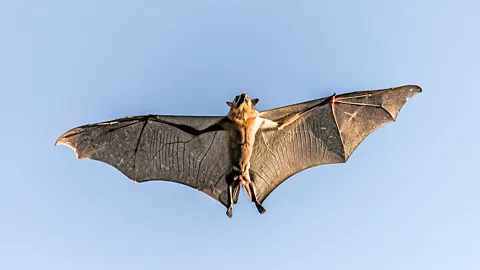
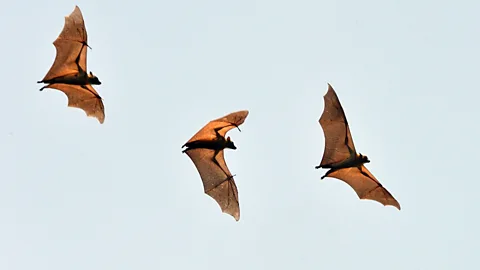
With a wingspan of up to a metre and a body length of 30cm, the straw-coloured fruit bat is an extraordinary long-distance flier. In 2005, biologist Heidi Richter fitted four bats with solar-powered transmitters. Satellite tracking revealed that each bat travelled more than 997km (619 miles). One, aptly named Hercules, flew more than 2,400km (1,419 miles).
 Chris Meyer
Researchers still don't know precisely where the bats come from, or where they to when they leave Kasanka. "Only a handful of tracking studies have been carried out, and on a relatively small sample size," Taylor-Boyd explains. "We're only just beginning to understand the migration routes."
That mystery is part of the park's appeal. As we climb down from Musola Hide, the last of the bats vanish into the darkness.
Plan Your Trip:
How to get there: Roughly 500km north of Lusaka, Kasanka National Park is best reached by self-drive (8-10 hours) or by private charter flight, for those short on time.
How to do it: Guided trips to the bat and sitatunga hides, along with walking trails and canoeing can all be arranged through the park.
Where to stay: Most visitors stay at Wasa Lodge, a fully catered lakeside lodge run by the Kasanka Trust. Alternatively, camp sites, such as Pontoon Camp, are all self-catering.
What to pack: Bring binoculars, a torch and warm clothes as pre-dawn and evening bat viewing can get chilly.
Tracking fruit bats
Back at Wasa Lodge, where we are spending the night, a hippo grumbles out on the lake and frogs chorus in the reeds.
The scenery wasn't always this peaceful. By the late 1980s, poaching had emptied much of the park and it was at risk of losing its national park status. In 1990, David Lloyd, a former British colonial officer, took over its management, using his own money to build roads, bridges and seasonal camps. Since then, populations of puku, bushbuck and sable antelope have recovered, and even elephants have returned. In the morning, we'll be off to look for another of Kasanka's signature species, the secretive sitatunga.
 Chris Meyer
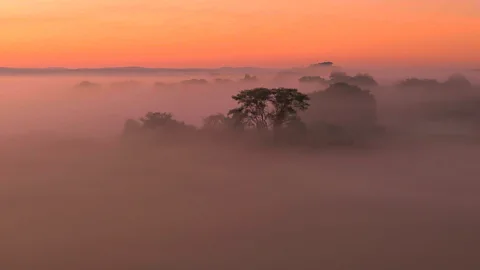
The next morning, coffee rouses us just after 05:00. Half an hour later we're driving 10km (6.2 miles) from the lodge to Vivienne's Hide, a wooden platform raised above a maze of reeds and papyrus. When we arrive, the swamp is almost invisible. A thick mist hovers low over the floodplain as the sky changes gradually from charcoal grey to pale pink. Tall reeds line the shallow channels of water, and somewhere inside them comes the soft rustle of movement.
Then a sitatunga emerges: a female stepping cautiously from the papyrus. Another follows, then a calf and finally a dark-coated male with elegant spiralled horns. Kasanka is one of the best places in Africa to see the shy sitatunga, the continent's only truly amphibious antelope. The park holds an estimated 500 to 1,000 of them. We spend an hour watching them graze before they slip silently back into the reeds.
Kasanka's wildlife often feels like this, fleeting and elusive. Elsewhere in the park are elephants, crocodiles, bushpigs, civets, puku, rare blue monkeys and hippos wallowing in the lagoon at Wasa Lodge, though numbers are not high. The birdlife is extraordinary – more than 450 species have been recorded here, making Kasanka one of Zambia's premier birding destinations.
We spend the rest of the day driving through the park and canoeing in the river. But by 05:30 the next morning, we're back at the bat forest.
 Chris Meyer
This time it's like watching everything in reverse. A golden stripe of sunlight appears on the horizon like an invisible signal, and the bats begin pouring back towards the roost. They arrive shrieking and colliding, spiralling downwards before crash-landing clumsily into the trees. Landing, it turns out, is not their greatest strength. Some successfully grab branches, while others collide into clusters of other roosting bats. The noise inside the colony is deafening.
As the bats settle back into the trees, the forest seems to sag once more under their collective weight, with the odd crack of a breaking branch. Eventually, the activity slows. The bats wrap themselves tightly in their wings, protection from the growing heat of the day. The chatter fades, and gradually the colony appears to sleep. In less than 12 hours the spectacle will start all over again.
More like this:
For scientists, the unanswered questions surrounding the bats remain irresistible. For conservationists, their ecological importance is immense. But for travellers lucky enough to witness the migration first-hand, the experience is something like standing inside a living storm.
Kasanka may never rival Kruger, the Serengeti or the Okavango in safari fame. There are no luxury lodges here, no traffic jams around leopard sightings, no guarantee of postcard-perfect wildlife moments.
What it does offer is a storm rolling across the woodland at dusk, a hippo grunting in the lagoon before dawn, mist lifting from papyrus swamps as a sitatunga appears and, when the timing is just right, millions upon millions of fruit bats pouring into the African sky, so dense that, for a few extraordinary moments, the sky itself seems to disappear.
--
If you liked this story, sign up for The Essential List newsletter – a handpicked selection of features, videos and can't-miss news, delivered to your inbox twice a week.
