Russia labels Pussy Riot members foreign agents

 Getty Images
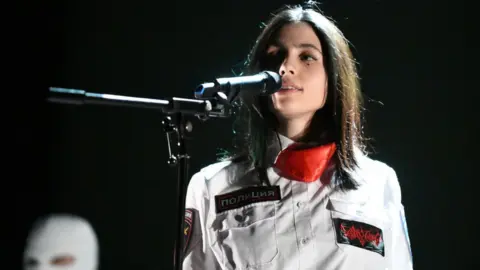
Two members of pop-punk activist group Pussy Riot have been listed as "foreign agents" by the Russian government, along with journalists and other prominent figures.
An updated list was published by the Russian justice ministry.
Pussy Riot said they would appeal in court and not comply with rules about labelling social media posts.
The term "foreign agent" carries a Soviet-era negative taint in Russia, suggesting spying.
The foreign agent law was passed in 2012 to signpost foreign-funded non-profits but was expanded to include independent media and individuals.
"These people systematically distribute materials to an indeterminate circle of persons, while receiving foreign funds," the justice ministry said in a statement.
Any individual labelled a foreign media agent has to register and provide details of activities and finances every six months. All their material, including social media messages, have to contain a long message indicating their status as a foreign agent.
Allow X content?

Formed in 2011, Pussy Riot, a feminist collective group, agitate against President Vladimir Putin and the Russian state through music and activism.
The members designated as foreign agents include Nadezhda Tolokonnikova, 32, who was jailed over a 2012 protest performance in a Moscow cathedral.
Journalists, a popular satirist and an art curator were among the others added in the Thursday update.
Andrei Zakharov, a journalist for BBC Russian, was among those previously added to the list in October.
Memorial, a prominent rights group also branded a foreign agent, was ordered to shut down earlier this week for failing to mark content with its official status.
The court ruling has been condemned abroad, including by rights group Amnesty International and the US state department.
