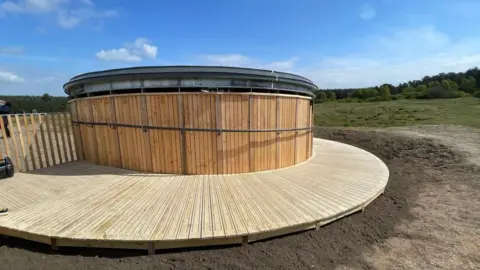
New entrance to Thetford underground labyrinth of tunnels

 Shaun Whitmore/BBC
A new entrance to a prehistoric flint mine will allow the public to explore an underground labyrinth of tunnels dug 4,500 years ago.
Grime's Graves near Thetford, Norfolk, was used as a Neolithic mine for hundreds of years.
In about 2500BC, miners began carving out the tunnels using tools made from deer antlers to mine the flint for use in everyday items and tools.
It has been described as "an absolute jewel" of a site.
Alongside the new entrance, English Heritage has created an exhibition space to display previously unseen flint tools including an axe, a sickle and a circular knife.
The site is made up of 430 mine shafts, some up to 13m (about 40ft) deep.
 Shaun Whitmore/BBC
Anglo-Saxons first named the site Grim's Graves, believing it was the burial place of the god of war Grim, also known as Woden.
It was later renamed Grime's Graves.
 Shaun Whitmore/BBC
Robin Sullivan, community engagement officer at Grime's Graves, said: "This is an incredibly rare site and it's the only one open to the public.
"It's a space like no other. It takes you out of your everyday. It's somewhere you can run around and explore. It's an incredibly rich site."
He said it was "an absolute jewel" where visitors could see marks and tools left behind 4,000 years ago.
"You can see the people crawling [and] picture them with their lamps and holding their pickaxes. taking out this chalk and flint," he said.
 Shaun Whitmore/BBC
 Shaun Whitmore/BBC
The new entrance over one of the mine shafts allows visitors to descend 9m (about 30ft) below ground into one of the original pits.
The mine was uncovered between 1868 and 1870 and most of the pits remain untouched.
English Heritage said geological surveys suggested the mine may cover a much greater area.
 Shaun Whitemore/BBC
Dickon Whitewood, English Heritage's curator of collections and interiors in the east of England, said the site above ground was like a "lunar landscape" as it was covered in grassy mounds.
Mr Whitewood marvelled at the tools and time it took Neolithic miners to create the "honeycomb of galleries".
"The main mining tool was from deer. They're very simple tools and they would have to mine down by hand," he said.
"To get this minefield we're talking about hundreds of years of people coming to the site for flint."

Got a story? Email eastofenglandnews@bbc.co.uk or WhatsApp 0800 169 1830
