How prepared is the West for hotter summers?

 PA Media
Record temperatures, school closures and pressure on hospitals during June's heatwave have raised questions about whether the West of England is prepared for hotter summers.
Somerset recorded its hottest June day on record when temperatures reached 36.7C in Merryfield, while the Met Office issued a red warning for extreme heat.
The heatwave also brought tropical nights, with temperatures remaining above 20C overnight, making conditions feel even more uncomfortable.
Flights at Bristol Airport were disrupted and businesses closed early as the region coped with the extreme weather.
Scientists say climate change is making heatwaves more common across the UK and warn that hotter summers could become the norm.
But how can our services and infrastructure cope and how prepared are we for more heatwaves?
Why are UK heatwaves getting hotter?
"We expect increasing temperatures and the breaking of temperature records due to climate change," said Lizzie Kendon, professor of climate science at the University of Bristol and head of climate projections at the UK Met Office.
"What is so extraordinary, however, is the margin by which the record will be broken."
While temperatures vary naturally from year to year, UK summers have been getting warmer.
Between 2015 and 2024, the number of days exceeding 30C in the UK more than trebled compared with the 1961-1990 average, according to the Met Office.
"Heatwaves are becoming more common," said Will Lang, chief meteorologist at the Met Office.
He said we are also seeing "more extreme heat, so that's temperatures of 35C or more and that starts to become a real problem for our health, our daily routines and for our infrastructure."
"It's down to climate change" and the extreme heat is a "trend that is going to continue, unfortunately," added Lang.
The atmosphere is warmer in general and that gives a "higher baseline from which to start having our heat waves in summer" which means we can "very rapidly see extreme temperatures we wouldn't have seen before in a pre-industrial climate".
How is extreme heat affecting hospitals and schools?
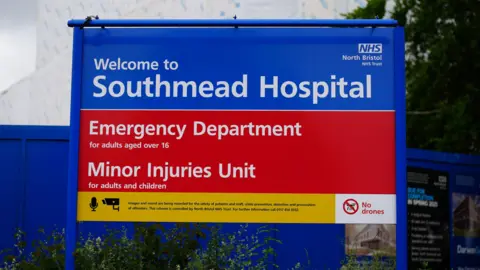
Southmead Hospital saw some of the highest admissions levels in years during the heatwave in June.
Dr Samir Patel, medical director at the Bristol hospital, said they are having to adapt their hot weather plans due to the increased temperature levels.
Current plans include allowing staff to work from home, converting outpatient appointments to telephone consultations and having flexibility for staff to take unplanned leave while their children were off school.
"We have to accept that the world around us is changing, and we have to change with that," Dr Patel said.
 PA Media
The impact was also felt in schools across the region.
Teaching unions NAHT and NASUWT have issued renewed calls for school buildings to be modernised and for a legally enforceable maximum classroom temperature.
Mike Welsh, executive head teacher at Goddard Park Community Primary School and Daycare Centre in Swindon, which was closed said "very tight budgets" over the past 20 years meant there was "little money" to invest in air conditioning.
"We're going to have to have national investment across the education sector in order to get air conditioning in," he added.
Claire Savory, CEO of The GLA Trust, which runs 11 primary schools across Gloucestershire, said it was "unprecedented times" for schools.
She said some children were sitting in their lessons with their feet in drawers that have been filled with water, to keep them cool.
Nearly 200 schools closed in Somerset during the heatwave.
Morwenna Dunstan, headteacher at St Mary's Primary School in Bridgwater, said: "Even with fans and even with ventilation, the buildings are just not fit for the weather we're getting at the moment."
Founder of Bristol's Oasis Academy Trust Steve Chalke, who runs 56 schools across the country, including 10 in Bristol, said despite having air con in some of the schools they still had to close sites due to staff not being able to work, as their own children's schools were closed.
Chalke said that schools, unions and the government need to join up to make short, medium and long-term plans to manage the disruption.
"In the future, we're going to see more and more of this," he said.
"This is a societal issue, and we kick the ball of climate change down the road time after time. It's now knocking at our doors.
"If we're going to successfully navigate the future for our children in school, we have to think about a more resilient pathway that deals with peaks and troughs in temperature."
How are roads and transport adapting to climate change?
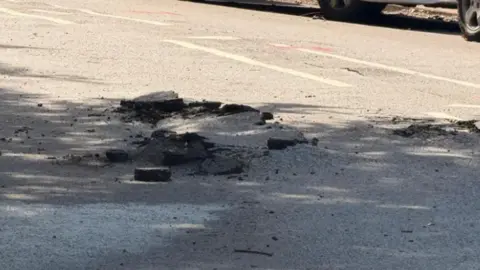
June's heat and the storms that followed caused damage in places, including cracked road surfaces and damaged manhole covers in Bath.
National Highways is trialling lower-carbon and more durable materials as part of resurfacing work across the M5 Huntworth Viaduct near Bridgwater, Somerset.
It said: "A highly modified binder will be used in the road surface to improve resistance and durability, making CO2 savings by reducing the need for future interventions."
The project will be carried out in phases, starting with overnight southbound closures between junctions 24 (Bridgwater) and 25 (Taunton), including the junction 24 entry slip road until 15 July.
Steve Aldridge, National Highways project manager, said: "We're changing the way we work to decarbonise construction on our roads, a crucial challenge of helping the UK to thrive as a low carbon economy."
Changes are happening very quickly for the railways too.
Chris Fuoco, programme director at Network Rail, explained that in 2022, they were managing rail temperature on the assumption they would get no hotter than 50C.
Just four years later, they're now working at an average of 57C.
"In some cases, we're painting rails white, and growing trees nearby to provide shade.
"Quite bizarrely, we can be in November and December, and we're undertaking summer preparation works - the reality is there's so much to do.
"But our infrastructure really is in a better position now than it's ever been in managing the hot temperatures," he added.
Efforts to reduce emissions are also gathering pace.
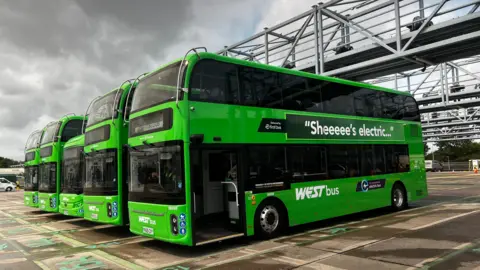
A fleet of 98 electric buses was introduced across the West of England in June 2025 following a £59m investment in depots in Bristol and Weston-super-Mare.
The West of England Combined Authority (Weca) estimates each electric bus will save an average of 75 tonnes of carbon a year, equivalent to taking 54 cars off the road.
The whole fleet will reduce global warming gas emissions by the same amount as 14,000 cars produce, it added.
Does this mean our winters will get warmer too?
The West is expected to experience milder winters as well as hotter summers, according to Lang.
"Unfortunately, that means that they're getting wetter too, which tends to mean a higher flood risk," he added.
But a warmer winter does not mean we can rule out cold weather entirely and we should expect some cold spells and even some snow in any given winter.
 Hayley Thompson
How can the West prepare for future heatwaves?
Lang said people need to recognise that extreme heat can affect not only vulnerable residents but also infrastructure and everyday life.
"We do need to be able to recognise that and become adapted," he added.
The Department for Energy Scrutiny and Net Zero said it is "taking action" by investing in "clean power" and ensuring new residential buildings are "designed to minimise unwanted heat from the sun".
A service has also been launched which provides local authorities with "easy access to tailored information to support adaptation planning," added a government spokesperson.
Follow BBC Somerset on Facebook and X. Send your story ideas to us on email or via WhatsApp on 0800 313 4630.
