'Groundwater scheme being used more than ever'

 BBC
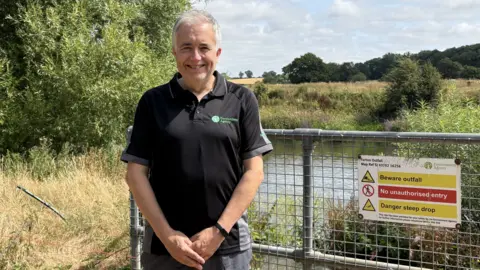
BBCA scheme to maintain the level of the River Severn throughout long spells of hot weather is being used more than ever, the Environment Agency (EA) has said.
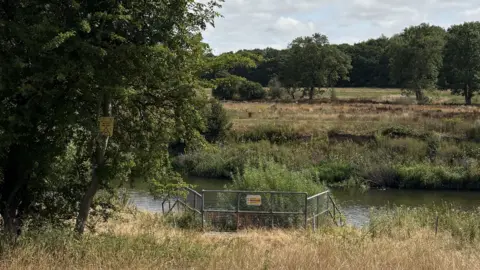
The Shropshire Groundwater Scheme, which uses groundwater stored naturally within the sandstone aquifer beneath north Shropshire and transfers it through a 53km network of underground pipelines, is releasing about 200 million litres of water a day.
It comes as the National Drought Group said the West Midlands was among the English regions on the brink of drought.
"The scheme used to operate one year in four," said Matt Lawrence, EA environment programme manager. "We're now seeing that we're using it every year or multiple tines every year."
"The climate, that demand for water is increasing, and things like this are essential to maintain flows."
At full capacity, the scheme, which is near Shrewsbury, can release up to 240 million litres of water a day, equivalent to about 96 Olympic-sized swimming pools.
"There's a couple of reservoirs in Wales that are also putting water in," said Lawrence.
He said the agency was not concerned about groundwater supply.
"The levels of the groundwater is over a much longer period of time, so they fill up over wet winters."
"That is something that we'll have to continue to monitor."
Only 13% of rivers across the country are classed at normal levels for this time of year.
This, Lawrence said, was creating a "really serious" situation for wildlife in the water.
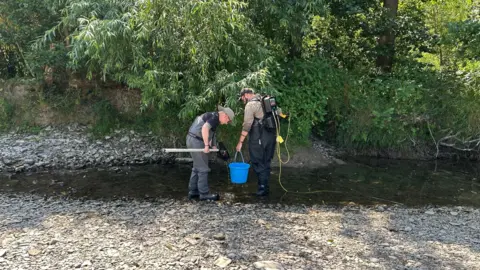
"We've seen fish rescues in south Shropshire on the River Teme, where parts of the river have dried up.
"We've had staff out there rescuing fish and transporting them to the sections of river with water in."
 Environment Agency
Lawrence added: "There's a balance between the needs of people.
"Six million people rely on the River Severn for drinking water, and the landowners, the farmers, and the growers rely on that to keep the crops watered.
"But that can't come at the cost of nature - the Severn holds some nationally, internationally important species that need protecting also."
Although water provider Severn Trent has not imposed a hosepipe ban, the company earlier this month recorded its highest level of demand on record and called on customers to reduce how much water they used.
"It's really important that everyone plays their part in managing water more wisely," said Lawrence.
"We'll be working with farmers if the situation gets worse."
Climate change in the Midlands
Analysis by David Gregory-Kumar, BBC West Midlands environment correspondent
Earlier this month, the Met Office published its annual State of the Climate report, looking back at 2025.
The report draws on trends, variations and extremes based on observations from weather stations, and is placed in context using long-running measurements like the Central England Temperature record.
This important data set goes back to the 17th century and is the longest instrumental temperature record in the world.
It was recorded monthly from 1659, and a daily version has been produced since 1772.
Currently, measurements are taken at Pershore in Worcestershire, as well as in Lancashire and Hertfordshire, and they show 2025 was the warmest year recorded in the 364-year history of this series.
In particular, the Midlands experienced a temperature anomaly, where the climate was a whole degree warmer than we saw on average between 1991-2020.
Looking at the Mean Maximum Temperature map in the spring, they have actually had to create an entirely new indicator to show just how hot it has been.
Different colours are placed over different parts of the country to signify the increases in temperature.
White means small increases, and the scale moves up through light red, red and very dark red.
Now, they have had to slot in purple as an extra colour beyond red - which is what you will see over the Midlands.
That is the effect of climate change in the region in a nutshell.
What was once unthinkable is now something we see - the uncommon has become increasingly normal.
From temperatures, to storms, to rainfall - you can be sure climate change will drive us towards breaking another record very soon.
Follow BBC Shropshire on BBC Sounds, Facebook, X and Instagram.
