Is this the secret to stop bananas going brown?

 Phil Coomes/BBC
Scientists have created a new variety of banana which resists browning for up to 24 hours after it has been cut.
Based at the Norwich Research Park Innovation Centre, Tropic has been using gene-editing techniques to disable enzymes in bananas - likened to "turning a light switch off" - so they stay fresh and yellow for longer and can be used in more dishes.
Georgie Oatley, Tropic's communications manager, said the technique could help the fruit be more resistant to disease and reduce waste along the supply chain.
But how is this technique different to genetic modification and are the bananas safe to eat?
Do we need to stop bananas turning brown?
 Tropic
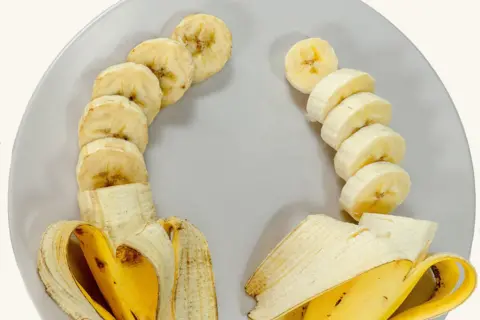
The gene-edited bananas stay fresh and yellow for longer without them turning brown and slimy once you've peeled or cut them.
By staying fresh for longer, Oatley said they could be enjoyed in banoffee pies, fruit salads, smoothies, cakes and pastries.
She said: "We are also developing new varieties that have resistance to disease, have a higher yield and are able to withstand the changing climate.
"A huge number of bananas are wasted throughout the supply chain and also at home once people have bought them and they have gone brown and aren't eaten.
"We are able to reduce waste at a farmer level, throughout the supply chain, in the supermarket and at home so it's better for carbon emissions and better for consumers and farmers."
If bananas are staying fresh for longer, is this the end of banana bread?
She said: "It might not be the end of banana bread but it's certainly a new beginning for lots of your other favourite dishes: banoffee pie, fruit salads, breakfast bowls — you name it."
How do you stop a banana turning brown?

The company uses gene editing to edit the DNA of the bananas to disable polyphenol oxidase, which is the enzyme that causes them to turn brown.
Polyphenol oxidase is found in plants, fungi, bacteria and animals.
In plants, it plays an important role in the ripening process and once it reacts with oxygen it can cause brown spots and when fruit, like a banana is cut, it makes it slowly start to turn brown.
Oatley added: "For our non-browning banana we have identified which enzyme is responsible for the oxidisation process and we have just disabled it so it no longer happens. It is still there, it's just turned off. It's like a light switch we have just turned off.
"It's something that's happened in nature for thousands of years but we are able to do it in a lab setting... we are able to fast forward that evolution."
By using gene editing the non-brown bananas stay fresh for a number of days if kept in a container in the fridge, and can last for up to 24 hours if left out on a countertop.
How is gene-editing different from genetic modification?
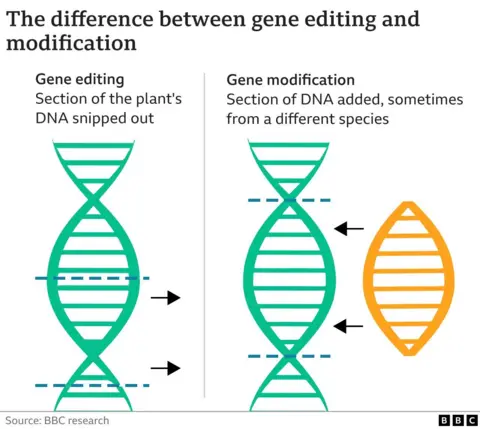
When Tropic scientists change the DNA of the banana, it is only making genetic changes to the fruit and no foreign DNA is added.
Gene editing is a newer technique which lets scientists target specific genes where they can turn on or off parts of the DNA.
The Precision Breeding Act which was introduced in England in May last year, means scientists and farmers can now make and sell fruits and vegetables which have used this technique as long as it could have happened naturally or through traditional farming methods.
Whereas genetic modification involves adding genes to a plant's DNA from a different species of plant or animal and creates new varieties.
"Genetic modification is bringing in an attribute from one plant to another, so taking something from an orange and putting it into an apple - that is very different to what we are doing," Oatley told BBC Look East.
Are they safe to eat?
 Barnaby Perkins/BBC
While there are concerns about how safe gene-edited and genetically modified food is to eat, Oatley claimed it was "very safe" and already been approved in 11 countries.
However, the company's non-browning banana has not yet had approval to be sold in supermarkets across the UK.
She added: "We are able to grow our bananas now in Brazil which is one of the biggest producers in the world... and sell and import in Japan which is well-known for food innovation and for very high standards of food quality.
"We are hoping to be approved here very soon and we will start seeing a non-browning banana in the supermarkets next year."
Do you have a story suggestion for Norfolk? Contact us below.
Follow Norfolk news on BBC Sounds, Facebook, Instagram and X.
