Hope boxes aim to ease baby separation trauma

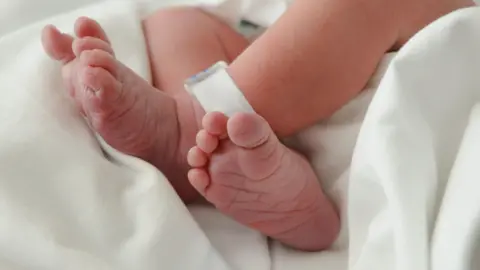 Getty Images
A scheme that aims to reduce the trauma associated with mums being separated from their child at birth is being launched in Hertfordshire.
From next month, midwives at Watford General Hospital will hand out Hope Boxes, containing keepsakes.
Hertfordshire County Council, which is funding the scheme, said about 30 mothers in the county were separated from their babies at birth last year.
Angela Frazer-Wicks, who had two sons taken into care in 2004, said: "For me, the Hope Boxes really matter because I know exactly how it feels to be left with very little to remember my baby."
Under the Children Act 1989, a local authority can issue care proceedings as soon as a baby is born if it believes the baby is likely to suffer significant harm as a result of parental action or inaction.
In some cases, a mother might have to attend court shortly after giving birth, sometimes on the same day.
 Lancaster University
There are a number of items in each Hope box, including an elephant toy and a blanket.
The idea came from a group of mothers who heard that midwives were striving to support women facing care proceedings with a newborn baby by adapting bereavement boxes given to mothers of stillborn babies.
Frazer-Wicks is one of the Hope Mothers who co-founded the Giving Hope (hold on, pain eases) social enterprise behind the scheme.
"Looking at a part-filled baby book, an empty hair-curl box and not a single photograph of the day my son was born is such a painful reminder of the trauma we both suffered in the days and weeks following his birth," she said.
"Being able to take that pain and use it to help design the Hope Boxes gave me something positive to do with those negative memories."
 Tim Walkiden
Tim Walkiden, who teamed up with the council to bring the scheme to Hertfordshire, said he got involved in fostering babies at birth after speaking to a member of staff during a hospital appointment.
"We felt we could offer a safe, stable, caring environment when they need it," he added.
"Our son was two when our first baby joined us. He was with us for a couple of months and eventually went back to birth mum."
Walkiden and his wife, Louise, care for infants up to the age of 18 months before they are put up for adoption.
"We have always felt a strong sense of empathy with the birth mothers who have their babies removed," he said.
"We are very privileged, as we still see a number of the babies we have fostered with their new families. The eldest are now in their late 20s. It is like having an ever-extending family.
"We find fostering very rewarding and there are so many highlights, from each baby's first smile right through to when we transition them to their forever family."
 Getty Images
Kelly McGovern, chief nurse at the West Hertfordshire Teaching Hospitals NHS Trust, said: "We are proud to introduce the Hope Box project across our maternity and neonatal services.
"We know that separation around the time of birth can be an incredibly difficult experience for families.
"These co-produced boxes offer a meaningful way to preserve memories and support the precious connection between parents and their babies.
"The project is one way we can help ensure families feel supported, cared for and treated with compassion and dignity during an incredibly difficult time."
Do you have a story suggestion for Beds, Herts or Bucks? Contact us below.
Follow Beds, Herts and Bucks news on BBC Sounds, Facebook, Instagram and X.
