How families helped children after Chernobyl blast

 Diana Brooks
A woman who helped children in Belarus after the world's worst nuclear accident at Chernobyl 40 years ago has recalled how the community came together to support them.
The disaster happened at a power plant in what was then the Soviet Union, when a reactor exploded during a safety test, sending radioactive material across large parts of Europe.
Diana Brooks, from Brenchley village in Kent, was one of four volunteers who ran the Trust for Chernobyl Children, which supported youngsters from Belarus whose health was affected, with many of them dealing with thyroid cancer.
Families hosted youngsters for month-long respite stays, she said, giving them access to clean air, clean food and clean water.
'Beach and ice cream'
The charity wanted to help as many youngsters as possible and decided to pay for one airfare for each of them.
"All of us who were involved in the Trust for Chernobyl Children had children of a similar age to those who were born at the time of the accident, so it very much hit home," she said.
Brooks said radiation in the soil affected the food chain in Belarus after the disaster in 1986, and the children were "drastically affected", with many undergoing cancer surgery.
Some of the children were as young as 10, she said, and it was a "huge deal" for them to leave home for a month to visit a strange country.
"There were two things that they particularly enjoyed - one was English ice cream and also the beach," she remembered.
"They were all absolutely fascinated by seeing the sea, so we had some great trips to the beach. Belarus is a landlocked country so most of them had never even seen the sea."
 Getty Images
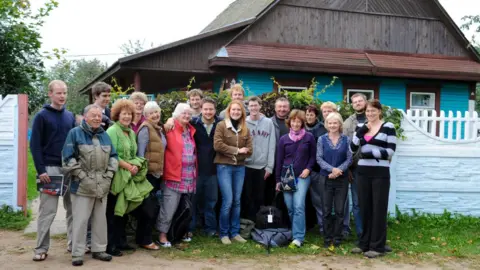
As the charity developed, volunteers also travelled to Belarus to support children who were unable to come to the UK, with some families forming strong links and paying for children to return in subsequent years.
Brooks said the work became a community effort, with local people supporting fundraising and helping to organise activities during the visits.
"It was challenging," she said. "We also all had great fun together and a number of our children all started learning Russian."
Follow BBC Kent on Facebook, on X, and on Instagram. Send your story ideas to southeasttoday@bbc.co.uk or WhatsApp us on 08081 002250.
