US offers $1bn to Colombia on new right-wing president's first day of office

 Reuters
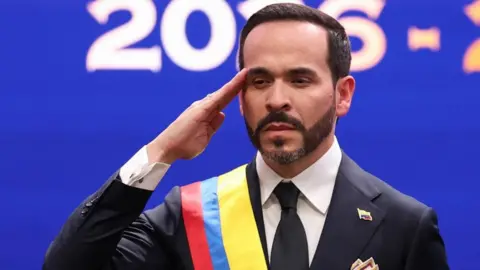
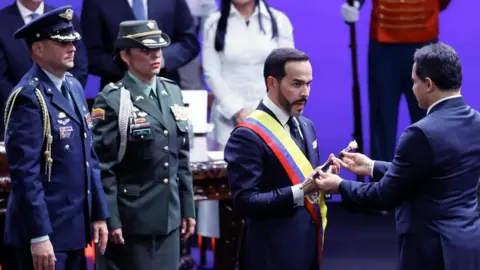
The US has pledged $1bn (£740m) to Colombia hours after the country's new right-wing populist president was sworn in.
Abelardo de la Espriella, an admirer of Donald Trump who echoed many of the US president's policies on the campaign trail, used his maiden speech to promise an "all-out war" on drug cartels.
The US state department said the "security package" would help him achieve "our shared goals", which include fighting organised crime and illegal immigration. Trump repeatedly criticised de la Espriella's left-wing predecessor over his approach to both.
The inauguration is the latest in a wider trend of Latin American nations shifting rightwards on a backdrop of economic hardship and concerns about gang violence.
Trump has taken a greater interest in Latin America during his second term, courting politically aligned leaders and spurning those with whom he disagrees.
Before the election, Trump said de la Espriella had the "total support and strength of the United States behind him", predicting a "much better relationship" with Colombia after he was elected in June.
A lawyer and businessman by trade, de la Espriella has cast himself as maverick outsider, vowing to combat crime with an "iron fist".
In a fiery first official speech - addressing troops at a nearby military base - de la Espriella pledged to crush armed insurgents, rebuild Colombia and defend democracy "by reason or by force".
He said in "the age of the Tiger" - a reference to his self-styled nickname - the state would be forceful and decisive against crime, adding: "There will not be a single place in our territory where criminals can feel safe."
Comparisons have been drawn between de la Espriella's plans and similar crackdowns by similar right-wing populists Nayib Bukele and Daniel Noboa in El Salvador and Ecuador, respectively.
This is in stark contrast to his predecessor, Gustavo Petro, whopursued what he called a "total peace" strategy to the country's internal armed conflict between guerrilla groups, the state and cartels, which prioritised negotiation and incentivising farmers to stop planting coca.
Critics say the method failed. Membership of armed groups has expanded in recent years, and a brutal conflict between rival rebel groups along the Colombia-Venezuela border displaced tens of thousands of people last year.
Colombia - and Petro's policies - have been among targets Trump has repeatedly blamed for the flow of drugs and illegal migrants into the US.
 EPA
EPAPetro, for his part, was highly critical of Trump's influence on the region, as well as his administration's seizure of Venezuela's socialist PresidentNicolás Maduro and his wife, Cilia Flores, to stand trial on drug charges in the US, clearing the way for US firms to tap Venezuela's oil reserves.
Petro, who could not stand for another term, and Iván Cepeda, the left-wing candidate he backed, had insisted Colombia should not become another "vassal" of the US.
In one of his first acts as president, de la Espriella said Colombia would join the "Shield of the Americas" security partnership founded by Trump.
The US state department welcomed the move, saying de la Espriella's "pro-growth agenda" had created an opportunity to "increase trade and deepen economic ties between our countries".
It also brings Colombia into league with other right-wing governments that have sought closer ties to the Trump administration, such as Argentina, whose libertarian President Javier Milei de le Espriella has said he admired.
Argentina was the recipient of a $20bn US Treasury bailout, while Trump has said he would feel "a lot differently" about supporting the country if Milei was replaced by a left-wing president.
In contrast, Trump has repeatedly threatened to give Cuba's Communist government similar treatment to Maduro's in Venezuela.
De la Espriella's ascension - along with that of Keiko Fujimori in Peru - means that Brazil's Luiz Inácio Lula da Silva now has fewer political allies in the region as the number of left-wing leaders dwindles.
However, he will face Flávio Bolsonaro, the son of jailed former President Jair Bolsonaro - a far-right populist friendly with the US president - in October.
De la Espriella has also promised a strong military alliance with the US and Israel, in stark contrast to Petro, who cut ties with the Israeli government over its offensive in Gaza and was a vocal advocate for the Palestinian cause.
Who is Abelardo de la Espriella?
He calls himself "El Tigre" - the tiger.
A media-savvy lawyer and millionaire businessman, he cast himself as an "outsider" who refused to govern with "the usual suspects" - a reference to Colombia's pre-Petro political elite.
The hardliner chose to take the oath of office not in Colombia's capital, Bogotá, but in the western city of Cali - signalling his desire to cast himself as apart from the centralised politics of the past.
Before entering politics, he had a successful career as a defence lawyer representing drug-trafficking paramilitaries - the kinds of criminals he now intends to lock up.
De la Espriella announced his candidacy a month after another conservative candidate was shot and killed, and regularly appeared at rallies behind bulletproof glass wearing a bulletproof vest - if not a Colombian football jersey.
He has been a US citizen since 2023 after living and working in Miami for many years.
Among attendees of his inauguration was US Attorney General Todd Blanche and Fifa president Gianni Infantino, who was accompanied by the head of South America's football governing body Conmebol as questions linger over his leadership.
