Badenoch accuses Starmer of leaving defence spending 'mess' for Burnham

 PA Media
Conservative leader Kemi Badenoch has criticised what she called a missing £5bn in the defence investment plan, saying outgoing prime minister Sir Keir Starmer was leaving a mess for his successor.
The long-awaited plan announced on Tuesday includes £15bn to boost the UK's defences, but Defence Minister Luke Pollard told the BBC the next chancellor will need to find an extra £4.7bn in this autumn's Budget to fund the proposals.
At Prime Minister's Questions, Badenoch asked whether Andy Burnham, who is widely expected to take over as PM on 20 July, had agreed to the plan.
Sir Keir accused Badenoch of "faux outrage" and said the Conservatives had reduced defence spending when in government.
Sir Keir unveiled the much-delayed defence investment plan on Tuesday, ahead of next week's Nato summit, which is set to be one of his final duties as prime minister.
The plan, which is meant to ensure the UK's forces are ready for future conflicts, will see defence spending increase by £15bn between now and 2030.
But it still falls short of the £28bn reportedly demanded by defence chiefs and former defence ministers John Healey and Al Carns, who resigned in protest over it.
The Treasury has only been able to identify £10.3bn in savings to fund the plan, with the remaining £4.7bn to be set out in the next Budget.
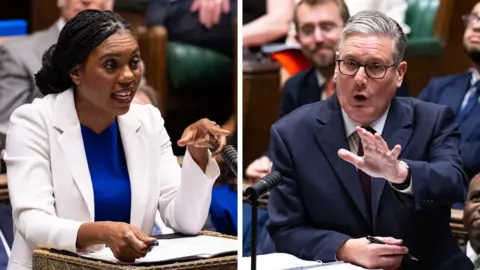 House of Commons
Kemi Badenoch claimed the government was "spending it all on welfare", adding: "Even the limited plan he [Starmer] has announced has completely unravelled because he hasn't found the money to pay for it: it's £5bn short.
"We all know he is leaving this mess to his successor, so can he confirm that the MP for Makerfield [Burnham] has agreed to fund the shortfall?"
She said that, in the past two years, the UK had only increased spending by 0.01% compared to its allies and Sir Keir's plan "didn't add up".
Sir Keir attacked the Tories for cutting defence spending when in power, saying: "I'm proud of this Labour government and any Labour prime minister would stand beside this plan."
And he said the government had been able to commit to an increase in defence spending thanks to the spare cash - or "headroom" - Chancellor Rachel Reeves had built into her Budget last November.
Burnham is widely expected to replace Reeves as chancellor if he becomes PM, with Energy Secretary Ed Miliband seen as the front-runner to step into the crucial role.
Downing Street declined to comment on whether Burnham's chancellor would have to use their Budget "headroom" to plug the gap - or whether the former Greater Manchester mayor had "signed off" on the defence spending plan.
Earlier on Wednesday, Luke Pollard told BBC Breakfast the next chancellor "whoever that may be" will have to "find the resources" in their autumn Budget, something he said was a "pretty standard" procedure for governments.
He said he was a "big supporter" of Burnham and hoped he would become prime minister, but also revealed that Burnham had only been told about the £4.7bn defence funding gap on Tuesday.
Burnham has yet to comment on the defence spending plan.
Sir Keir ruled out further borrowing to fund the increase in defence, saying instead that the money would be found by cutting the long-term investment budgets of other government departments by 1%.
Liberal Democrats leader Sir Ed Davey accused the government of leaving the UK "vulnerable to missile attack" due to funding in the DIP falling "dangerously short".
Sir Keir defended the investment plan but rejected the Lib Dem proposal for defence bonds, saying they looked "very closely" at them but described it as "simply borrowing by another name".
Roads backlash
The Transport department is making £700m in savings from roads projects, with the A38 Derby Junctions and A46 Newark Bypass scheme being considered for cancellation.
The Department for Energy Security and Net Zero is finding an additional £2bn from its budget, mainly through "efficiency" savings.
But Downing Street could not provide a full list of other projects that could be axed, saying further details would be set out in the autumn.
Transport is likely to be in the firing line because it has a large capital spending budget and the PM's official spokesman could not rule out cuts to rail as well as road projects.
He said frontline NHS services would be protected but asked if new hospital projects could be affected, he would only commit to sites in the "first wave" of the New Hospital Programme and work on seven sites found to have been built with dangerous reinforced autoclaved aerated concrete (RAAC).
Plans to cancel the road projects have already sparked a backlash from local leaders and MPs, with Labour's East Midlands mayor Claire Ward calling them "completely unacceptable".
Reform UK MP Robert Jenrick, who represents Newark, also weighed in, saying: "I have written to the transport secretary and demanded an urgent explanation for local residents.
"It is shameful that such a big decision has been snuck out by the government without any debate."
Lincoln MP Hamish Falconer, a Foreign Office minister, has said he was "disappointed by the uncertainty" around the A46 scheme, while Mid Derbyshire Labour MP Jonathan Davies said cutting transport spending risked putting a "brake on economic growth".
Asked what Sir Keir's message was to Ward and MPs angry about cuts to the road programme, the PM's spokesman said: "We are prioritising Britain's security in a more dangerous world."
