Trial opens for US mum who says postpartum issues led her to killing own children

 Getty Images
Warning: This story contains distressing details and discussion of attempted suicide
Jury selection has begun in Massachusetts in the case of a woman charged with killing all three of her children - whose defence team says she was suffering from postpartum psychosis.
Prosecutors allege the killings carried out by Lindsay Clancy at her home in 2023 were premeditated and intentional.
She has pleaded not guilty. Her legal team does not dispute that she carried out the killings, but is expected to argue that she was not responsible and raise an insanity defence.
Clancy herself was also paralysed after attempting to take her own life the same night.
Prosecutors allege that Clancy sent her husband, Patrick Clancy, away from their house so that he would not be home when she killed the children.
Investigators have said that she looked into how long the errands would take her husband so she would know how long she would be alone with the children.
As part of their defence, Clancy's legal team say her condition means that she experienced hallucinations and delusions after giving birth. She was undergoing medical treatment for psychiatric problems that developed postpartum when the children were killed.
In statements made as part of a civil case they filed earlier this year, Clancy and her husband accused her medical providers of not properly diagnosing, treating and monitoring her for a "severe postpartum psychiatric condition".
Weeks before she killed her children - Cora, 5, Dawson, 3, and 8-month-old Callan - Clancy spent a few days at a psychiatric hospital.
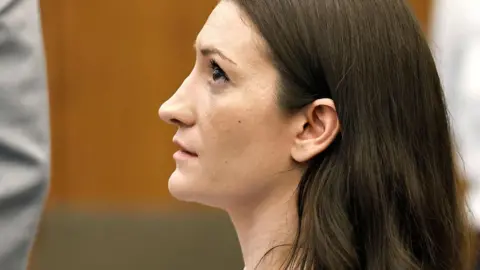 Greg Derr/The Patriot Ledger via AP
In the filing, Clancy said she had experienced trouble sleeping and had heard voices in her head repeatedly telling her to harm herself and her children.
"Lindsay Clancy did everything a mother in her situation could do," the lawsuit said. "She recognized something was wrong with her. She sought medical treatment. She went to emergency rooms. She called crisis hotlines. She admitted herself to hospitals. She took the medication prescribed to her. She communicated her worsening symptoms to her providers. She told them the medications were making her worse."
In a GoFundMe post that followed the killings, Patrick Clancy reportedly said that the "shock and pain is excruciating and relentless", but asked people to look at his wife as he had done.
"The real Lindsay was generously loving and caring toward everyone — me, our kids, family, friends, and her patients," the fundraising post said, according to the BBC's US partner CBS News. "The very fibers of her soul are loving. All I wish for her now is that she can somehow find peace."
The UK's National Health Service (NHS) defines postpartum psychosis as a rare serious mental health illness that can affect someone soon after having a baby. "Postpartum psychosis is very different from the 'baby blues'," the NHS adds. "It's a serious mental illness and should be treated as a medical emergency."
Five of the 18 jurors needed for Clancy's trial to proceed were seated on Monday during the selection process. Clancy's husband and dozens of others are expected to testify as the case takes place.
Clancy has been receiving treatment at a state hospital between her courtroom appearances.
If you are suffering distress or despair and need support, you could speak to a health professional, or an organisation that offers support. Details of help available in many countries can be found at Befrienders Worldwide. www.befrienders.org.
In the UK a list of organisations that can help is available at bbc.co.uk/actionline.
