Mums call for more understanding of 'dangerous' pregnancy condition

 Action for Accreta handout
A hundred mothers have joined forces to share their survival stories of a life threatening condition during pregnancy as part of a campaign to address what they say is "a dangerous gap in maternity care".
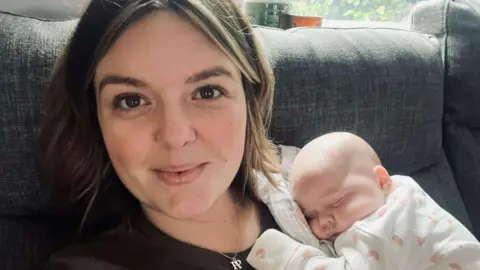
Chloe Robinson, from Rossendale in Lancashire, is among them after she developed placenta accreta spectrum (PAS) - which sees the placenta grow too deeply into the wall of the womb.
She was 34 weeks pregnant with her daughter in 2024 when she began bleeding heavily and had to have an emergency hysterectomy.
Chloe, who is now part of the Action for Accreta campaign group, said not enough is known about the condition and she had endured an "extremely traumatic" ordeal.
Donald Peebles, national clinical director for maternity at NHS England, said maternity teams were supported by "clear clinical guidance to spot the warning signs and, where needed, refer women to specialist NHS centres with experienced multidisciplinary teams and access to critical care".
Chloe told BBC Radio Lancashire she felt there was "not enough understanding and knowledge" of PAS, generally.
She said: "There wasn't enough awareness of essentially this being a problem and this being a possibility."
She said the impact on her "was enormous" and "made the whole thing extremely traumatic".
 PA Media
She continued: "My daughter suffered what's called a neonatal stroke, and that essentially has resulted in having quite significant damage to the left side of her brain and has resulted in cerebral palsy.
"So that's essentially something else that we're having to deal with as well as the trauma.
"What's meant to be one of the best days of your life ultimately can also unfortunately be one of the worst, and that's something that is really difficult to balance.
"I'm sort of having therapy for that and having to deal with the aftermath really emotionally and mentally on me as well as also having to deal with just postpartum, which is a lot in itself."
Other mothers have also told how they have been left with permanent damage to their bladder and bowels, while a nurse had to leave the profession after developing PTSD linked to her working with blood during treatments for the condition.
'Tip of the iceberg'
Amisha Adhia launched the campaign in February after also suffering from PAS during her pregnancy.
She said she wanted to "make a difference" and "fight" to improve women's maternity care.
"These hundred women and families are not the only story. They are the tip of the iceberg," she said.
"There is no national database. No mandatory reporting. No one is counting. The system cannot see the harm it is causing and that invisibility is not an accident, it is a gap.
"We know how to diagnose this condition and prepare for it. But the guidelines are a decade behind modern reality, and without the infrastructure to track, train, and prepare every unit, best practice stays locked in a handful of specialist centres."
Action for Accreta said 61% of all mothers who develop PAS were undiagnosed before delivery and 64% go on to require major emergency surgery, with 30% resulting in emergency hysterectomies.
Peebles said: "Placenta accreta spectrum is rare, but when it does happen it can lead to very heavy bleeding, which is why identifying women at higher risk early in pregnancy is so important.
"Our focus is on making sure every woman receives safe, expert and compassionate care throughout her pregnancy and birth."
Listen to the best of BBC Radio Lancashire on Sounds and follow BBC Lancashire on Facebook, X and Instagram. You can also send story ideas via Whatsapp to 0808 100 2230.
