What does AstraZeneca's £300m investment mean for Cambridge?

 AstraZeneca
Pharmaceutical firm AstraZeneca has said it will invest £300m into UK drugs development in what the prime minister has described as a "major vote of confidence" in the country. It comes seven months after the company "paused" investment in Cambridge, so what does it mean for the city, and what prompted the U-turn?
Why is AstraZeneca important to Cambridge?
AstraZeneca is Britain's largest pharmaceutical company and is often cited as the biggest company of any sort in the UK, valued at more than £210bn.
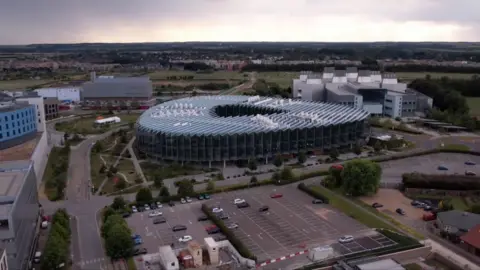
Its global headquarters are in Cambridge - the largest life sciences cluster in Europe - where it employs more than 4,000 people directly (about half of whom are in the £1.1bn DISC building on the city's biomedical campus) and supports more than 6,000 other jobs.
The company said it chose Cambridge so it could be close to the city's "world-leading academic research institutions, renowned hospitals and leading-edge biotech companies".
Aside from employment, which generates money for the local economy, AstraZeneca's presence in the city also has an impact on patients.
It is now involved in around 200 science-led partnerships across the Cambridge area.
Its partnership with Cambridge University Hospitals NHS Trust (CUH), which includes Addenbrooke's Hospital, means patients often have access to clinical trials for a variety of cancer, respiratory, cardiovascular and renal treatments.
AstraZeneca currently sponsors approximately one third of all clinical trials run by pharmaceutical companies at CUH.
What is AstraZeneca's 'new' investment?
 House of Commons
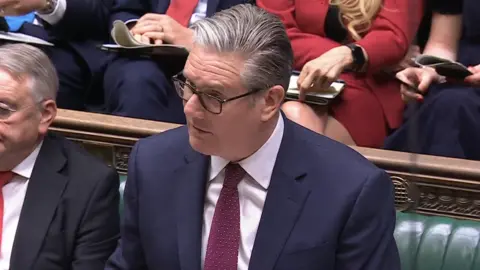
At Prime Minister's Questions in Parliament on Wednesday, Sir Keir Starmer said: "Today I can announce a significant new investment by AstraZeneca, which is investing £300m in UK life sciences."
The money is to be split across existing AstraZeneca sites in Cambridge, and Macclesfield in Cheshire, but only the Cheshire investment appears genuinely "new".
The company has just announced it will build a "digital lab" there, which will use artificial intelligence and other technology to advance drug development.
However, AstraZeneca's chief executive Pascal Soriot said the funding meant they now "look forward to completing the construction of the Rosalind Franklin building on the Cambridge biomedical campus".
The prime minister said the investment would "future-proof thousands of jobs in Macclesfield and Cambridge".
Construction of this building halted in 2025 when AstraZeneca announced it had "paused" a £200m investment in the city.
The company's president, Tom Keith-Roach, told MPs at the time that the UK had become an "increasingly challenging" place for pharmaceutical companies to develop drugs and "to get through the front door of [the National Institute for Health and Care Excellence (NICE)], into the NHS, [and] to bring forward innovation to patients".
NICE is the body which approves new drugs for medical use in the NHS.
This latest investment announcement, or U-turn, in Cambridge appears to be more about turning the financial taps back on, rather than providing a new source of money altogether.
Why has the company changed its mind on investment?
 Getty Images
Both AstraZeneca and the UK government have attributed the change in position to a pharmaceutical deal between the UK and US struck in December 2025.
It will mean the NHS pays more for medicines, but also that the US will impose 0% tariffs on branded drugs from the UK for three years, rather than the 100% tariffs announced last year.
Pharmaceutical companies had long called for the UK to pay more for medicines which, they said, would improve patients' access to treatments.
The Science Minister Patrick Vallance agreed, although Health Secretary Wes Streeting initially insisted it was a "short-sighted approach".
Over the last 10 years, UK spending on medicines has fallen from 15% of the NHS budget to 9%.
Under the deal, the NHS will pay 25% more for new medicines. It will also allow NICE to approve more expensive drugs for NHS patients.
The organisation assesses the cost effectiveness of drugs before approval and currently allows medicines costing between £20,000 and £30,000 for every "quality-adjusted" year of life brought to the patient.
That threshold had not changed since 1999 but the upper limit is now £35,000, which has already led to the approval of two new cancer drugs.
'Strong sector'
Along with AstraZeneca's paused investment in Cambridge and a further £450m cut at its site in Liverpool, pharma company Eli Lilly froze its investment plans and US company Merck scrapped plans for a £1bn site in London and said it would cut UK jobs.
Merck blamed a lack of government investment in the sector, but US tariff threats also prompted some companies to divert investment across the Atlantic instead.
The pharma deal between the UK and US - which includes other financial promises - alleviates some of the problems raised by companies in the UK.
It is improvement enough for AstraZeneca to resume investment in the UK. In January, it submitted plans for another building in Cambridge, a sign that a U-turn was, perhaps, on the cards.
Soriot said: "We would like to thank the British government for their efforts to improve access for patients.
"We look forward to further enhancing the access and the reimbursement environment and build a strong life sciences sector."
It is clear pharmaceutical companies would like more from the UK government, and that they are willing to halt their investment plans if the conditions are not considered acceptable.
But already questions are being raised about the affordability of this deal and whether the impact of secured jobs and investment is worth it.
Do you have a story suggestion for Cambridgeshire? Contact us below.
Follow Cambridgeshire news on BBC Sounds, Facebook, Instagram and X.
