Something old, something new - the designers reimagining NI fashion

 Titanic Belfast
Belfast designer Gráinne Maher describes herself as a "creative person" who is "always into art, design and fashion".
As a milliner, she creates bold and contemporary pieces that she feels challenges traditional concepts of head wear.
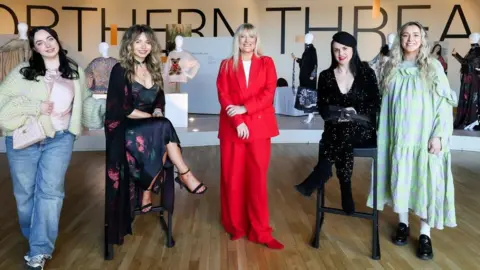
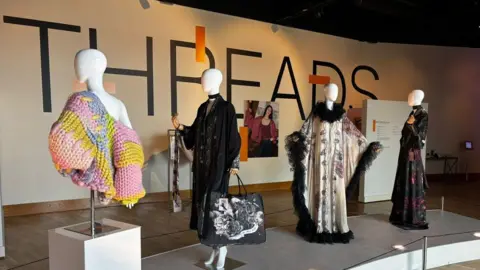
Maher is one of four female designers from Northern Ireland taking part in an exhibition called Northern Threads, in the Titanic Museum, showcasing how fashion and textile design is "bold, expressive and deeply connected to place".
Their work aims to shine a spotlight on Northern Ireland's rich textile heritage, reinterpreting traditions that have been carried on through generations.
About 20 years ago Maher wanted to establish her own business - at the time there was a gap for people who wanted to take part in traditional millinery.
"I did some short courses and found I had a real flare for it," she said.
This flare led to Maher designing hats for celebrities such as Selena Gomez and Alexandra Burke.
Maher said: "Hats are always one-offs, everything's bespoke, made to order, although you might see the odd remake of a bestselling style."
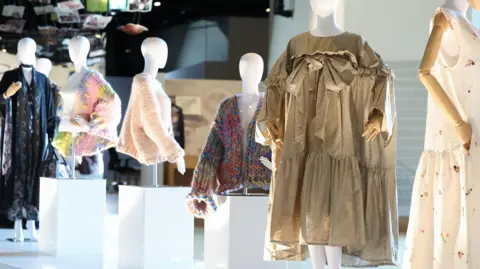
The exhibition offers glimpses of the materials and traditions that continue to inspire today's designers.
"I think the textile heritage is important to anybody that works in this industry, because we protect the heritage and we need to glorify it," Maher said.
"We need to keep it alive; it's nothing without reusing it, reinventing it and keeping it around for the next generation and generations after that."
What is Northern Ireland's textile history?
 Titanic Belfast
Northern Ireland has a rich textile heritage.
At the end of the 19th and start of the 20th Century, Belfast became a world leader in linen production.
There were roughly 200 companies employing more than 70,000 people, using one million spindles and operating more than 40,000 looms - many of them in Belfast.
Many people at the time depended on linen mills for their livelihood. They were dotted around the country stretching from Sion Mills near Strabane to Mossley Mill in Newtownabbey.
However, by the mid-20th Century, the industry was changing.
The introduction of synthetic fabrics, such as polyester and nylon, meant the once booming industry began to decline.
Generations of workers saw production move overseas and mills close.
Portrush-born designer Sara O'Neill also aims to carry on old traditions.
O'Neill, who founded her own clothing brand, Éadach 12 years ago, said many of her pieces are inspired by traditional folklore.
"I wanted to carry on the stories my granny had told me as a child, the Irish myth and legend," she said.
"Obviously now, with social media, the rise in popularity and the relearning of the Irish language and the awareness of the Irish culture, there is definitely a rise in people being interested in those stories."
O'Neill designed pieces worn at the Oscars, BAFTAS and Emmys. Her pieces have also been worn by actress and presenter Siobhan McSweeney in an episode of The Traitors Ireland and U2's The Edge has been seen wearing custom Éadach.
"It's just amazing to be able to do that from our corner of the world and because we have such a history and heritage of textiles, I'm glad to be able to do my own small bit to carry that on," she said.
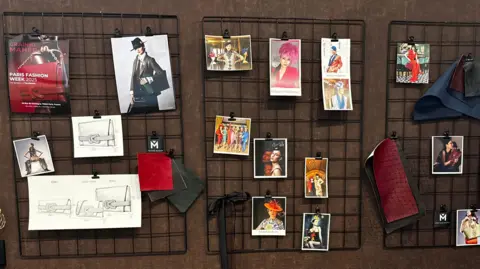
Another key element of O'Neill's work is highlighting working class women - and she also takes inspiration from the punk scene.
"My granny was from the Wicklow mountains," she said.
"She moved to Dublin and worked in the Cadbury's factory in Coolock for years
"So I want to celebrate those women. Because those women, working class women, who worked in factories, textile mills are the backbone of so much of our society and working class women don't get celebrated in our history enough."
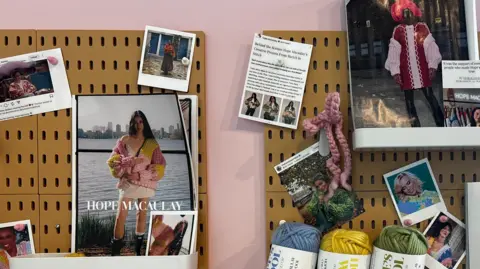
Another well-known figure in the Northern Ireland fashion industry, Hope Macaulay, also has her work featured in the exhibition.
She rose to even greater prominence during the recent BBC reality show, The Traitors and its sister show The Celebrity Traitors, as her now-famous knitwear was worn by the likes of singer Charlotte Church and NI-born Rachel Duffy, who went on to win the most recent show.
Her work features bold, colourful, sculptured knitwear inspired by the landscapes of Northern Ireland's north coast.
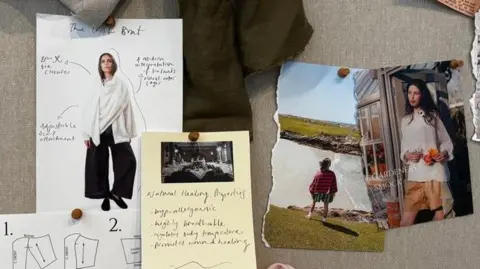
It was a photograph of her granny spinning linen in a mill in Moygashel, County Tyrone, that prompted the fourth exhibitor, Amy Anderson, to found the company Kindred of Ireland.
She was inspired to reconnect with lost textile traditions, according to the exhibition's website.
The brand reimagines Irish linen for a modern wardrobe, working with family-run mills and local seamstresses.
So how do these women think the exhibition is being received?
Gráinne Maher hopes recent graduates feel encouraged by it and that it will help to put Northern Ireland on the fashion industry map.
"I would hope that they would see the diverse range of talent that we have and be very impressed that this small enough little patch of earth, has managed to produce so many wonderful creatives," she said.
