Hundreds remember synagogue attack victims

 Family handouts
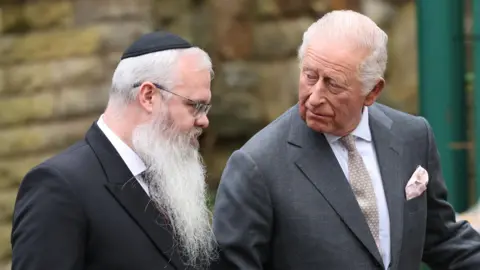
The Chief Rabbi Ephraim Mirvis and Communities Secretary Angela Rayner were among about 800 people who attended a memorial event for the victims and survivors of last year's Heaton Park synagogue attack.
Melvin Cravitz and Adrian Daulby were killed, and three others injured, as they tried to defend their place of worship from attacker Jihad al-Shamie on 2 October 2025.
Relatives of the bereaved and some of the survivors were among the speakers at Monday's service of remembrance at the synagogue in Manchester.
Prior to the event, Rabbi Daniel Walker said the Jewish community feels less safe now than it did immediately after the attack.
He said rising antisemitism, combined with a lack of action to "deal with core problems", had left many members of Heaton Park Hebrew Congregation – and British Jews more widely – feeling increasingly vulnerable.
Two seats remained empty for the service, bearing the names of Melvin Cravitz and Adrian Daulby.
 Supplied
Sherelle Dresner, representing the family of Melvin Cravitz, spoke of the "lonely" and "overwhelming" new world she and her family faced in the aftermath of the attack.
"I have heard this new existence be described by survivors and bereaved families of other terrorist attacks as a club that no-one wants to be a part of; a club that no-one would ever choose to belong to," she said.
She said she had received antisemitic abuse and "these messages should worry us all, that there are people out there justifying his murder and blaming this on his religion".
Dresner praised those who "put your own lives at risk" on the day to save others, including a woman who ran "towards danger" to help Melvin.
The chief rabbi, in his address to the service, said: "The attacker came here feeling positive, comfortable in his ways, encouraged and inspired by a tone of deep antisemitism within our society.
"We know so well how hateful thoughts can be translated into hate speech which, in turn, is only one step away from hate crime."
 EPA
EPAIn a message read out at the start of the service, King Charles said: "My wife and I hold all those whose lives were so tragically disrupted by that terrible day most closely in our thoughts and prayers.
"Though the months have passed, the sense of shock and sorrow remains undiminished.
"The memory of those who lost their lives, Adrian Daulby and Melvin Cravitz, and of those who were injured, Andrew Franks, Bernard Agyemang and Yoni Finlay, remain especially vivid in my mind."
He concluded: "Hatred can never prevail over our shared humanity."
Raphi Bloom, chair of the Yom Kippur Commemoration, said the service was "not only about remembrance" but was also about resilience and "honouring Melvin and Adrian by ensuring that Jewish life continues to flourish".
He said "the wounds remain, but so does our spirit" and, together, they were sending a simple message that they would not be intimidated, defined by hatred or "driven from the place we have called home for more than two centuries".
"As Jews we will stand tall, united, proud and strong," he said.

Angela Rayner referenced other "sickening terrorist attacks" across the world when she told the congregation: "These acts are a crisis for us all - they reflect the increase we've seen in obsessive, intense hatred of Jews."
She said "any attack on Jews is an attack on all of us".
"Together we can overcome and defeat antisemitism – and we will never rest, until every Jewish person is safe."
She said this was "a hatred we must stand robustly against, and root out from its very foundations", which meant "taking on extremists and bearing down on those who seek to divide our communities".
"The only way we can root out this poison is through a whole of society approach."
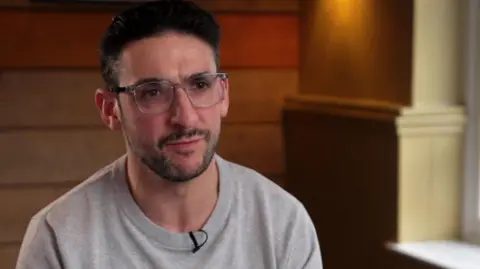
Yoni Finlay, who was hit by a stray police bullet while helping to barricade the doors during the attack, said: "An evil person tried to destroy us on Yom Kippur and together we have not let that evil win.
"When I was lying on the floor in the foyer, just through those doors, with four of my organs badly damaged by a bullet that had gone through me, I made myself a promise, that I would not die, this is not where my life was going to end.
"But I could not do this on my own, and neither could the shul. We could only do this with the support of the people around us."
He said he was lucky enough to have an amazing family, "but we are also an incredible community".
"I realised that maybe, just maybe, we were going to be okay, when we showed that rather than being stopped, we were more together than ever".
Earlier, asked by BBC Radio 4's Today programme about how the Jewish community in the UK feels almost a year on, he said: "I don't think things feel safer, I think we certainly live behind ever increasing gates, more security than we've ever had.
"Jewish people are having to hide their identity. Even my own son, who's in college at the moment, has faced death threats."

Other speakers at the memorial service included Alan Levy, who helped barricade the doors against the attacker, and Greater Manchester Police Chief Constable Sir Stephen Watson.
Although the first anniversary of the Heaton Park attack is not until October, the Jewish community will mark it on the religious anniversary rather than by the secular calendar.
The attack happened on Yom Kippur, the holiest day in the Jewish calendar, which falls in September this year.
Rabbi Walker said the service was being held because the community also wanted to hold a public memorial before the Jewish High Holy Days, both to ensure those affected are remembered by wider society and to call for change in society.
Listen to the best of BBC Radio Manchester on Sounds and follow BBC Manchester on Facebook, X, and Instagram. You can also send story ideas via Whatsapp to 0808 100 2230.
