'Who cares for carers?' asks under-pressure dad

 BBC
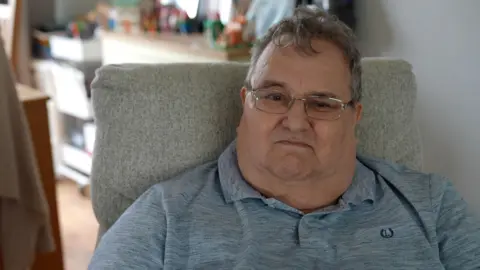
BBCA retired man caring for his wife and daughter says financial and practical support has "slowly eroded" over two decades.
David Chapman, 73, from Beverley, no longer receives Carer's Allowance after reaching pension age.
He is awaiting treatment for a serious illness and worries about what will happen if he can no longer cope. It has left him asking: "Who cares for the carer?"
East Riding of Yorkshire Council says it recognises the "vital role" unpaid carers play, is reviewing its support for them and considering a "wider range of options" to better meet people's needs.
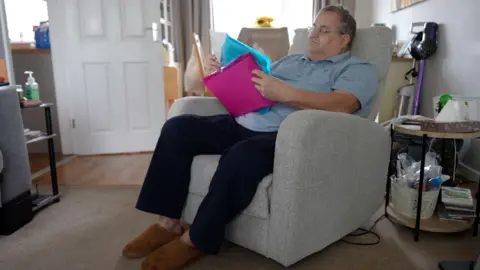
David has been an unpaid carer for nearly two decades.
His wife has a neurological condition, while his 20-year-old daughter has Ehlers-Danlos syndrome, a rare genetic condition.
"I have to look after my wife with effectively no financial support," he says. "So if I go down, then what happens? Does the council look after her, or does family have to step in?"
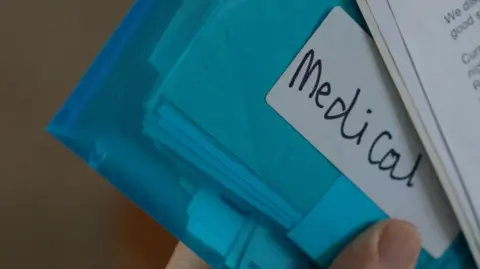
David received Carer's Allowance – a benefit paid to people who care for others for at least 35 hours a week – while he was working.
After retiring, that support stopped because people whose state pension is worth £86.45 a week or more do not get a Carer's Allowance payment.
His wife does still receive the allowance for caring for their daughter.
"For the last 15 or 18 years, that service has eroded more and more," David says.
"There was a time when we could get a slight amount of money in my wife's support package to have a break – just go away for a weekend, or a couple of days out. But that's slowly gone."
Practical, everyday support has changed too, he says.
While he stresses that social workers have been "wonderful" in supporting the family, he believes the burden is being carried more and more by unpaid carers.
"Who cares for the carer? We can't see anything changing – it's just going to get worse and worse until the whole thing collapses."
According to Census figures from the Office for National Statistics, the proportion of people providing unpaid care in England and Wales fell from 11.4% in 2011 to 9.0% in 2021.
Over the same period, those providing between 20-49 hours of care a week rose from 1.5% to 1.9%.
Meanwhile, there was a slight rise in the proportion of people providing 50 hours or more, from 2.7% in 2011 to 2.8% in 2021.
In East Yorkshire, the pattern is even starker. While census figures show the total number of self-identified unpaid carers fell by nearly 7,000 between 2011 and 2021, to just over 30,000, the number providing 50 hours or more of care a week rose by more than 1,000 to 9,684.
Put simply, there are fewer carers – but those who remain are doing more.
A leading national care charity says unpaid care is propping up adult social care in the community, often at significant personal cost.
Carers UK estimates 1.7 million people provide 50 hours or more of of care a week.
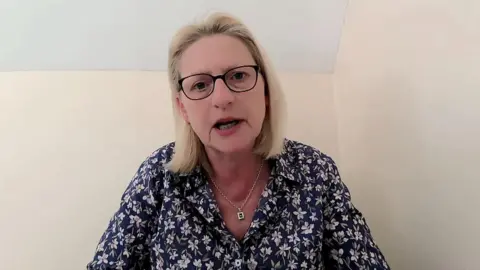
Helen Walker, the chief executive, says David's situation reflects a growing national challenge, driven by an ageing population and gaps in social care.
"With more people living longer with complex health conditions, unpaid carers are having to provide more hours of care.
"At the highest end, people in their 80s and 90s are caring for more than 50 hours a week. That is not acceptable."
She warns that for carers whose own health is at risk, the lack of support can have wider consequences.
"If carers can't attend their own hospital appointments, because they can't find respite, or their physical and mental wellbeing deteriorates, they may have to stop caring.
"That has a knock‑on effect across health and social care."
'Immense contribution'
The government says it has increased the amount unpaid carers can earn by £2,750 in two years.
"We value the immense contribution of all unpaid carers," a spokesperson for the Department of Health and Social Care says.
"Unpaid carers can also receive support, including short breaks and respite services, through the Better Care Fund (BCF), and local authorities are also required to deliver support for carers."
The government says it is also committed to "long-term reform" through the development of a National Care Service.
But for David, long-term plans feel distant compared with the reality he faces now.
As his own health becomes more uncertain, the question that troubles him most is not about policy, but about contingency.
"I've been able to do this for 18 years," he says. "But I won't always be able to."
Listen to highlights fromHull and East Yorkshire on BBC Sounds, watch the latest episode of Look North.
Download the BBC News app from the App Storefor iPhone and iPad orGoogle Play for Android devices
