Wildfire warning as weather increases risk

 Dan Jessup
July has been a prolific month for wildfires as long periods of warm, dry weather have left grassland and woodland areas particularly vulnerable.
Following confirmation from the Environment Agency that Kent and East Sussex are now officially regions in prolonged dry weather, the emergency services have issued a warning to be prepared and play a proactive role in stopping fires from breaking out.
Fire services in Sussex, Surrey and Kent have all issued advice on how to help with prevention.
West Sussex Fire and Rescue Service's (WSFRS) wildfires tactical advisor, Matt Gamblen, said: "By taking a few simple precautions, residents can help protect their communities, local wildlife and our firefighters."
 Surrey Fire and Rescue Service
Avoiding the use of disposable barbecues in open spaces, taking litter home and extinguishing smoking materials properly are all steps recommended by WSFRS, with Gamblen clear that it only takes a "small spark" to ignite a flame.
People are also encouraged not to park vehicles on dry grass, as hot exhaust systems can ignite vegetation, and to keep garden waste clear of combustible materials.
While these preventative steps are crucial, Gamblen admitted it is "not possible to predict exactly where or when a wildfire may occur".
Fields, forests and woodland
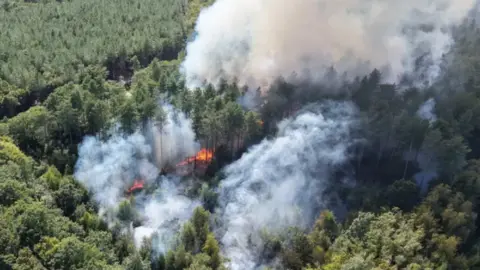
Sussex over the last month has seen wildfires in Ashdown Forest, the inspiration for the Winnie-the-Pooh stories, and in Abbot's Wood, near Polegate.
The former involved 70 sq m of smouldering grass and trees, while in Abbot's Wood, an area of about 600m by 200m (1,968ft by 656ft) of gorse and trees was alight.
And this summer, there have been a number of wildfires on the South Downs, including near Eastbourne and at Devil's Dyke.
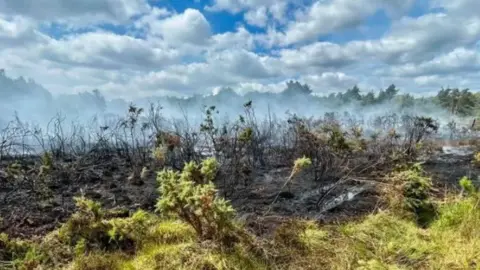
In Surrey, about 1.8 hectares of land at Chobham Common were left "crispy and burnt" by wildfire, while a Fetcham farmer said it was "quite alarming" to watch a fire on his land.
Steven Conisbee, who runs the Barracks Farm, believes repeat incidents are a real risk, given the "total tinderbox" conditions.
The increased risk is also visible in Kent, where in the last week alone firefighters have attended separate grass fires in Sittingbourne, Faversham, Maidstone and Canterbury.
Some incidents were milder than others, though 40 firefighters were required to tackle the wildfire in Sittingbourne.
According to data published by the National Fire Chiefs Council (NFCC) on Tuesday, fire and rescue services in England and Wales have responded to 706 wildfires so far in 2026.
Though this number remains below the 788 recorded by the same point in 2025, 208 incidents alone were recorded between 16 and 28 July this year.
Phil Garrigan, NFCC chair, said: "More than 200 wildfires in just 12 days shows how quickly the risk can escalate when hot, dry conditions take hold."
Follow BBC Sussex on Facebook, on X, and on Instagram and listen to BBC Radio Sussex on Sounds. Send your story ideas to southeasttoday@bbc.co.uk or WhatsApp us on 08081 002250.
