Sea trout and salmon numbers declining in rivers

 David Cheskin/PA Media
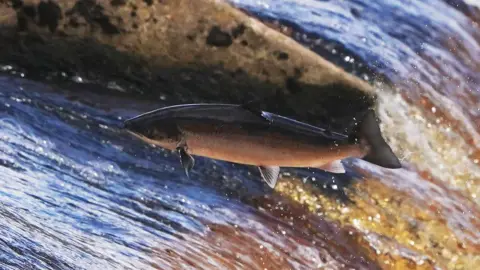
Fish counters monitoring the number of sea trout and salmon swimming up rivers in the north-east of England have been recording low numbers and are often not operational.
The Environment Agency (EA) has counters at the Tees, Wear and Tyne rivers and the Tyne is the only river in England where the salmon stock is classified as not at risk.
The tracker in the River Wear has not been operational since the beginning of 2025 and a faulty counter in the River Tyne has meant readings for all but one month this year have been estimates.
The EA said it was "too early to draw conclusions" on the numbers of salmon and sea trout this year but continues to monitor the situation.
The organisation said it is currently in contract discussions with a specialist contractor to repair the fish counter on the River Wear.
In the River Tyne, egg deposition is declining and the EA forecasted that by 2029 it would lose its not at risk status and become "probably not at risk".
 PA Media
A spokesperson said: "It is vital for fish stock that we improve the habitats needed to allow successful spawning and adequate nursery areas for young fish.
"That's why working alongside partners we have improved fish passages over barriers such as weirs and bridge footings, so that fish have access to their natural spawning grounds."
In July, the Tyne's fully operational counters recorded 6,471 sea trout and salmon which was significantly lower than the last non-estimated July count from 2022 of 11,845.
The EA said the damaged counter at Riding Mill was repaired in June and additional strengthening work was completed to improve the "resilience of the structure".
'Unfavourable conditions'
Until July this year only 30 sea trout or salmon were recorded in the River Tees and the EA said the reason for such low counts was "unclear".
The counter recorded 83 fish in July, the highest number for July sine 2021 when 100 were recorded.
The EA said low counts earlier in the year could be due to unfavourable conditions such as low water levels and high tides along the fish passage, or fish could be taking other routes upstream.
The organisation also said the timing of returning fish varies each year due to environmental conditions.
