Losing Halifax brand a 'great mistake', say residents

 Hayley Coyle/BBC
"It's part of our heritage and has been a lifeline for the town."
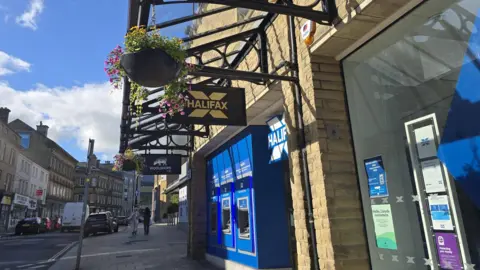
Halifax building society has been a high-street stalwart up and down the country for decades, but nowhere has it been more important than in the West Yorkshire mill town where it began and is still headquartered today.
No wonder residents were mourning the loss of the high-street staple in the wake of this week's news of a rebranding.
The Halifax was founded in rooms above a pub in the town centre in 1853 and went on to become one of the UK's largest building societies before being floated on the stock market in 1997.
But it was announced on Wednesday the bank's branding would be scrapped after 173 years and migrate to Lloyds Banking Group, meaning the town will have to say goodbye to the famous blue and white logo.
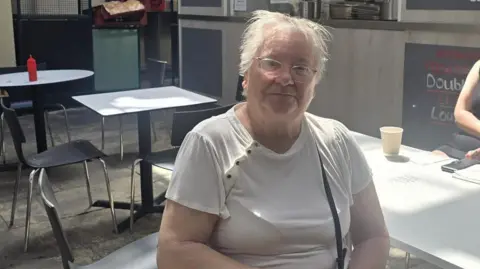
Kathleen Robinson, 79, who took out her first mortgage with the Halifax in 1972, said: "It's something else we are going to lose."
 Hayley Coyle/BBC
"My sister-in-law used to work at the main office as a mortgage broker - so that's how we got our mortgage," said Robinson.
"You get to know all the girls by their first name and now we're going to lose that."
About 3,000 people work at the bank's HQ on Trinity Road and residents remember a time when "everybody knew somebody who worked there".
As a child growing up in Halifax, you were expected to open your first bank account with the bank of the same name.
But now, even though customers' sort codes and accounts numbers will remain the same, the comforting logo, synonymous with the company's late-90s peak, will be no more.
Lloyds Banking Group's chief executive of consumer relationships Jas Singh said: "As Halifax changes to Lloyds, our Halifax customers will keep everything they know and love today - the same fantastic app design, the same friendly faces in our branches."
It is expected the changes will come into place in early 2027 across the organisation's 190 Halifax-branded sites.
Tony Callahan, from nearby Huddersfield, told the BBC that losing the sign and name would mean a "general loss of identity for Halifax".
"It's a great place... it's a typical old mill town and it's just losing its character with this news," said the 72-year-old.
"It's going under a big corporate identity and losing its history and I think it's sad."
He added: "Somebody needs to stand up and say, 'look, this is part of us, leave it alone, thank you'."
 Hayley Coyle/BBC
A walk around the town is a history tour of the bank's story.
After those early meetings above the Old Cock Inn, Halifax's first office was at the Old Market.
Today, it is a busy boozer complete with a pool table.
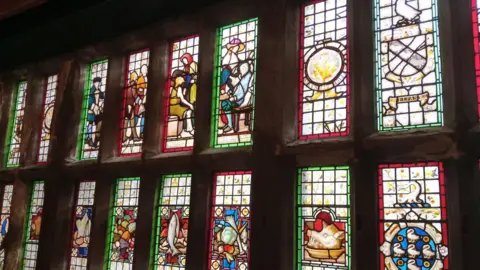
But the original stained glass mullioned windows and fireplace are still intact in the upstairs function area, the Oak Room, where the building society's meetings took place.
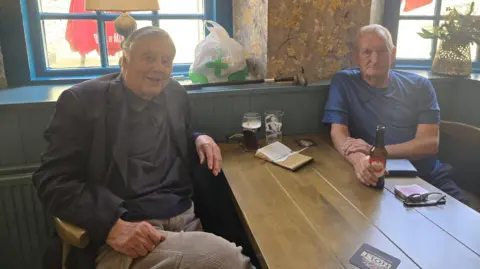
Stuart Woodhead, whose son Mark Gledhill owns the Old Cock Inn, said of the pending changes: "I suppose it's a thing of the times - there's a loss of all the banks.
"I don't have a view on it, but the Halifax is part of the town, this pub where it began is the second oldest in town.
"When my son bought the pub four years ago he knew it was part of the heritage of the pub.
"I don't really have a feeling about the news. I just feel sorry for the people of Halifax, there should be ample banking facilities for the people who need them."
 Tony Callahan
Woodhead, 88, also said thanks to ventures like the Piece Hall - which has helped regenerate parts of the town - there is "quite a bit" of money coming into Halifax.
He suggested the bank might not be needed as much as it once was.
Unlike commercial banks, building societies are run by their customers and traditionally specialise in savings accounts and mortgages.
That made the Halifax Permanent Benefit Building Society, as it was previously known, a means for ordinary people to borrow funds to buy or build their own homes.
Its very first mortgage, in 1854, was for £121 and given to a man called Esau Hanson, who borrowed the money to buy land for a house in St John's Lane.
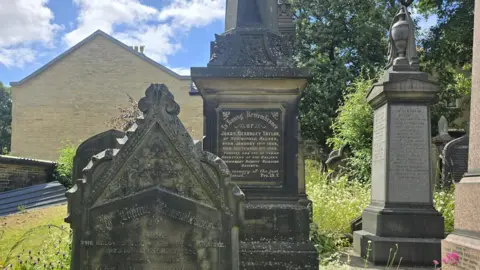
Hanson, like many other notable figures of the town, is buried at Lister Lane Cemetery, a three-acre space with memorials that shaped the development of Halifax during the 19th Century.
The tombstone of one of the founding fathers of Halifax - Jonas Dearnley Taylor, who acted as the building society's secretary for half a century - is also located there.
He was only 24 when he took up the post.
 Hayley Coyle/BBC
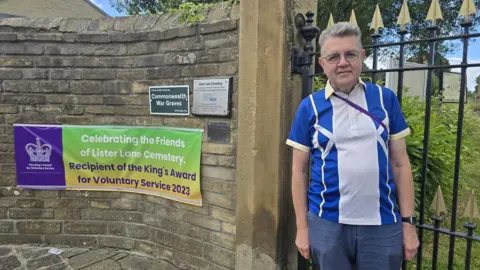
David Glover, president of the Halifax Antiquarian Society, said the young Taylor would have been a "real hard worker" who "got things off the ground".
He said losing the Halifax association would be a "great mistake" and warned: "If that is to go, surely people are going to forget Halifax itself?
"It got Halifax, our town, on the map for 170 years and more.
"We have had many industries in Halifax in the past, many of which have now completely gone for one reason or another and the Halifax has been one of our very major employers."
Glover added: "The fact that we still have a good number here and Lloyds is committed to that is a good thing, but it won't be quite the same without the name Halifax.
"There is great pride in it."
 Hayley Coyle/BBC
In 2001, the Halifax merged with the Bank of Scotland to form HBOS, which was bought by Lloyds Banking Group in 2009.
Rumours of the rebranding started around May along with the idea of phasing out Halifax as a standalone brand.
But what will this mean for the customers?
Retail expert Kate Hardcastle said brands like Halifax "don't just hold market share, they hold memory".
She said: "When you change something that is recognisable, customers don't only process it rationally, they feel it emotionally.
"A rebrand can absolutely signal progress, but businesses have to remember that heritage carries enormous value."
She added: "You can modernise without losing the essence of what made people trust you in the first place."
Listen to highlights from West Yorkshire on BBC Sounds, catch up with the latest episode of Look North.
