Why you might see a Russian warship when you are sailing in the Channel

 Ministry of Defence
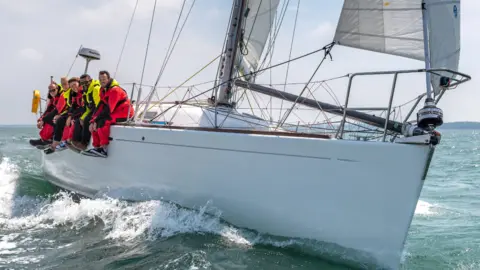
When Jane and Alan Kelvey set sail from Lymington in the New Forest the last thing they expected was to be involved in an international incident with a Russian warship.
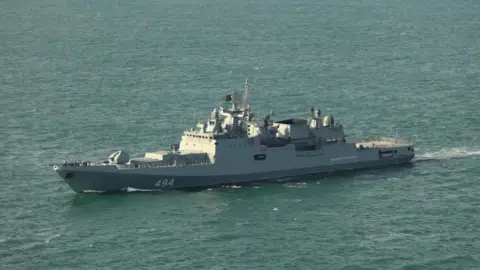
The British couple were in international waters in the English Channel on 16 June when they came across the Admiral Grigorovich, 23 miles (37km) off the Isle of Wight.
The frigate fired warning shots as the Kelvey's sailed their yacht on what Russia's defence ministry said had been a "dangerous approach" but the couple said they were "not on a collision course".
So, why was the frigate there and what laws regulate its movements?
Russian warships regularly pass through international waters in the Channel, which are separate from UK and French territorial waters.
The ships are monitored by Royal Navy vessels and the Ministry of Defence (MoD) described it as an isolated incident.
Stephen Askins, who left the Royal Marines in 1990, and is now a maritime law expert, said it was "not unusual" for warships, including Russian ones, to use the English Channel.
He said "warships are allowed and do have the right of passage through straits or the Channel or anything like that" under the rights of Innocent Passage.
The United Nations (UN) states that passage is innocent "so long as it is not prejudicial to the peace, good order or security of the coastal state" but adds that passage "shall be continuous and expeditious".
Askins added: "Generally, warships are not allowed to loiter in people's territory waters, but they do have a right of passage through narrow waterways in order to get from A to B."
 Shaun Roster
Aside from not being allowed to loiter, Askins said: "A warship in those sort of waters would still have to adopt the Collision Regulations which govern how ships relate to each other, whether you give way to the person on your right or how you overtake people."
Dave Robson, principal of Hamble School of Yachting, based in Mercury Yacht Harbour in Southampton, said "everybody has a responsibility to avoid collision".
"Normally a warship is what we would deem as a power-driven vessel and a sailing yacht as a sailing yacht," he added.
"As much as there is no such thing as right of way on the water, everybody has a responsibility to avoid collision and keep clear, technically the sailing vessel has priority."
Robson added: "What you have is two vessels - you have a stand-on vessel and you have a giveaway vessel - so the stand-on vessel would be the yacht, the giveaway vessel would be the warship in this case.
"It is the responsibility of the giveaway vessel to make an early and substantial manoeuvre of action and take early and substantial action to avoid collision.
"If they don't do that then the responsibility then lies on the stand-on vessel.
"The key words there are early and substantial action."
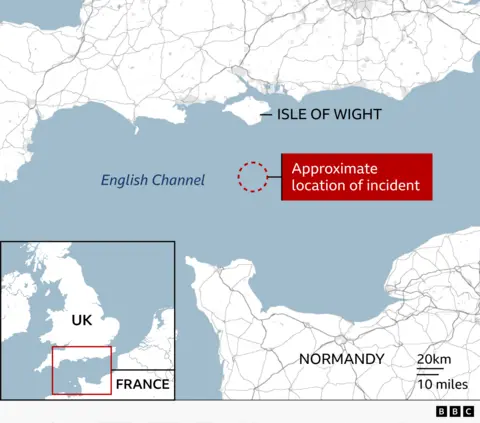
The incident on 16 June happened approximately 20 nautical miles - about 23 standard miles - south of the Isle of Wight, outside UK territorial waters.
British authorities said the yacht - which was sailing from Lymington to Cherbourg - had reported the Russian vessel had fired warning shots from around 500 yards (457m) away - a relatively near distance by the standards of sea travel.
An MoD spokesperson said: "Following attempts to contact a British vessel in the channel, the Grigorovich fired warning shots.
"These were not aimed at the vessel and were an attempt to prevent a possible collision."
Jane Kelvey said their yacht, the Bright Future, was "definitely not on a collision course".
Askins said: "There are no rules against firing warning shots or firing small arms."
He added that he does not think the incident was "the signal of anything dramatic or escalating".
The Admiral Grigorovich was being shadowed by HMS Mersey, as it had been for several days after being spotted off the coast of Brest in France.
The frigate is understood to have been operating in the area for some time and had been repeatedly re-supplied by a repair vessel.
 Ministry of Defence
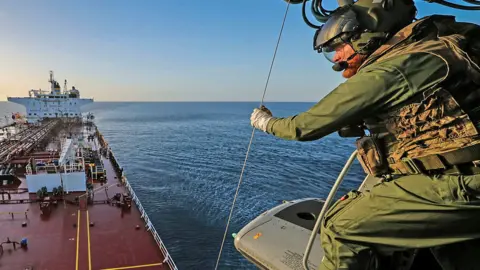
The incident came days after Royal Marine Commandos intercepted a Russian shadow fleet tanker carrying sanctioned oil in the Channel on Sunday, in the first operation of its kind carried out by the British military.
A Nato source told BBC Verify the Admiral Grigorovich had been ordered by Moscow to escort "shadow fleet" vessels through the Channel.
Following Russia's full-scale invasion of Ukraine in 2022, the UK and its G7 allies imposed unprecedented sanctions on the Russian energy sector, including an Oil Price Cap.
Russia has been operating a "shadow fleet" to evade these sanctions.
Responsible for carrying 75% of Russia's sanctioned oil, the fleet of more than 700 vessels provides a critical lifeline for the Kremlin, the MoD said.
Askins said a warship might also sail in international waters as a "geopolitical signal" to show they can operate there.
"I think nations will always bend their warship into areas and through passages just to demonstrate that there is a freedom of navigation," he said.
Askins added that this kind of behaviour is common globally.
"It's a bit like when the Russians send their aeroplanes over and they fly as close as they can and they work out when our RAF jets finally get to them and intercept them - so there's always that little bit of probing," he said.
"It's not just our country... there are trainings in Greece and Turkey. Countries do that kind of [thing] all the time."
In May, BBC Verify analysis suggested that almost 200 Russian shadow fleet vessels have entered UK waters since the prime minister threatened to intercept them nearly seven weeks prior.
In March, Sir Keir Starmer announced that British armed forces "are now able to board sanctioned vessels that are passing through our waters".
