Cells from dead gorilla Jock could bring new life

 Bristol Zoo Project
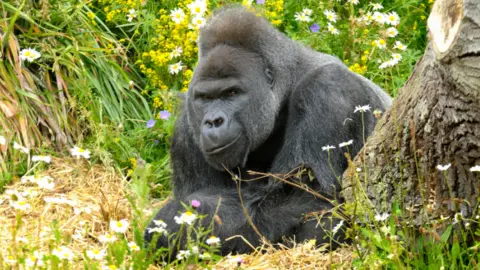
Sperm cells from a 42-year-old gorilla could bring the promise of new life thanks to the work of a wildlife charity.
Jock, a silverback western lowland gorilla who spent the majority of his life at Bristol Zoo in Clifton died in February after his relocation to the zoo's new site near Cribbs Causeway.
Following his death, wildlife conservation charity Nature's SAFE worked with the Bristol Zoological Society to preserve Jock's bodily tissues, testicular tissue, and semen.
"Although Jock has passed, it is of real comfort to know that, in a sense, part of him lives on in our tanks," said Terri Hill, vice chair of the charity.
The charity works to save animals from extinction by preserving genetic material from threatened species.
It has said western lowland gorillas are critically endangered and their numbers have declined by more than 60% during the past 20 to 25 years.
"As the leader of Bristol Zoo Project's gorilla troop, Jock played an important role in international conservation efforts, fathering several infants," said Sarah Gedman, curator of mammals at the charity.
'Genetic legacy'
Jock was one of the oldest silverbacks in the UK and was part of a troop of eight at the zoo.
Live sperm cells from Jock have been cryopreserved - frozen at extremely low temperatures - in the charity's biobank.
The preserved testicular tissue could be used to grow new sperm cells, while the stored bodily tissues could enable the creation of a genetically identical animal.
Hill said Jock had helped to inspire generations of people to care about wildlife.
"By cryopreserving his reproductive and somatic cells, we are safeguarding a unique and valuable genetic legacy that could one day support advanced reproductive technologies and strengthen the long-term resilience of Western lowland gorilla populations," she said.
Follow BBC Bristol on Facebook, X and Instagram. Send your story ideas to us on email or via WhatsApp on 0800 313 4630.
