'I'm making the most of life after testicular cancer'

 BBC
BBCExactly a decade ago, I received a diagnosis which roughly one in every 220 men in this country will hear in their lifetime.
I had testicular cancer.
It all started when my then two-year-old daughter jumped on my lap – which caused an injury that eventually led to the discovery of a lump I had not know about.
The diagnosis felt like the worst possible news I could have heard.
A lengthy recovery followed, but with the help of my family, friends and a team of experts at the Churchill Hospital in Oxford I was finally confirmed as cancer free.
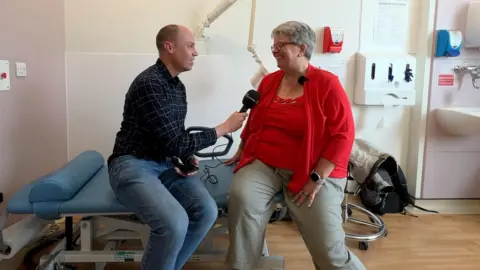
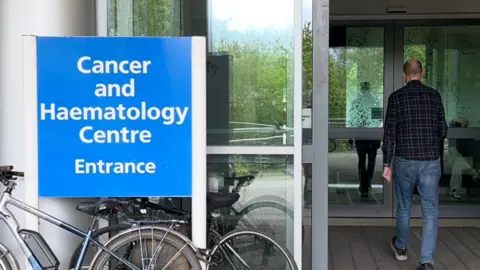
To mark ten years since the ordeal, I've revisited those doctors and nurses who cared for me, and so many like me, to say thank you and raise awareness of testicular cancer.
It was about 2013 that I first thought to myself that maybe something wasn't quite right.
I think I felt that there may be a slight lump, but I put it back in my mind because nothing materialised.
And then, in around March 2016, my daughter Ellie jumped on the bed and jumped on me. I was in the most amount of pain that I think I've ever, ever been in.
Revisiting it now, consultant doctor at the Churchill Mark Cuthill says: "I think that people have a way of being diagnosed with these sorts of things."
"It's just how it happened for you.
After visiting the doctors following the pain, one of the consultants I saw at the time said: " I think we need to get this out, there could be a chance that there's a tumour."
Hearing that news with your wife, who was about seven months pregnant at the time, was quite frightening.
It was all in the space of about four weeks, from Ellie jumping and landing on me, to then the checks, and then basically being told by that doctor: "We need to operate, we're going to get you booked in."
I wasn't ill, and it wasn't until after the operation that I was diagnosed with having testicular cancer.
I had been on holiday with my family when cancer nurse specialist Jackie Redgwell called and told me that although the operation had been a success, what had been removed was a cancerous tumour.
When I told my wife and explained to her, she broke down in tears because she realised how serious it was and how lucky I had been.
Thankfully, in Oxfordshire we have world leading services literally on our doorstep.
Looking back, Jackie tells me: "You just hug everybody close to you and have to get through the pathway that you have to go through."
"You've now got out the other side and have moved on with life and had more kids," she says.
"I'm glad I was there and able to help you through it, really."
If it wasn't for Jackie, and her emotional support, I don't know what I would have done.
After I tell her that, she says: "That means a lot to me."
"You put a lot of yourself into these jobs and it's great to hear that we help people," she adds.
Although my monitoring over the next four years had been mostly blood tests, I can still remember feeling the nerves before an appointment.
"What you say is absolutely recognisable," consultant doctor Prof Andrew Protheroe tells me, five years on from my final cancer-related appointment.
"Once you have a diagnosis of cancer, any ache or pain, you automatically overthink and think that's going to be related to your cancer," he says.
He adds that if anyone who may have concerns with anything to do with their testes, they should see their GP.
Since the all clear, I have taken up long distance running and have raised thousands of pounds for local charities in the process.
I have never gone out there with the idea of doing it because I was given almost a second chance.
I think there must be somewhere in my mind that's telling me to make the most of it.
