'They all had names' - famine graves finally marked

 BBC
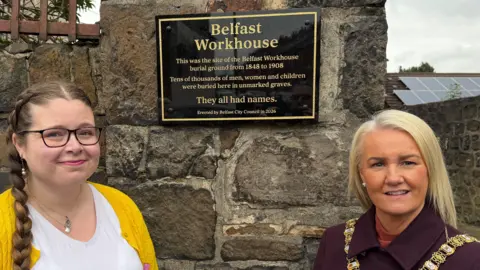
BBCUnmarked graves of thousands of people who died in Belfast during the Irish famine have been officially marked, thanks to a campaign by a young historian.
More than 170 years after the first bodies were laid to rest, Belfast City Council has recognised the burial ground.
Dr Robyn Atcheson has been lobbying politicians and public officials about the issue for five years.
She said: "I feel very honoured to have been a part of this and I feel overwhelmingly pleased that these graves are finally marked."
There is a housing development on the land in south Belfast that used to be the graveyard, and only a gate-post and a small section of wall from the original site remains on the Donegall Road, near the City Hospital.
On the gatepost now is a memorial plaque with the words: "They all had names."
At least 10,000 bodies were buried at the cemetery, which opened in the late 1840s before closing in the early 1900s.
The ground was used to bury poor people from a nearby workhouse, including during the Irish famine in the late 1840s.
Before now, there was nothing in the area to acknowledge the graves which lie beneath the streets.
There is no definitive figure for the number of graves but Atcheson, an historian based at Queen's University Belfast, believes it could be as many as 60,000 over a 70-year period.
She said: "It's so important to remember the forgotten people from history - the women, the poor, the oppressed, the sick."
Politicians from across the political divide in Belfast, as well as a Catholic priest, attended a short ceremony at which the commemorative plaque was unveiled.
Representatives from the Alliance Party and the SDLP (Social Democratic and Labour Party) were at the unveiling of the plaque.
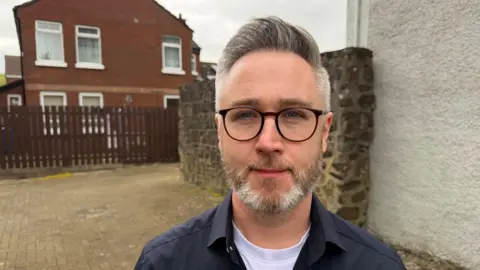
Councillor Gary McKeown from the SDLP said: "The fact that it was such a massive graveyard here, and that it has largely been forgotten about, is a travesty."
The Lord Mayor of Belfast, Tracy Kelly from the Democratic Unionist Party (DUP), said the plaque was long overdue.
"For too long, this significant chapter of our city's history remained hidden, but now we can ensure that those who suffered within the walls of the workhouse are finally remembered with the dignity they deserve," she said.
An Ordnance Survey map from the 19th Century shows the exact location of the burial ground.
It was a short walk from the Belfast Union Workhouse which closed in 1948 and has since been demolished.
The City Hospital is now on the site.
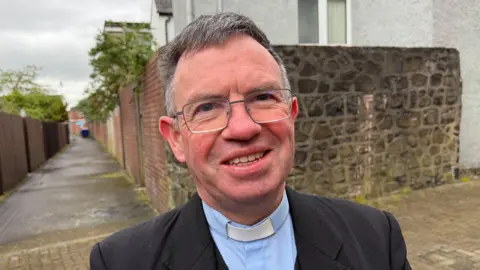
Father Martin Magill said the installation of an official plaque was important.
"I'm very struck by the wording 'They all had names'.
"It's so easy to forget people. It's really good that this has happened," he said.
The burial ground dates back to 1848, when Belfast was still a town rather than a city.
At Belfast City Hall, there is a stained-glass window to remember those who died in the famine in the 1840s and an accompanying plaque refers to the graveyard at Donegall Road.
However, until now, there was nothing on the road to signify its history.
