Village becomes 'island' amidst solar panels

 BBC
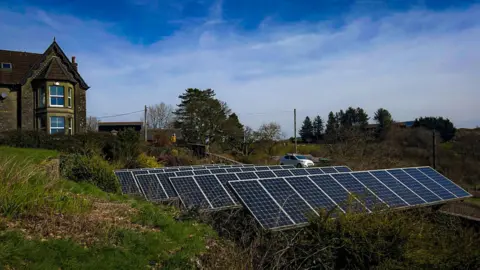
BBCPeople living in a Welsh rural village fear becoming an "island" after ministers approved doubling solar farm capacity across the nation.
Latest UK government data indicate a green light for 65 new solar parks in Wales, including two being built either side of Cosheston in Pembrokeshire.
One of these is being used as a carbon offset for a new estate in London.
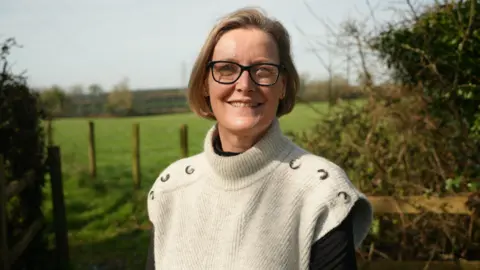
"You used to look up and see a green hillside, you will now see solar panels," said Tessa Hodgson, an independent county councillor.
She fears the Welsh government's ambition to have 100% renewable energy by 2035 will mean the "creeping industrialisation" of the countryside.
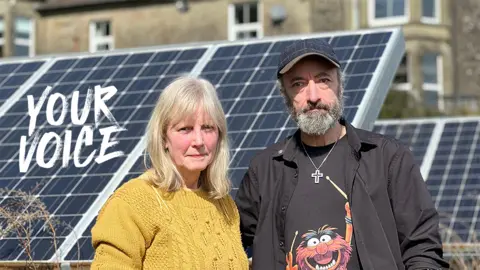
Many people across Wales contacted the BBC via Your Voice about the development of the Welsh countryside for renewable energy.
A ground-based solar boom will see the industry's total output more than double, from 900MW to nearly 2GW, according to UK government data up to the last quarter of 2025. It lists 65 projects in Wales as having planning permission granted or under construction, with a total capacity of 970MW.
As those projects come online Welsh solar farms will go from a capacity to power about 144,000 homes to nearly 300,000 homes in the next two or three years, based on the assumption that 1MW is enough to power about 160 homes in the UK.
The solar boom is largely down to 20 new solar farms classed as Nationally Significant Infrastructure Projects (NSIPs). This allows them to be directly green lit by the Economy, Energy and Planning Secretary Rebecca Evans.
The NSIP projects are mainly in corridors in the north and south of the country near major grid connections, with Vale of Glamorgan, Anglesey and Newport the most affected counties.
The biggest project planned is the Alaw Môn solar farm near Beaumaris on Anglesey, which will cover 660 acres, the size of 450 football pitches, to produce 160MW. This is more than double the output of Wales' biggest operational solar farm producing 75MW at Llanwern inNewport.
But many under 10MW solar farms are also going ahead, leaving one village feeling surrounded.
People in Cosheston support renewable energy, Hodgson said, having lived next to a 8MW solar farm since 2013.
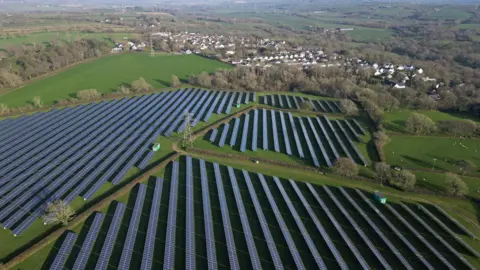
But last year approval was given for a 9MW solar farm next the existing one, and then for a new 10MW solar farm to the south.
"Slowly but surely the village is becoming a sort of island amongst these solar panels.
"[People in the village] are very concerned about what I would call the creeping industrialisation of our countryside."
She said nobody has asked the people of Wales "how much of green space are they willing to give up to pursue the Welsh government's renewable energy ambitions.
"What is acceptable, 20% of Wales covered in panels?" she asked.
"I think we need to have a national policy to try to find more a balance in all areas," she said.
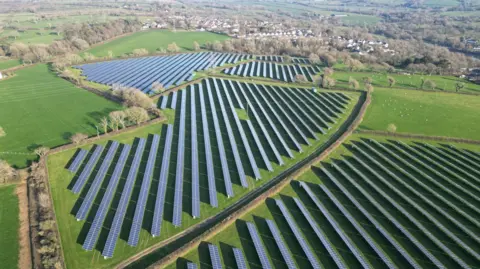
The solar park being built south of Cosheston has another feature - owner Shawton Energy said energy from the farm's 14,000 panels, covering 28 acres, will offset 40% of electricity-associated emissions from King's Cross, a new estate in London with businesses, shops and homes.
Jamie Quinn, the firm's sustainability director said the Point Lane solar farm in Cosheston reflects the company's mission to "deliver long-term, low-cost renewable energy for businesses, particularly those in dense city locations where on-site generation isn't an option".
Hodgson would not comment specifically on the the business deal that sees power produced in Wales used to offset carbon emissions in England.
But she would say she is concerned the project not only has a visual impact but also takes farmland, rated by the Welsh government as best quality, out of food production for decades.
Solar farms are "tempting" way to make money for farmers and landowners, said Simon Brooke, chair of the Newport branch of the Campaign for the Protection of Rural Wales.
The group is worried about a significant new proposal (not included in the UK data from 2025) that would see a 350MW mega solar farm on 1,352 acres on the Gwent Levels.
Solar developers prefer greenfield sites because solar farms trying to build on commercial rooftops or brownfield land can run into more legal and environmental challenges, he added.
"Greenfield is the easy solution, but is not the right answer," Brooke said.
Getting the balance right 'is difficult'
He and other environmental campaigners want a Wales-wide planning approach to all renewable projects so biodiverse areas or best quality farmland can be set aside for protection in an organised way.
Better planning in the transition to renewables was recommended by the National Infrastructure Commission for Wales, but chair David Clubb said the Welsh government has come up short on implementation.
"One thing that we think has been lacking for too long is a vision for energy in Wales."
He said this should cover how much energy generation should be owned by Welsh institutions, how much electricity Wales should aim to export and how much wealth should be generated from all energy projects.
Richard Dallison, an environmental science lecturer at Bangor University, said Wales' "long history of good agricultural production" can put food security at odds with energy security.
"Getting that balance right at a national perspective is difficult, and you're never going to do it without upsetting some people," he said
Wales must diversify into as many types of a renewables as possible, he recommended, especially in offshore wind, hydro and tidal to "to try and ease the burden of specific areas becoming overrun with solar panels".
Solar farms versus wind turbines
One couple living in an idyllic rural valley contacted BBC Your Voice to say they prefer solar farms over wind turbines.
Penny and Peter Camilleri opposed the construction of eight new wind turbines on hills around nearby Ynysybwl, Rhondda Cynon Taf, arguing solar would have less impact.
"They are a lot less intrusive really than the wind turbines, which are sprouting up everywhere," said Peter Camilleri.
However, the nearby wind turbine project was classed as NSIP, getting ministerial approval without the same degree of public consultation.
"It all just seems academic, the planning process, they're going through the motions, they've already made their decision," said Penney Camilleri.
She said the process left the couple feeling "pretty angry".
"It's our home," said Peter Camilleri.
"That's our view that we look at and we should have a say.
"We haven't. We're just silenced," he added.
The couple operate a "tucked out of sight" 30-panel solar farm on their land and said they would like to see political parties consider more solar over wind in their pledges ahead of May's Senedd election.
What do the politicians say?
Reform UK said: "For far too long, successive Plaid-backed Labour governments have ignored the views of local residents and have obsessed over net zero targets.
"Reform will ban new solar farms, using ministerial call-in powers to end the damage being done to communities and our productive arable land."
Plaid Cymru said renewable projects were key to making Wales an "energy independent nation".
"We will require greater community-ownership of energy projects as a key condition of consent, and ensure business rates on wind and solar farms are retained in the local authorities in which they are located, whilst also protecting high-quality agricultural land from being lost to large-scale, excessive solar developments.
"We are serious about the green transition, but it can only be achieved by bringing communities along with us - by ensuring they see more of the benefits from renewables, and their fair share of the profits too."
The Welsh Conservatives promised to put a moratorium on "industrial-scale solar developments to protect the countryside from inappropriate large-scale projects", while ensuring future infrastructure was better planned and supported by communities.
"We recognise the important role renewable energy can play, yet too often, local people feel decisions are being imposed on them without proper consideration."
Welsh Labour said clean, homegrown energy would bring skilled jobs and lower energy bills.
"We set a legally binding target of 100% of electricity demand to be met by renewable sources by 2035.
"We will ensure that renewable energy projects benefit the communities that host them, and that they work to protect Wales from unstable global energy markets."
The Welsh Liberal Democrats said: "Wales needs clean energy, but right now it feels like a free for all, with the Welsh government failing to plan and leaving communities boxed in while projects are waved through."
The party said there was a better way, focusing on offshore wind and tidal power, driving rooftop solar energy on homes and buildings, and "working with communities, not against them", while backing farmers to generate their own energy.
The Wales Green Party said called for the acceleration of the transition to renewables and "clean, safe, resilient and community-owned energy system that tackles climate change while reducing fuel poverty and creating skilled jobs across Wales".
Sunny Wales?
Sunny weather saw British solar power surge past the 2024 total by August of last year.
"Despite the UK's reputation for gloomy weather, solar has been unstoppable in 2025, thanks to a powerful combination of very sunny weather and record capacity on the system," Josie Murdoch, policy analyst at energy think-tank Ember, told the Financial Times.
For one half-hour period on 8 July, solar output was a record 14 gigawatts, meeting almost 40% of Britain's electricity demand during that period, according to the National Energy System Operator (Neso).
Between January and July, solar supplied about 10% of England and Wales' electricity.
