'We're right on track,' says Streeting as key target for hospital waiting times hit

 Getty Images
The government has hit an interim target for speeding up hospital treatment in England.
The goal was for 65% of patients to be treated within 18 weeks by March 2026 – and it hit that, but only just, with the figure reaching 65.3%.
It was seen as the first stepping stone to hitting the 92% target by the end of the Parliament in 2029 – a key manifesto pledge of Labour's.
The news came just hours before Wes Streeting resigned as health secretary, saying there needed to be a leadership challenge as he had lost confidence in the Prime Minister.
Speaking before he resigned, he hailed the achievement – performance was below 59% when Labour came to power.
He said: "It means we are right on track to deliver the fastest reduction in waiting times in the history of the NHS.
"That is thanks to the government's investment, modernisation, and the remarkable efforts of staff right across the country.
"Lots done, lots more to do."
But while the national target was met, improvement was not uniform across the board. Four in 10 hospital trusts did not meet their own individual targets and 10 actually saw performance get worse.
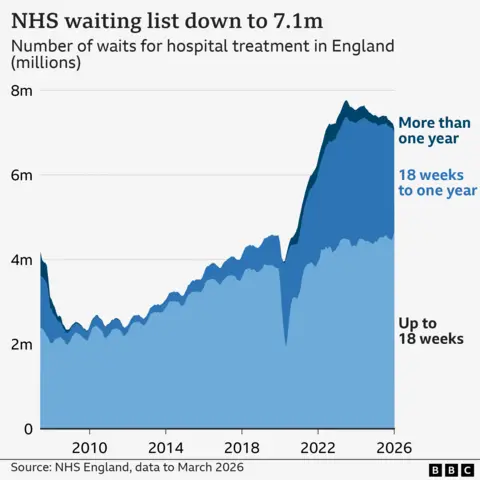
The overall size of the waiting list also improved, falling from 7.2 million to 7.1 million in the space of a month - the lowest for three and a half years.
NHS England chief executive Sir Jim Mackey described it as a "huge moment".
"Today's achievement goes beyond a set of remarkable statistics – it shows that we're making real inroads on the things that matter to our patients and communities."
He said the progress was "all the more extraordinary" given the NHS has had to cope with repeated strike action by resident doctors.
Hard to sustain
But experts warned there was still a long way to go before the target of 92% was hit – something that has not been done for more than a decade.
Tim Mitchell, of the Royal College of Surgeons of England, said while staff were working flat out, their efforts were being undermined by long-standing under-investment in buildings and equipment.
"Too many teams are still working in ageing buildings with too few theatres and beds. Without addressing these constraints, progress for patients already waiting will remain fragile."
And Sarah Woolnough, chief executive of the King's Fund, said the interim target had only been met after the government pumped in extra funding since January so hospitals could put extra effort into meeting the March deadline.
She called this spring funding - and said such investment would be hard to sustain going forward.
"It brings into question whether reaching the eventual 92% target by rinsing and repeating this sequence of 'elective sprints' is financially feasible or manageable for already stretched NHS staff."
She also pointed out that the focus on the 18-week target was masking the fact that several other waiting lists continue to grow, suggesting the government should re-think is narrow focus on this particular target.

